Verse 41821iinah hu))aa
G5
In this meter the first long syllable may be replaced by a short; and the next-to-last long syllable may be replaced by two shorts.
1
let the heart be a roadway of the thought of wine and wineglass indeed
2
if the breath didn't become a path to the destination of piety
'emphat. part. Yea, verily, indeed, true enough, forsooth; just so; very well, so be it, let it be; just; pray; please; (often added to the particle , e.g. , 'Just come then,' 'come if you dare'; — 'Pray open,' 'do open').'.
'Way, road, pathway, highway; the right road; manner, practise'.
| References | |
|---|---|
| Arshi, Imtiyaz Ali | Ghazal# 7 |
| Raza, Kalidas Gupta | 321 |
| Nuskhah-e-Hamidiyah | 40 |
| Asi, Abdul Bari | 55-56 |
| Gyan Chand | 62-63 |
| Hamid Ali Khan | Open Image |
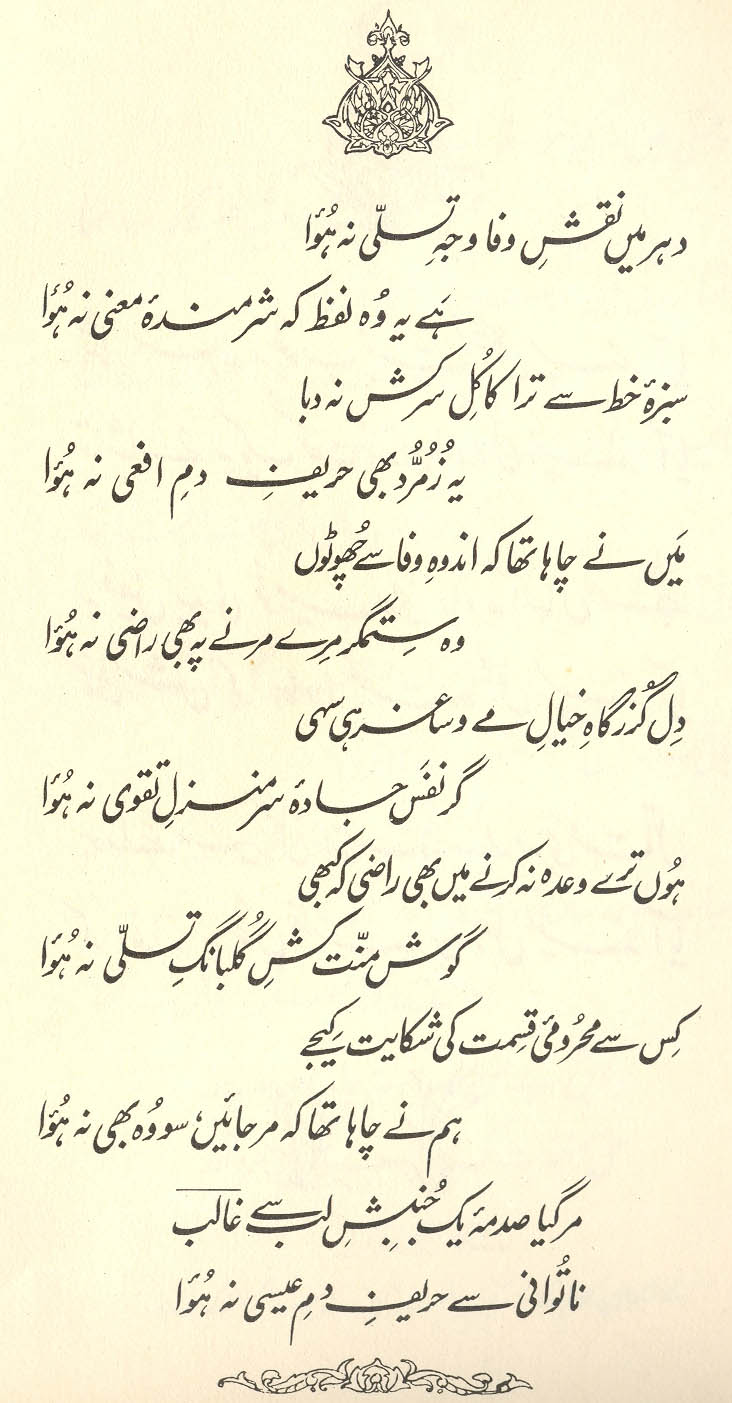
The poet means that if you haven't attained piety, then have rakishness at least. (9-10)
== Nazm page 9 ; Nazm p. 10


Urdu text: Vajid 1902 {9}
That is, the heart wants to lead a pious life. But when the taste for sin doesn't let it remain pure, then why not let yourself go and sin freely? In any situation, one should do what is in one's power; what kind of wisdom is it to pass one's days like someone devoid of senses? (17)
The goal of piety is that a man should remain happy at all times. Since I attain this mood from the thought of wine-drinking, if my temperament is not inclined toward piety then what's the harm? (265)
Compare 51,4 . (62)
ABOUT EXPRESSIONS WITH : The colloquial expression has a vigor and fluency that's hard to capture in translation; for discussion of this form, and examples, see 148,1 . Examples of its negated form ('so what if not', or 'if not indeed'): 36,9 ; 114,4 ; 148,7 , the whole of 175 , and 228,9 . Ghalib himself adds to the list: 148,10 (and see the definition above). There is also alone, which has a more simply concessive sense ('so be it'; 'no doubt'; 'indeed', 'even so'), without such an emotional charge; examples include 19,5 ; 66,8 ; 98,8 ; 115,4 ; 115,8 ; 157,6 ; 205,6 ; 209,3 ; 215,2 ; 216,1 ; 231,8 // 413x , ; 414x , .
ABOUT : This word, with a basic meaning of 'path' (see the definition above), seems to be part of Ghalib's regular tool-kit of highly abstract imagery. He usually combines with some other word for road or highway. This is the first example we've seen, but there are a number of others. They include: 10,12 ; 18,2 ; 33,1 ; 41,10x ; 65,2x ; 67,4x ; 74,1 ; 84,4x ; 92,2 ; 92,3 ; 117,4x ; 123,11 ; 123,14x ; 145,16x ; 190,5 ; 213,3x ; 223,1 // 237x,2 ; 269x,1 ; 269x,5 ; 286x,2 ; 335x,1 ; 335x,5 .
If the breath is not to be an austere, linear Sufi path to a pious destination, then the heart should be a passage, a highway full of back-and-forth traffic, for thoughts of wine and wineglass. There's a kind of metaphysical defiance: if we can't get what we want in the piety line, then let's turn our attention to a more promising domain. After all, as the speaker points out in 22,2 , he's the kind of person who would turn back from the door of the Ka'bah itself if it didn't open. Faruqi also rightly singles out 51,4 as a parallel.
In a characteristic bit of ghazal inversion, the first line is the 'then' clause, the second line the 'if' clause, so that the meaning remains opaque until the very end of the verse.
The quasi-parallelism of the two lines is part of the thought-provokingness too. If the breath is not a path, then let the heart be a roadway. One is thus led to ask how the 'destination of piety' is parallel to the 'thought of wine and wineglass'. Could they be as similar and closely linked as breath and heart, path and roadway?
Note for fans of spelling technicalities: On the pronunciation of , see the discussion of in the similarly-manipulated 9,7 . If you find the word confusing, see 15,6 .
graphics/winefountain.jpg