Verse 10after 1816athii sahii
G11
In this meter the first long syllable may be replaced by a short; and the next-to-last long syllable may be replaced by two shorts.
1 a
let the teasing of/by/with the beloved keep going, Asad !
1 b
the teasing of/by/with the beloved might/would keep going, Asad
2
if not 'union', then longing/grief, {at least / indeed}
'Touching, touch, handling, passing the hand over; meddling with, molesting, molestation, provocation, excitement, irritating, irritation, vexing, vexation, worrying, annoying; --touching up, stirring up, making active; action, activity, stir; incitement, stimulus, fillip; --dalliance, flirtation, amorous intercourse or skirmishing; jest, fun'.
| References | |
|---|---|
| Arshi, Imtiyaz Ali | Ghazal# 182 |
| Raza, Kalidas Gupta | 298-99 |
| Nuskhah-e-Hamidiyah | 243 |
| Hamid Ali Khan | Open Image |
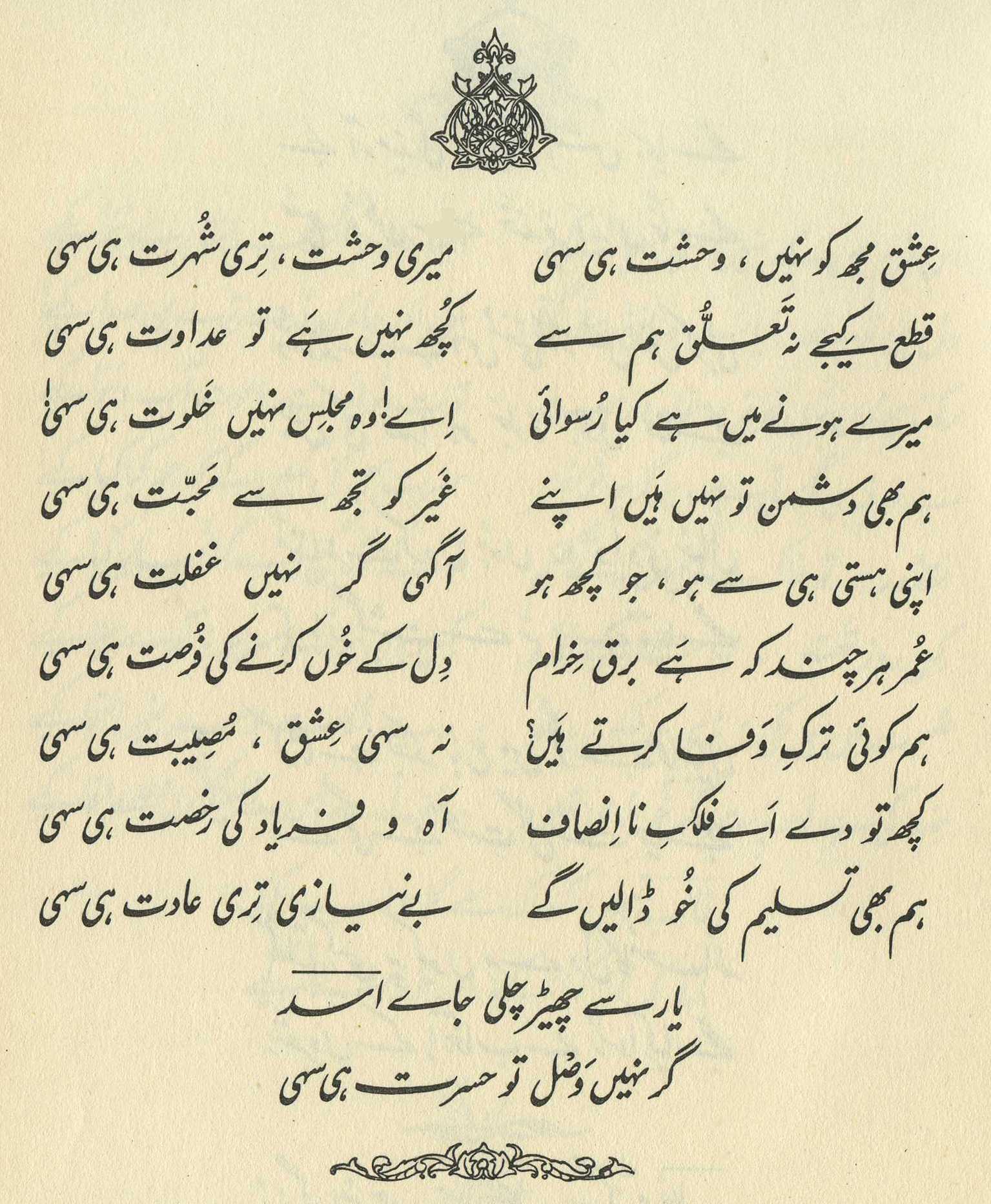
[c.1865, to Qadar Bilgrami:] According to word-lists or dictionaries, in Arabic they say this, and in Persian this [other thing], and in Hindi this [third thing]. Hindi's style of speech can never be that of Persian; or Persian's that of Hindi. For example, 'stolen sugar is sweet' []-- don't ask what it would be in Persian, there's no telling. And how could and have Persian forms? This is the colloquial speech [] of Urdu: [line two of {148,10}]. (Arshi, 286)
==Urdu text: Khaliq Anjum vol. 4, p. 1427
==another trans.: Daud Rahbar , pp. 287-88
We ought to understand by 'longing' the 'expression of longing', which has assumed the form of teasing. Because a longing that would be only in the heart, and would not be expressed-- why would it begin to assume the form of teasing? The word he brings into the poem in imitation of the Persian poets; otherwise, in the idiom of Urdu no one says ; they say . And for this reason is rejected in prose, and in Lucknow some poets have rejected it in poetry too. (157)
== Nazm page 157

He says, 'Oh Asad, the teasing and pestering [] of the beloved for the achievement of what you want-- let it continue! To keep on sitting in silence will get you nowhere. If union is not attained, then the expression of longing at least []!' (215)
Keep on telling the beloved the longing of your heart. Let teasing and pestering [] continue. If there won't be union, then there won't []. There will be the pleasure of importuning and teasing. (287-88)
For discussion of the versatile idiomatic expression , see 148,1 .
It's hard to translate , but I think 'tease' comes closest, because one can tease either verbally ('Stop teasing your sister!'), or physically, as when people 'tease' animals by goading or harassing them. Moreover, teasing can express flirtation or affectionate intimacy; or a more general desire for amusement and joking around; or an active hostility and a wish to torment the victim (see the definition above).
All these possibilities, in their many subtle combinations and variations, are left open by the cleverly ambiguous grammar of the first line. The speaker calls for the , the teasing 'with' the beloved, to continue. This use of strongly suggests transaction and interaction: think of , to converse 'with' someone; , to fight 'with' someone, etc.
The commentators are generally convinced that it's the lover who's 'teasing' the beloved-- he nags and pesters her with constant importuning for the 'union' that he'll never stop wanting and she'll never grant. Thus he's (relatively) content, because even if they don't have 'union' they still have a connection of sorts, so he wishes that the teasing at least, if not something better, would continue (1a). Faruqi agrees with this view, and rejects the idea that any such 'teasing' would originate from the beloved's side (Nov. 2004).
But surely it could also be the beloved who's 'teasing' the lover. We see her do it in one way or another in many verses; in 46,1 , for example, and (even more clearly) in 59,2 ; while in 191,3 , the lover even wishes that she would never cease to make a 'game' of 'tormenting' him. After all, the second line doesn't make clear how the non-'union', and the 'longing', are connected to the first line; we're obliged to decide for ourselves about the relationship between the two lines. The second line thus might describe not his motivation for teasing her, but his reaction to her teasing, or to their mutual banter and repartee.
But her 'teasing' may well be a source of torment and frustration too, as well as arousing hopeless yearning. The first line can also be read with a simple subjunctive (1b), not as the expression of a wish but as a simple statement that something might or might not happen. The lover may be looking, resignedly or grimly, into his own future, and simply reporting what he sees there: he knows her, and he knows himself, and he sees no end to their stalemate.
graphics/longing.jpg