Verse 31852aa))enah bane
G5
In this meter the first long syllable may be replaced by a short; and the next-to-last long syllable may be replaced by two shorts.
1
she's considered it a game-- may she not abandon it, not forget about it!
2
if only it would be even/also like this: that she couldn't stand not to torment me!
'To pain, torment, torture, distress, harass, persecute, oppress, inflict injury upon, afflict, harm; to trouble, grieve, tease, annoy, vex, worry, molest'.
| References | |
|---|---|
| Arshi, Imtiyaz Ali | Ghazal# 226 |
| Raza, Kalidas Gupta | 429-30 |
| Hamid Ali Khan | Open Image |
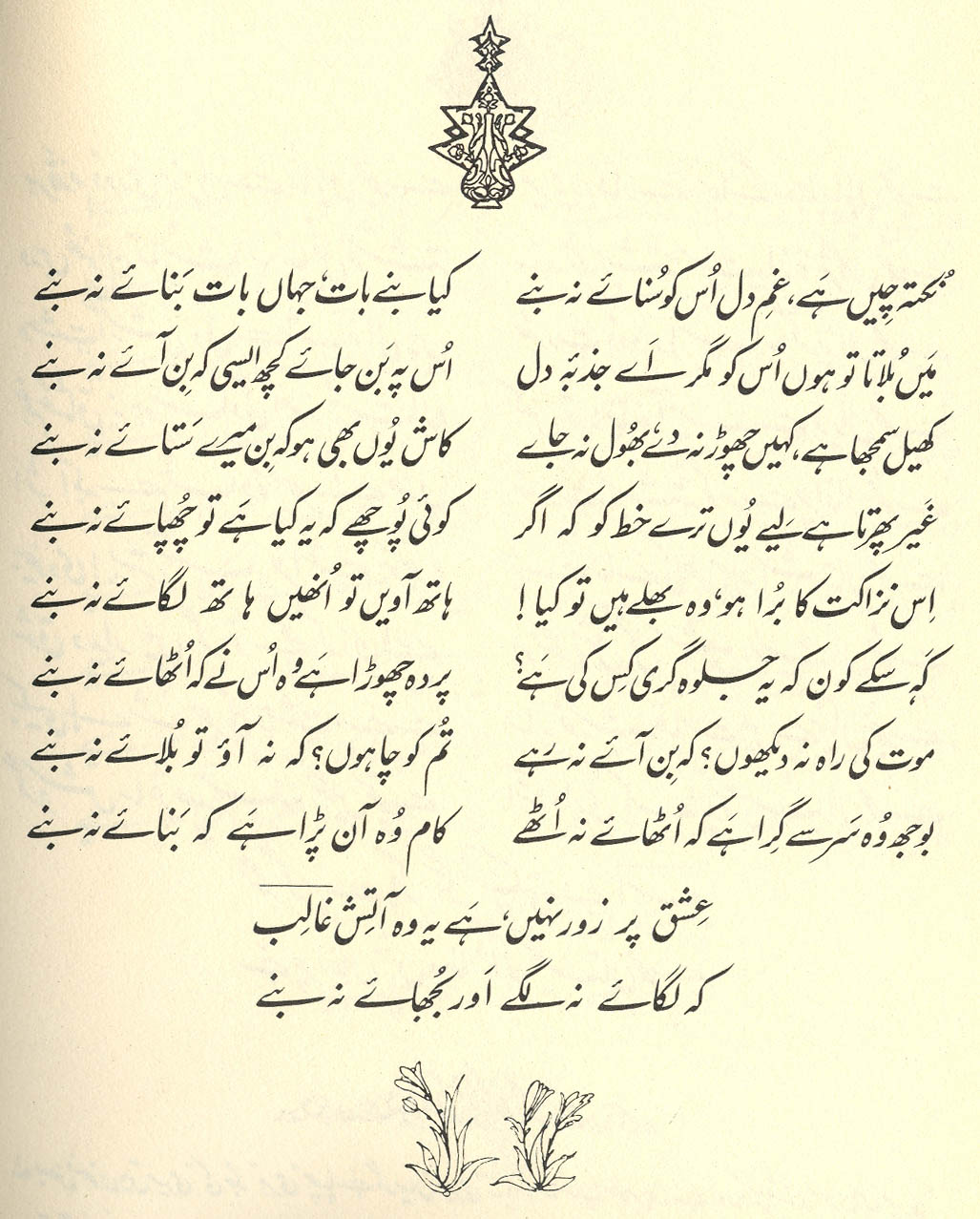
If only it would be that without tormenting me she would have no peace. (214)
== Nazm page 214

He says, 'Even the tyranny and cruelty with which she treats me, she considers a game. Thus I fear lest she might leave off the tyranny, or forget it. If only it would be that she would have no peace without tormenting me, and every day, regularly, she would keep tormenting me!' (274)
Compare 60,6 . (133)
The beloved is young, and torments me. But she doesn't consider it necessary to torment me-- rather, where there are other games, this game too is one among them. And from her tyranny I get pleasure-- may the Lord grant that she not forget, or leave off! May she herself get such pleasure from tormenting me that she wouldn't be able to stand not to torment me.
Janab Shaukat [writes], 'The beloved fears lest the lover might leave her. What-- as if such a thing can happen!' What a beautiful idea he has expressed. (374)
On the idiomatic grammar of expressions, see 191,8 .
The verse begins with a brief report from the lover. The beloved 'considers it a game'. (On the usage of , see 90,3 .) But what is it that she considers a game? Apparently something delightful, since the lover greatly fears that she might tire of it, or might forget about it. In mushairah -verse style, the verse is careful not to tell us in the first line, so that we must remain curious until (after a suitable delay) we're allowed to hear the second line. Even then, the nature of the game-- its consisting of 'torment'-- is not revealed until the last possible moment.
Far from lamenting this 'torment' (see the definition above), the lover longs only for it to be guaranteed to continue. After all, anything is better than being ignored by her (as we're reminded in 148,2 ). s so often, we're also back to the basic pain-equals-pleasure paradox that lies at the heart of the ghazal world; for more on this, see 17,7 .
The second line of the verse reveals a simpler form of the same wordplay as that of the previous verse, 191,2 . Instead of we have only ; but in the immediate aftermath of the previous verse and the astonishingly complex second line of the first verse, even this much sound-play and script-play still resonates enjoyably. (On the grammar of , see 191,02 .)
Bekhud Mohani approvingly cites Shaukat's alternative reading of the first line, which is apparently one of fear on the beloved's part: 'She has considered it [=the lover's devotion] a game [on his part]-- [she thinks,] "May he not forget, may he not leave off!"'. But even apart from the highly un-beloved-like behavior that it envisions, this reading doesn't seem to offer any real connection with the second line, so it hardly seems sustainable.
graphics/hypnotictorment.jpg