Verse 71852aa))enah bane
G5
In this meter the first long syllable may be replaced by a short; and the next-to-last long syllable may be replaced by two shorts.
1
would/should I not {wait for / 'watch the road of'} death-- {which / since it} wouldn't refrain from coming?
2
would/should I desire you-- who/since if you wouldn't come, then you couldn't be [successfully] called?
| References | |
|---|---|
| Arshi, Imtiyaz Ali | Ghazal# 226 |
| Raza, Kalidas Gupta | 429-30 |
| Hamid Ali Khan | Open Image |
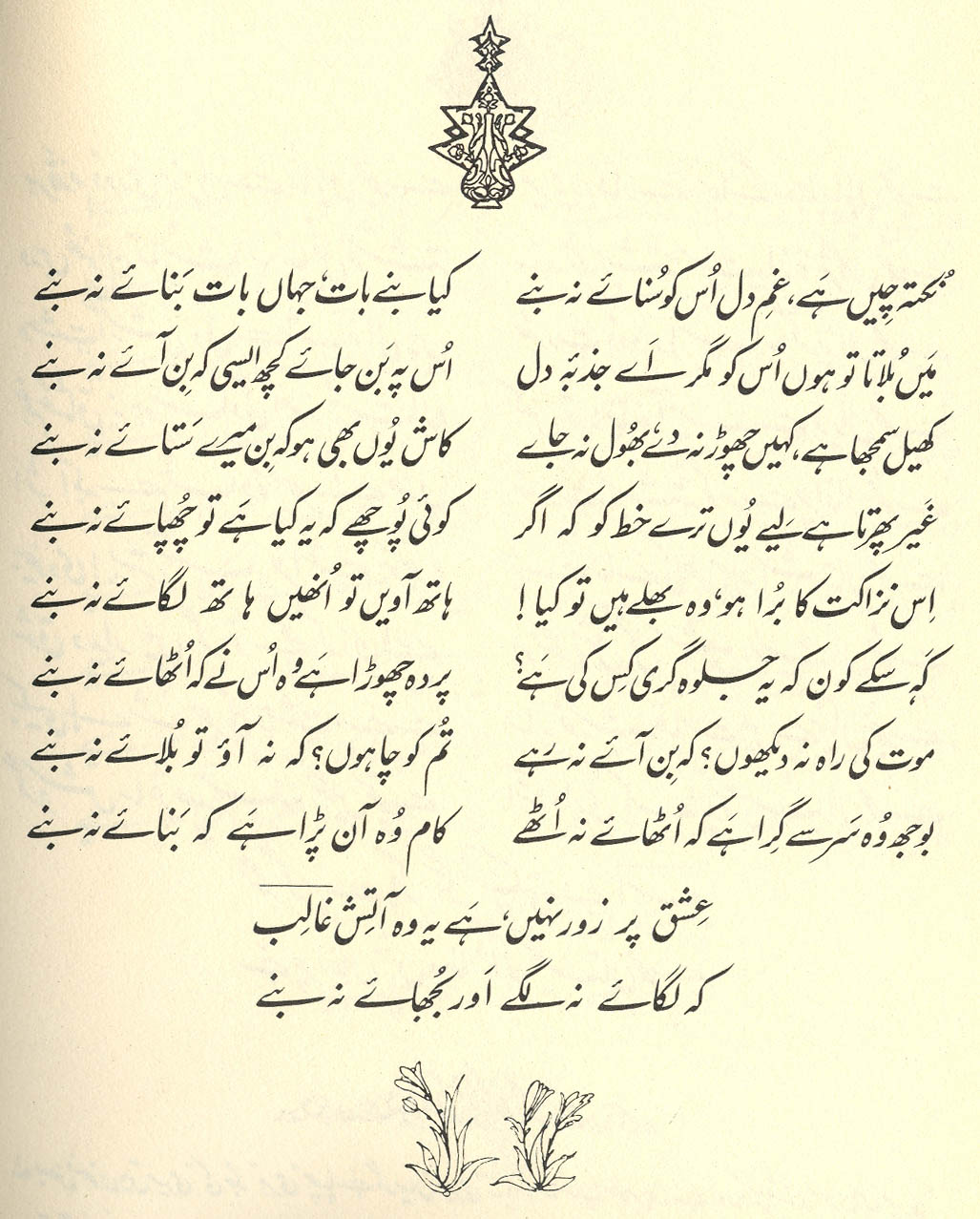
[1853, to Haqir:] Brother, I am greatly surprised at you, that you felt a hesitation about the meaning of this verse []. Two questions have come into it that he has asked of the beloved by way of reproach and insinuation. Should I not wait for death? Why should I not? I will indeed wait for it, for it can't not come. For this is one of the things thing to the honor [] of death, that one day it will indeed come. The wait will not be in vain. Should I desire you? What a fine idea! Why should I desire you, when if you don't come, you can't be called? That is, if you would come of your own will, then you'd come, and if you wouldn't come, then what power would anyone have to call you?
As if this helpless one says to the beloved, 'Now I've left you and have become a lover of death. It has the virtue that without being called, it doesn't refrain from coming. Why would I desire you, when if you don't come, then I can't call you?' The thing is that if in reading 'should I desire you, since you wouldn't come' [] this utterance comes into the mind joined together, then a person is amazed []. is separate, -- this phrase is separate. You didn't pay attention, otherwise the mood of this reproach and insinuation would of itself have become apparent to you.
==Urdu text: Khaliq Anjum vol. 3, p. 1117
He says, 'Why shouldn't I wait for death, since it won't refrain from coming. I can't bear it that I would call you and if you wouldn't come, then even my calling wouldn't bring about the result. That is, if you yourself would refuse to come, then how would I have the nerve to call you?' The suggestion is that the coming of death is better than your not coming. (215)
== Nazm page 215

The meaning is that meeting with you is more difficult than the coming of death. (274)
To wait for death is useless, because it will come in any case. Indeed, I ought to love you, because if you don't come, then you wouldn't even be able to be called. That is, the claim of courage is that a man should do that task which would be very complicated. The people of courage can't manage to do a commonplace task. Mirza Dagh says:
[how the last breath draws near, because of the difficulty-seeking heart!
that task goes awry which is not difficult]....
[Disagreeing with Nazm:] 'If you yourself would refuse to come, then how would I have the nerve to call you?'-- the Lord knows what the connection of this meaning is to the first line! And those interpretations that have been made-- they are amusing. (376-77)
On the idiomatic grammar of expressions, see 191,8 .
The two lines are parallel, but with intriguing differences. The action proposed in the first line is something like 'looking out for', death [], literally, to 'watch the road' by which it's expected to come. So it suggests an eagerness and attention and desire that are stronger than merely passively 'to await'. But neither is it the same as , to 'desire' or 'love', in the second line. Are we to pay attention to the similarities, or the differences? Both, no doubt, since this is Ghalib.
Moreover, nothing in the grammar rules out doing both activities at once. Nor does anything in the grammar establish any other relationship between the lines: the idea that death is a new beloved who might supplant the old one; or the alternative idea that waiting for death is a mere counsel of despair because of the beloved's inaccessibility; or Bekhud Mohani's notion that the man of courage should love the beloved actually because of her inaccessibility-- these and other such interpretations can be present only by implication , since the verse itself doesn't formally produce them.
There's also the elegant multivalence of -- 'since, because'? 'for'? 'in that'? 'such that'? 'the one which/who'? The particular (causal or non-causal) relationship between the clause before it and the clause that it introduces is always open to mediation by each semantic situation in which it occurs. For an excellent example of such flexibility, just compare the use of in the next verse, 191,8 , where it clearly means something like 'the one that'.
Ghalib in his letter seems to pride himself on a kind of (in an extended sense) that he's created by careful arrangement of the 'midpoints' grammar of the second line. As he explains it, in the first reading (or, ideally, hearing), we naturally take the first two clauses together, because of the apparent parallelism with the first line, so that the 'midpoint' phrase is read with the first part of the line ('should I desire you, because you might not come?'); only after hearing the final clause do we go back and-- enjoyably, on the fly-- revise our initial guess (to read with the latter part of the line).
Note for grammar fans: This radically verse is a kind of textbook of the future subjunctive-- no fewer than five instances occur. Along with two idiomatically-used past participles, they are the only verbs in the verse. Their flexibility is cleverly exploited: the first subjunctive in each line is a proposed action that the speaker is seriously considering, so that in English it would have the sense more or less of 'should I...?'. By contrast, the other subjunctives all simply describe, in the classic subjunctive way, actions might or might not happen. This former, deliberative sense is available only in the first person, because one can't deliberate about, or choose, other parties' actions. The subjunctive can of course also express a wish or hope, as in 173,6 .
Compare 201,2 , which meditates on the capriciousness of death.
graphics/longroad.jpg