Verse 21853arhai kyaa kahiye
G9
In this meter the next-to-last long syllable may be replaced by two shorts.
1
{such a / 'this'} contrariness/obstinacy-- that today it wouldn't come, and that it wouldn't fail to come!
2
to what extent/'fate' we have a complaint against fate/death-- 'what can you say?!'
'Contrariety, opposition, the spirit of contrariness; persisting, persistence, insistence, perseverance, pertinacity, obstinacy'.
'Divine decree, predestination; fate, destiny; fatality; death'.
'Fate; predestination; the angels who preside over destiny, the recording angels'.
'Measure; degree; quantity; magnitude; bulk, size; portion, part; —whatever is fixed or ordained of God, divine providence, fate, destiny'.
| References | |
|---|---|
| Arshi, Imtiyaz Ali | Ghazal# 227 |
| Raza, Kalidas Gupta | 440-41 |
| Hamid Ali Khan | Open Image |
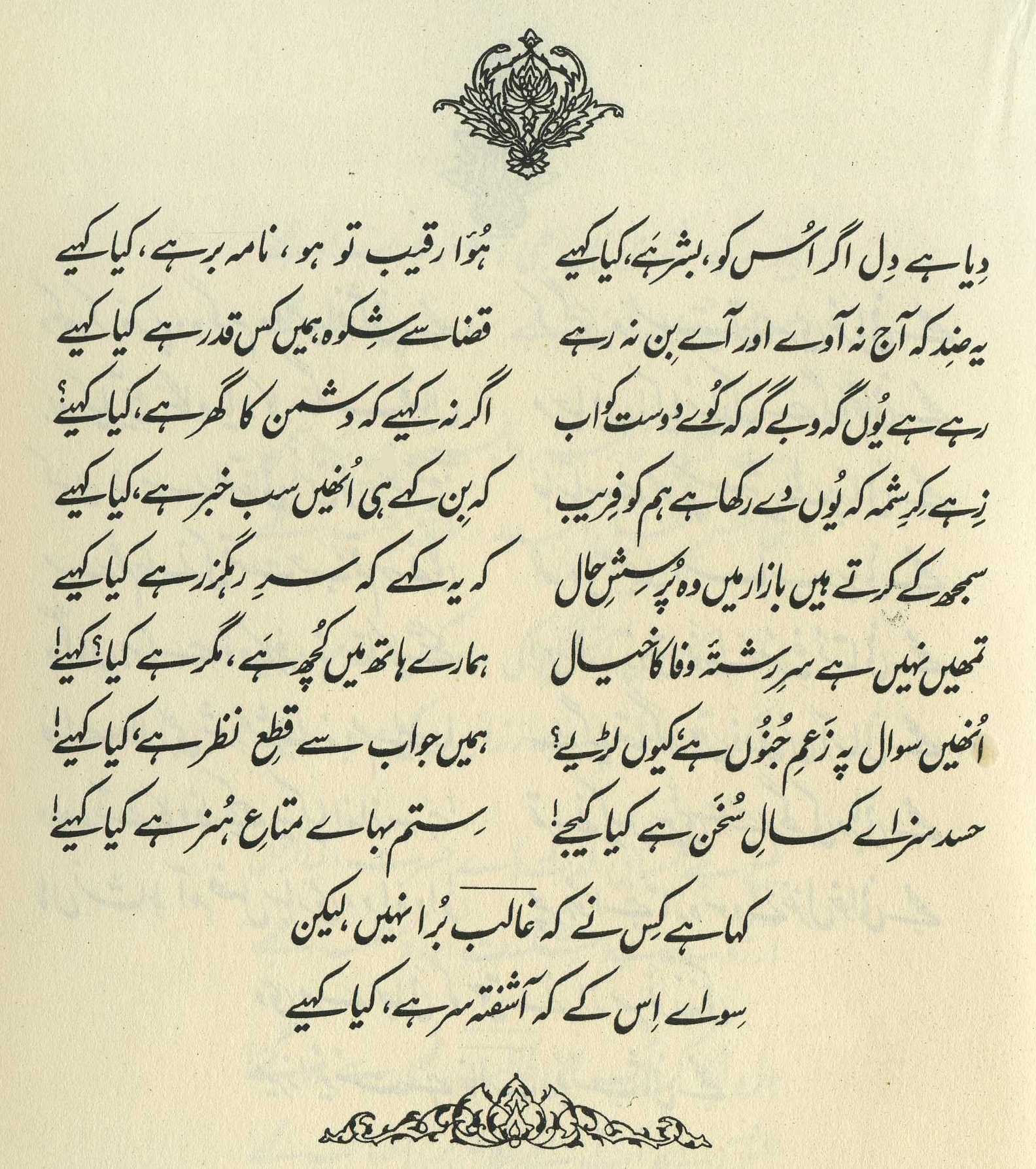
God is great! This contrariness of fate, such that it will certainly come, but it doesn't come today-- so look what kind of a complaint! (225)
== Nazm page 225

He says, 'The coming of death is an inevitable and necessary thing-- one day or another the wretch, without being summoned, will certainly come and confront you. But it shows us such contrariness that today, in the night of separation, it doesn't come when we call it. For our whole lifetime we'll make this complaint against it.' (282)
My God, my God-- how contrary death is! It will certainly come, but today-- in separation from the beloved, or in the night of difficulty-- it won't come. What can we say, about what kind of a complaint we have against it! That is, a complaint to the maximum limit. (394)
How contrary can you get! In the first half of the first line we might be hearing about the beloved, but then the second half of the first line dispels that possibility once and for all. So we're prepared to relish the second line, with its rueful humor that both sharpens and diffuses the force of the complaint. Death won't come when you want it, and yet it will come-- almost certainly, given its perversity, when you don't want it. (On the grammar of , see 191,2 .)
The verse is also enlivened by a really superb example of idiomatic wordplay (and meaning-play): the beautifully appropriate pair of and , which not only have largely overlapping meanings, but also commonly occur as a petrified phrase, (see the definitions above). Yet is such a common, colloquial, petrified phrase that when its alternative meaning suddenly looms up, the effect is one of powerful surprise and delight.
An enjoyable companion piece for this verse, since it turns the complaint against death into a complaint against the beloved, is 191,7 .
graphics/clockworks.jpg