Verse 91853arhai kyaa kahiye
G9
In this meter the next-to-last long syllable may be replaced by two shorts.
1 a
who has said that Ghalib's not bad? -- but
2
except for this: that he's disordered in the head-- 'what can you say?!'
'But, but still, on the other hand, however, notwithstanding, nevertheless, yet'.
| References | |
|---|---|
| Arshi, Imtiyaz Ali | Ghazal# 227 |
| Raza, Kalidas Gupta | 440-41 |
| Hamid Ali Khan | Open Image |
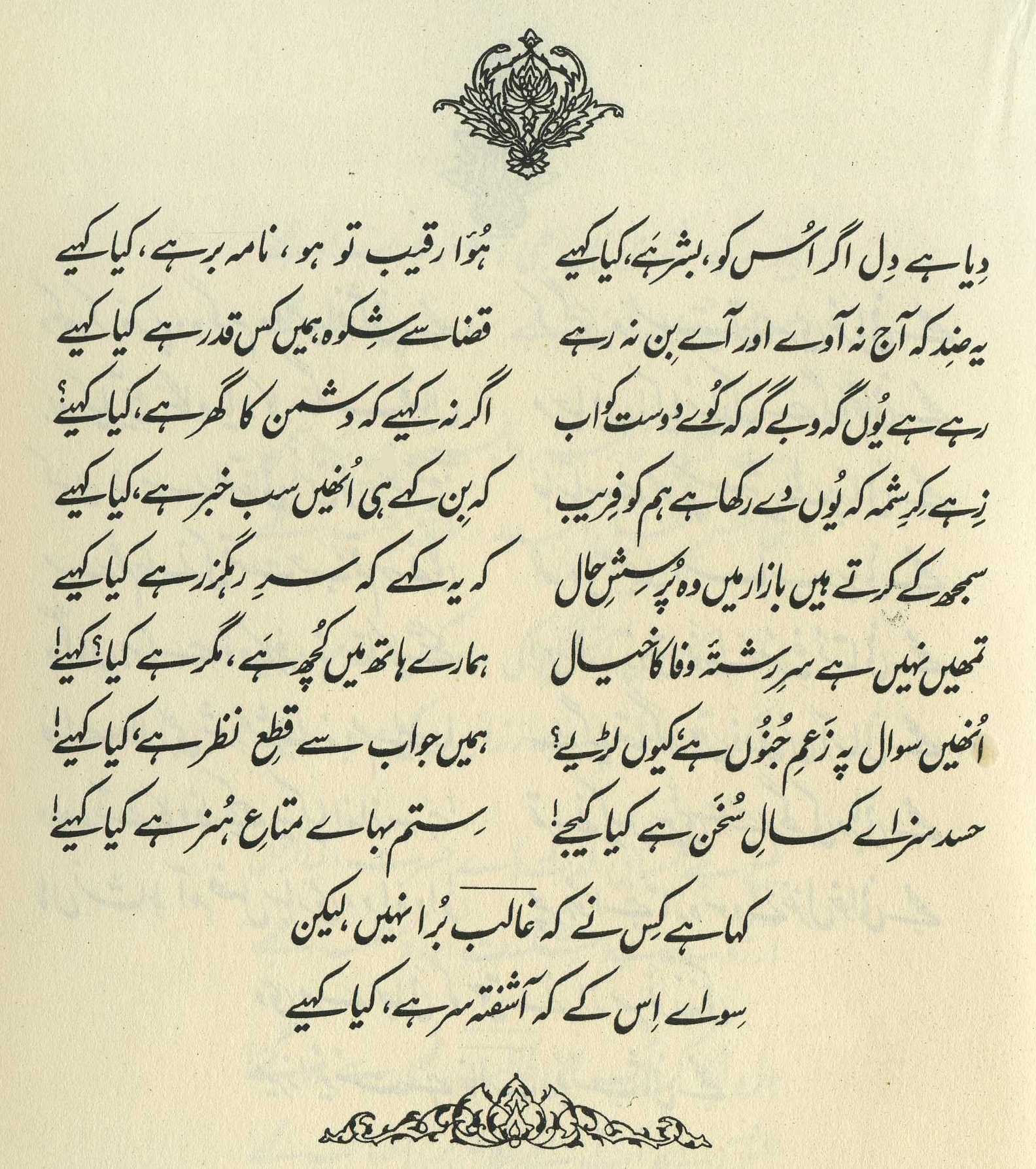
That is, if he wouldn't be mad, then what can be said about him at all? [Discussion of the Arabic word being used with a Persian and also an Indic , and the nuances of this in terms of Urdu idiom.] (226)
== Nazm page 226

The reference of 'who' is toward the beloved. He says, 'She's said that Ghalib is not a bad man, but it's a pity that he's mad, and about it/him what can be said'. (284)
Some friend of the beloved's has said something to her about Ghalib. At this she has gotten angry, and the gentleman friend has seen her altered mood and turned the direction of the conversation: 'I didn't say that Ghalib is not bad-- I said that he's a madman, so what can be said about him?' (396)
It's clear that the commentators-- these and others-- can't agree on who's saying what to whom. Which isn't surprising, is it? Ghalib has obviously rigged the verse that way. I can't figure out any one clear reading either. Here are some of the possibilities:
=Who has said, 'Ghalib's not bad'?! But except for for the fact that he's disordered in the head, what can anybody say?
=Who has said, 'Ghalib's not bad'? But except for for saying 'He's disordered in the head', what can anybody say?
=Who has said, 'Ghalib's not bad'? [He is bad, of course.] But except for the fact that he's disordered in the head-- he's indescribable [in his excellence]! ( , like , can also be used for the inexpressibility trope.)
If you ever see actual quotation marks in an edition of the divan , remember that they're only those of some modern editor trying to 'help' us by ruling out all readings other than his own. Ghalib would never have been so destructive of his own multivalence. But no matter how we choose to parse the implicit quotation marks, one clear and excellent feature remains: the interaction of with every possibility is jaunty, idiomatic, clever, amusing, and absolutely appropriate.
For another view of the 'disordered head', see 159,7 . (Isn't it a pity that our 'scatterbrained', which is almost a literal translation, doesn't have the same meaning?) For another multivalent use of , see 209,1 .
graphics/madness.jpg