Verse 11853aakahiye
G9
In this meter the next-to-last long syllable may be replaced by two shorts.
1
if I would say/tell my condition, then you say, 'Please say/state your purpose!'
2
only/emphatically you say [imperative]: if you would say/'speak like' this, then what can one say?
'What is claimed, or alleged, or pretended, or meant; desire, wish; suit; meaning, object, view; scope, tenor, drift'.
| References | |
|---|---|
| Arshi, Imtiyaz Ali | Ghazal# 228 |
| Raza, Kalidas Gupta | 441-42 |
| Hamid Ali Khan | Open Image |
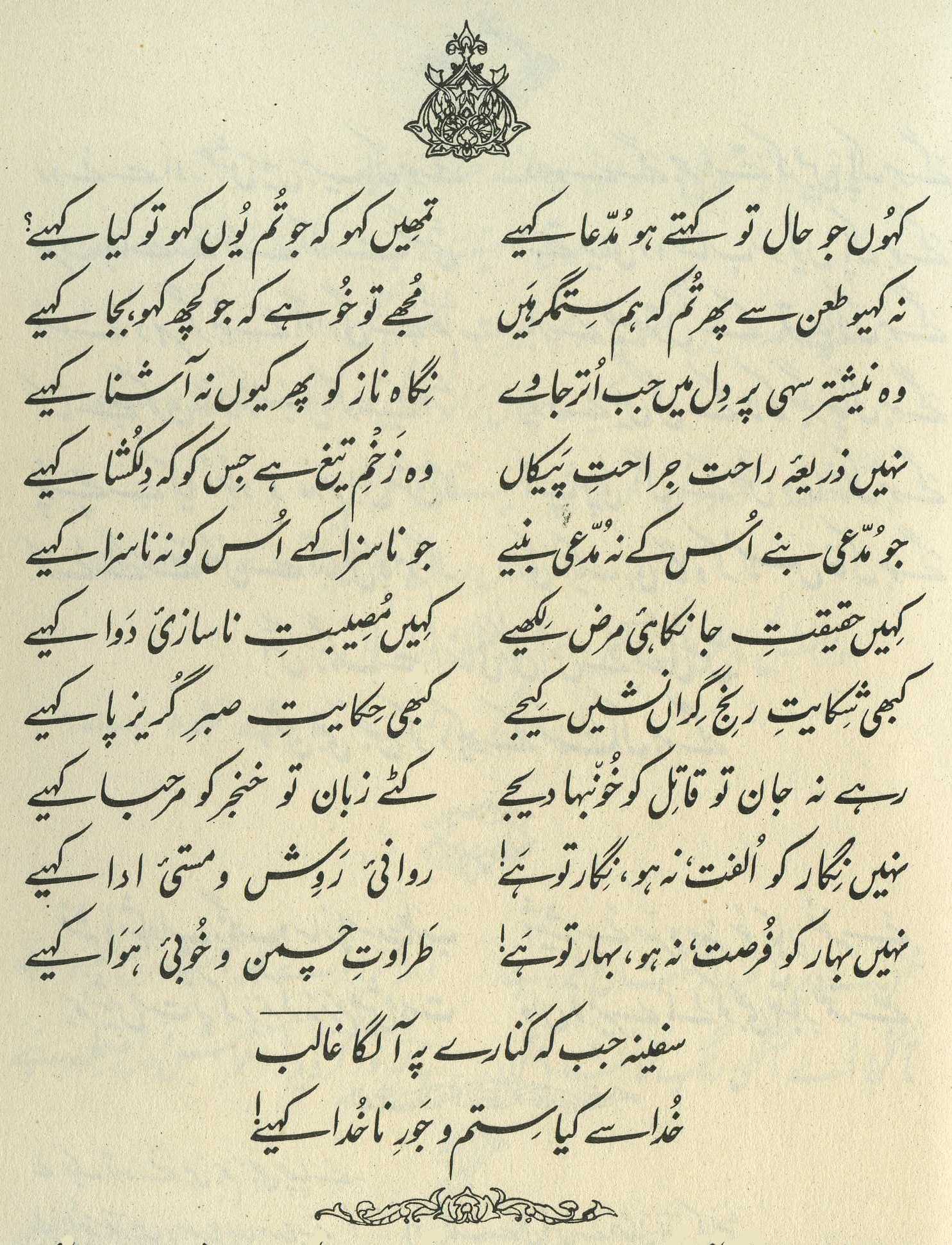
[See his reference to this ghazal along with 201,1 .]
[1858, to Mihr:] -- this ground had once here become the pattern . But the meter was different. , etc. [{209,1}]; , etc [ 209,8 ].; , etc. [ 209,11 ]. ==Urdu text: Khaliq Anjum vol. 2, p. 714 ==another trans: Daud Rahbar , p. 91
[1858, to Mihr:] -- this ground had once here become the pattern . But the meter was different. , etc. [{209,1}]; , etc [ 209,8 ].; , etc. [ 209,11 ]. ==Urdu text: Khaliq Anjum vol. 2, p. 714 ==another trans: Daud Rahbar , p. 91
'You'-- that is, not anybody else, you who are well acquainted with my purpose, you who having heard my condition say ignorantly, 'please say your purpose'. In answer to this, what would I say first? (237)
== Nazm page 237

He says, 'If I say/tell my state of restlessness in ardor, then you say, 'Please say/state your purpose'. Although you're very well acquainted with and aware of the purpose of my heart, you then feign ignorance! Now I ask of you yourself: in answer to this question of yours, what ought I to say? (294)
If when understanding the meaning of this verse we keep in our minds a picture of some bad-tempered, powerful person and some oppressed, helpless person, then this verse is understood with the greatest ease. When I begin to tell you the state of my heart, then you grow angry and say, 'What are you babbling about? Say/state your purpose-- after all, what do you want?' Now you yourself do justice: when this state of affairs exists, then what would I say, and with what hope would I say anything? This verse too is like what Mirza has said in another place: 178,9 . (421)
Here's a remarkable network of word- and meaning-play based on the word , 'to say', which is used no fewer than six times in two lines, in a variety of complex ways, including quoted dialogue, anticipated dialogue, and idiomatic forms.
In the first line, the subjunctive 'I would say' [] excellently conveys the sense that the speaker would try to say something, but would then be at once cut off: 'you say' [] is in the habitual, so perhaps this scenario occurs over and over again. And what the beloved says is something like 'Please state your case' or 'Please get to the point' []; the polite imperative verb here suggests not real courtesy but a dismissive, semi-bureaucratic indifference. Here are some of the possible ways to read the line:
=When the lover tries to talk about his situation/condition, the beloved insists on hearing instead about his 'purpose'.
=When the lover tries to say something, the beloved interrupts him and makes a show of indifference, ignoring his words.
=When the lover speaks, the beloved pretends not to have heard him, and demands that he repeat everything.
In the second line, the speaker appeals for justice from the beloved herself: 'only/emphatically you say' or 'you yourself say' []. And what is the problem being presented? The complaint has two readings, thanks to the versatility of : 'if you would say this' suggests that the problem is that she would say the words quoted in the first line, . And 'if you would speak like this' suggests that she would say a variety of other dismissive, indifferent things as well.
But the best part is the final phrase, . Here are some of its possibilities:
=Something like 'what can I say?'-- an all-purpose colloquial response, the verbal equivalent of a shrug of the shoulders.
='What can anyone say? what words are there for such a situation?'-- a colloquial form of the inexpressibility trope.
='How remarkable! how extraordinary!'-- an exclamatory idiom that's often used for praise, perhaps sarcastic praise of the astonishing behavior the beloved shows.
='What should one say?'-- a request for information: in such an untenable situation, please suggest what kind of reply should be made.
This verse-- and this whole ghazal in general-- offers a case study in the idiomatic uses of (and sometimes other polite imperatives as well). Grammatically is the polite imperative of , of course, and it's certainly used that way, but very often it's used idiomatically, to apply to proposed or approved behavior by a variety of grammatical persons, in a variety of situations. (The same thing is done with in 209,5 .)
When it's part of the even more pithily idiomatic , its expressive possibilities are further expanded; for examples of such colloquial flexibility, see almost all the verses of 201 .
For a similarly complex treatment of , 'to tell', see 46,7 .
graphics/loversquarrel.jpg