Verse 61853aakahiye
G9
In this meter the next-to-last long syllable may be replaced by two shorts.
1
somewhere/anyhow/perhaps write down the reality/truth of the life-destroyingness of the illness
2
somewhere/anyhow/perhaps speak of the difficulty/trouble of the contrariness of the medicine
'Somewhere; anywhere; wherever; whithersoever; --ever, anyhow, by any chance;... may be, perhaps'.
'Essence (of a thing), essential property or quality; truth, reality, fact, true or real nature or state or circumstances or facts, gist, pith; — rightness, sincerity; — account, narration, relation, story, state, condition, explanation'.
'Diminishing; weakening; destroying; consuming, &c. (used as last member of compounds)'.
'Discordance, dissension; --adverseness, opposition, contradiction; --indisposition; --ill-behavior; --dissimulation'.
| References | |
|---|---|
| Arshi, Imtiyaz Ali | Ghazal# 228 |
| Raza, Kalidas Gupta | 441-42 |
| Hamid Ali Khan | Open Image |
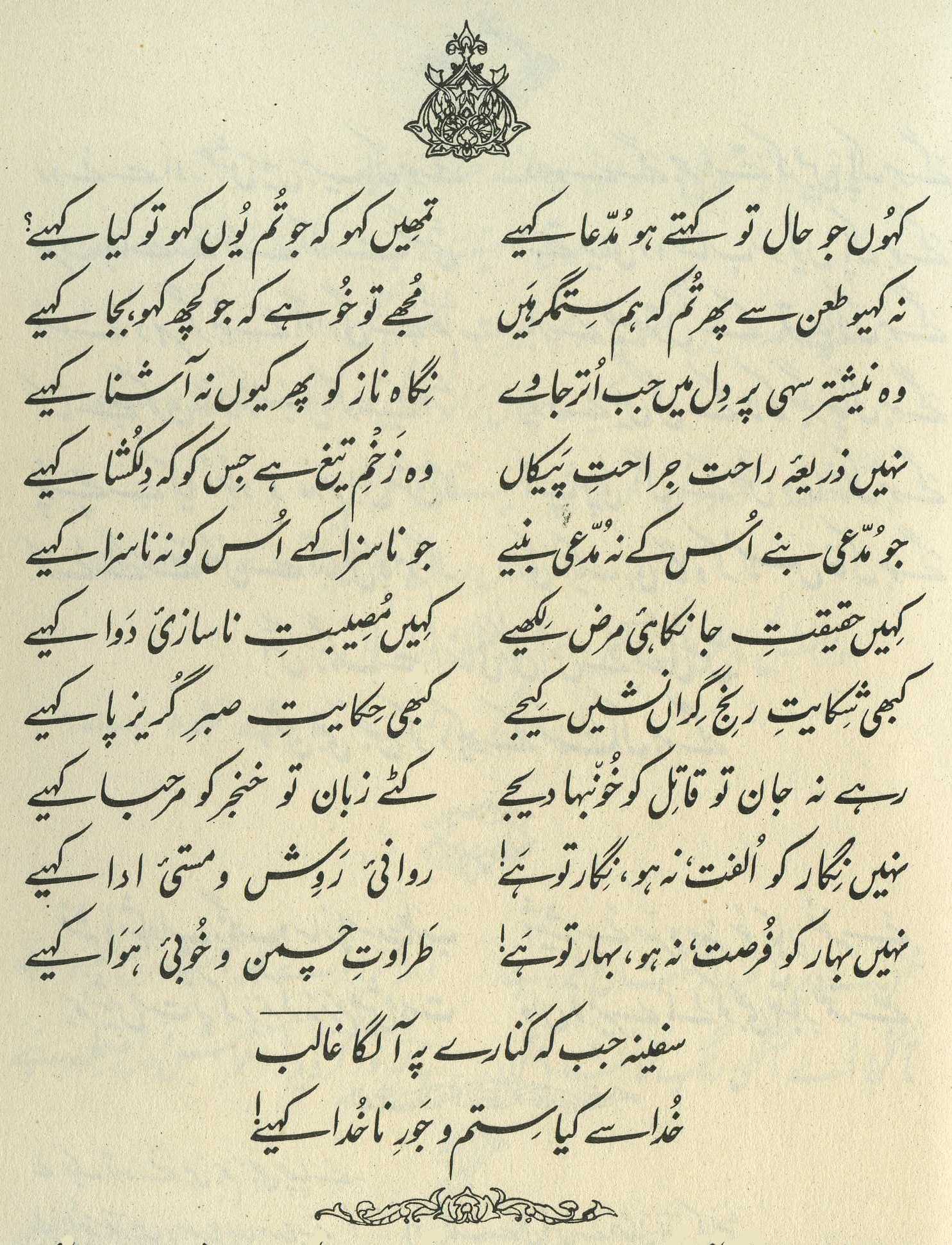
[Commenting on both this verse and 209,7 :] Well, it has just happened like this to us. And in our fate it was written that before one after another we would bemoan the grievousness of our fate, we would wander around complaining to one after another. Sometimes we would grieve at the hands of sorrow, sometimes we would lament about the faithlessness of endurance. (238)
== Nazm page 237

He says, somehow please write the truth of the life-destroyingness of the illness of passion; that is, what shocks happen to the heart in separation, its state in detail. And somehow please express the difficulty of the contrariness of the medicine; that is, for the ascetic even union proves uncongenial; that is, insistence to the beloved, the restlessnesses of passion, the thorn of the dawn after union, the prickling of jealousy of the Rival -- all these things keep one restless in union. (295)
[Commenting on both this verse and 209,7 :] Alas for our destiny! Our life passed like this, and is passing like this: sometimes we write the state of the restlessness of sickness, sometimes we express the difficulty that medicine has no effect. Sometimes we complain that sorrow has settled into our heart in such a way that it can't at all be removed; sometimes we express the fact that the feet of endurance are usually dislodged. (465
In both verses [this one and {209,7}] the theme is continuous . (339)
This verse and the next, 209,7 , seem to work as an informal verse-set . The commentators treat them variously: Nazm, Bekhud Mohani, and Chishti comment on both together without labeling them in any special way, while Hasrat, Baqir, and Bekhud Dihlavi treat them separately, as normal verses. Shadan labels everything from the present verse on to the end of the ghazal explicitly as a verse-set (470). Mihr creates an even more unusual grouping: he presents and comments on the verses from {209,5} through {209,10} as a set (672-73), but doesn't apply any label.
In the present verse, the two lines are strongly parallel, but what exactly is their relationship? Are they two alternative thematic choices, from which a poet might select one or the other? Or do they describe the same situation, simply emphasizing different aspects of it? Is one of them the cause of the other, and if so which way does the causality go? (Is the illness deadly because the medicine is contrary, or is the medicine contrary because the illness is deadly?) Is there an opposition between and , writing and speaking, or should the latter be understood in its literary sense of 'compose'?
These questions become more compelling and significant because the lines are so thoroughly parallel that every single word of each line has a counterpart in the other line. How can we refrain from considering what it means that 'reality/truth' and 'difficulty/trouble'; 'life-destroyingness' and 'contrariness'; 'illness' and 'medicine' are so exactly juxtaposed to each other? And the first two pairs have strong phonetic similarities as well, while the final pair have an unignorable semantic tie.
And what about the implications of (see the definition above)? Does it retain its literal sense of plus , and thus mean 'in one place' one might do something, and 'in another place' do something else? Does it refer to something that one might casually, 'perhaps', do, or else not do? Or might it be part of an injunction--' no matter where, 'wherever', do it!'. The framework of the verse makes it remarkably open-ended. Its tone is ours to determine-- is it encouraging? despairing? neutral, like an inventory? In any case, its structural connection to the following verse, 209,7 , is particularly strong, and it really does feel right to read them together.
This verse also feels linked to the previous one by a small semantic tie between two unusual words: from to feels like a very plausible jump for a poet's mind to make.
graphics/medicine.jpg