Verse 101853aakahiye
G9
In this meter the next-to-last long syllable may be replaced by two shorts.
1
if springtime would not have leisure, let it not-- after all, it's springtime!
2
speak of the verdure/juiciness of the garden and the excellence of air/love/desire
'Spring, prime, bloom, flourishing state; beauty, glory, splendour, elegance; beautiful scene or prospect, fine landscape; charm, delight, enjoyment, the pleasures of sense, taste, or culture'.
taraavat>> : 'Freshness, juiciness, succulence; greenness, verdure; moisture, humidity, dampness'.
'A bed (in a garden), flower-bed, a parterre; a flower-garden; a blooming, verdant, or flourishing place'.
'Air, wind, gentle gale;... --affection, favour, love, mind, desire, passionate fondness; lust, carnal desire, concupiscence'.
| References | |
|---|---|
| Arshi, Imtiyaz Ali | Ghazal# 228 |
| Raza, Kalidas Gupta | 441-42 |
| Hamid Ali Khan | Open Image |
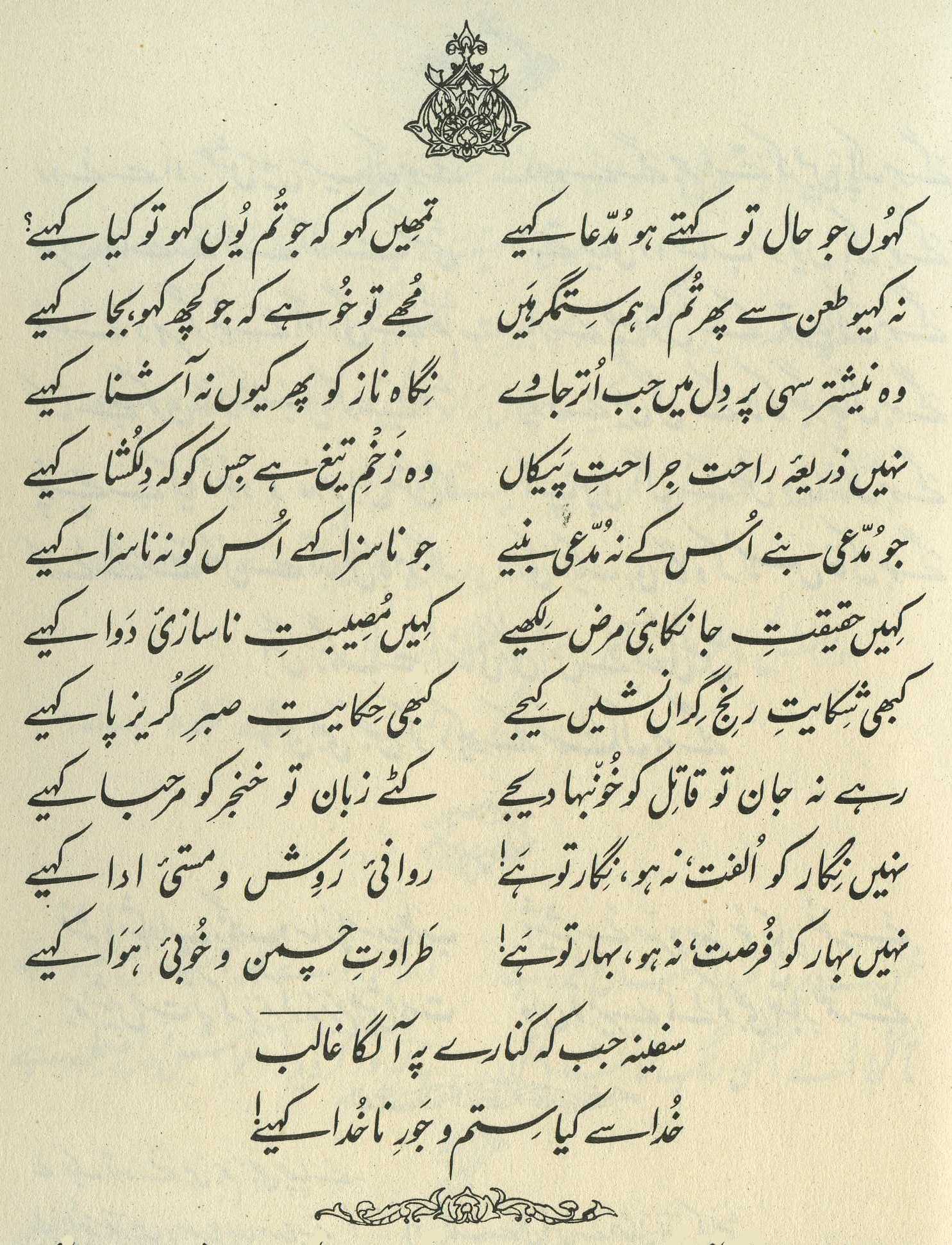
The meaning of this verse too is exactly that of the previous verse. And by 'leisure' is meant 'leisure for settledness and faithfulness'. (238)
== Nazm page 238

He says, 'If springtime doesn't have leisure for settledness, then let it not. But nevertheless, it's the spring season. One ought to abandon this complaint, and praise the verdure of the garden and the joy and pleasingness of the cool breeze.' (296)
One group of wise men have the practice that one remains pleased with the good aspect of everything, and overlooks the bad aspects. (426)
This verse and the previous one, 209,9 , seem to work as an informal verse-set .
The previous verse was saved from mere truistic prosiness by the clever use of . This verse is also saved by the elegant choice and deployment of vocabulary. The first line indeed sounds as sententious as the commentators could desire. But then in the second line, the relatively uncommon word has a strong literal sense of 'juiciness, succulence', and only secondarily that of 'greenness, verdantness'. We notice this in passing, and are a bit alerted by it.
Then the final clinches the effect (on the multivalence of see 8,3 ): it could at least as easily refer to 'desire, lust' as to a 'spring breeze'. So that in retrospect, we're reminded that too can easily mean 'prime' or a 'flourishing state', and even , which generally means 'flower-bed', can have such the secondary sense of a 'flourishing place' (see the definitions above).
Thus we're left with a verse that either: (1) praises the verdure and luxuriance of springtime (or youthful desire) despite its brevity; or (2) enjoins us to forgive springtime (or youth) for its brevity by appreciating it as the season of luxuriant, 'juicy' desire. As so often, it's up to us to choose the praises, and the evocations, for ourselves.
graphics/garden.jpg