Verse 81853aakahiye
G9
In this meter the next-to-last long syllable may be replaced by two shorts.
1
if life would not remain, then let the blood-price be given to the slayer
2
if the tongue would be cut out, then say 'welcome/bravo' to the dagger
is an archaic form of ( GRAMMAR )
| References | |
|---|---|
| Arshi, Imtiyaz Ali | Ghazal# 228 |
| Raza, Kalidas Gupta | 441-42 |
| Hamid Ali Khan | Open Image |
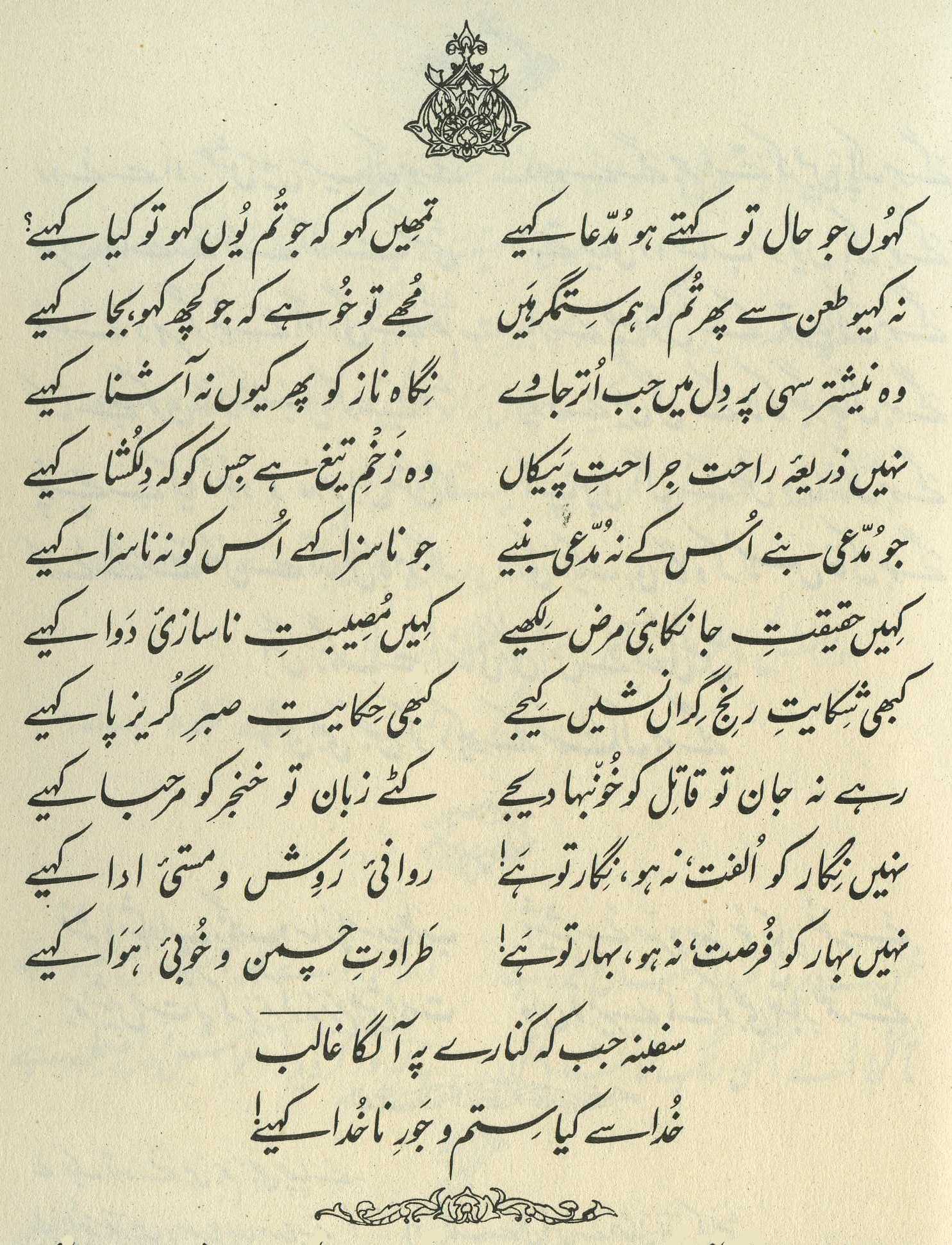
Here, by 'to give the blood-price' is meant 'to forgive [] the blood-price'. (238)
== Nazm page 238

He says, in love it's a matter of 'the hand that has come under a stone' and 'the proof of faithfulness' [as in 230,7 ]. At the time when life is departing, one ought to forgive the murder the blood-price; and if the tongue is cut out, then one ought to praise the dagger. (296)
Mirza says that even if you are murdered, then instead of making a claim in return for your blood, and taking the property of the murderer, you ought not only to forgive the murderer for the sin, but rather also give her/him the blood-price. [As for Nazm's view,] people of insight know that here that is absolutely not intended. (425)
How far overboard is it possible to go, in welcoming and even passionately seeking death? Here's a kind of limit case, pushed into a reversal of normal experience in the first line, and an actual paradox in the second line.
Traditionally a murderer must pay a mutually agreed-upon 'blood-price' to the victim's relatives (for more on this, see 21,9 ), as a form of compensation that saves him from the risk of being murdered in retaliation. It would be generous enough even to excuse the murderer from paying the blood-price, as Nazm suggests. (Compare 64,6 , in which the lover volunteers to be solely responsible for the whole blood-price for any number of victims.) But it's even more perversely lover-like to order that a blood-price be instead actually paid to the murderer, so that the murderer makes a profit from the deed. Compare 19,4 , in which the lover tries to arrange some contrivance by which the beloved would murder him-- a financial reward might well be part of such a deal.
The paradoxicalness of the second line works strongly against Nazm's reading, and in favor of Bekhud Mohani's. For needless to say, if someone's tongue has just been cut out, he's not well placed to start 'saying' things-- whether congratulatory or otherwise-- to the dagger that has cut it out. But at least the intention can be there-- the desire to express extreme gratitude for the powerful gift of silence, which is a prelude to the related, but even more overwhelming, gift of death.
graphics/dagger.jpg