Verse 61816anpar
G2
1 a
what a stylish wounded/slaughtered one Asad is! --he says to the slayer
1 b
what kind/style of a wounded/slaughtered one is Asad ? --he says to the slayer
2
'Practice coquetry-- the blood of the two worlds [be] upon my neck!'
'Measure, measurement; quantity; weighing, weight; degree, amount; valuing, valuation, value; rough estimate; conjecture, guess; proportion, symmetry; elegance, grace; mode, manner, style, fashion, pattern'.
'Piercing suddenly (with a spear); —striking, beating, or lashing with velocity; —tearing; —writing, drawing (the letters); ... —a model (for imitation), a copy (to write after); an example; an exercise; —practice, usage, use'.
| References | |
|---|---|
| Arshi, Imtiyaz Ali | Ghazal# 62 |
| Raza, Kalidas Gupta | 181-82 |
| Nuskhah-e-Hamidiyah | 108-109 |
| Asi, Abdul Bari | 119 |
| Gyan Chand | 208-209 |
| Hamid Ali Khan | Open Image |
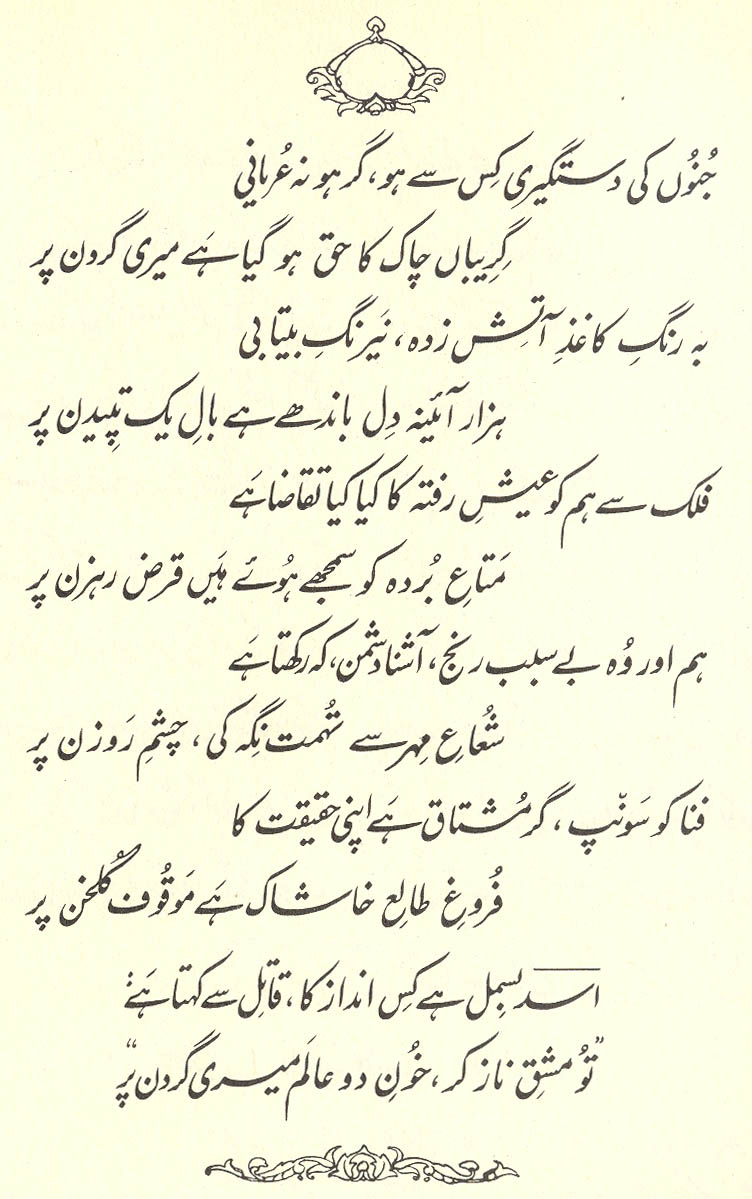
The meaning is clear. And here is not for inquiry, it is for exclamation. It is beyond the bounds of possibility to give sufficient praise to this verse. (65)
== Nazm page 65

He says, one feels surprised at the situation of Asad-- he is a wounded one of such style that one can't understand him. He himself says to the murderer, 'Keep on practicing coquetry in this very way, and let people go on getting slain, the blood of two worlds will be upon my head, you will not be held to account for it'. (113)
Compare 21,9 . (54)
From this verse it can be learned that that coquetry is Doomsday. The verse is irresistible. (146)
Some modern divan s, including Hamid, have instead of at the beginning of the second line. As always, I follow Arshi.
Bekhud Mohani is right to suggest 21,9 for comparison. In that verse, there may very likely (depending on the reading we choose) be no blood-guilt at all for those 'martyrs' slain by the beloved's glance. In the present verse, it's clear that there is, and it's of cosmic proportions-- but the lover still insists on taking it all upon himself. He urges the beloved to 'practice' [] coquetry'; and as a fringe benefit for our delectation, the other meanings of (see the definition above) in their own right all too well evoke the beloved's treatment of the lover (and the lover's literary response). The lover then solemnly affirms that the blood should/may be 'upon my neck' [], which is a formal guilt-assuming expression like 'Upon my head be it!' in English. Another example of this usage: 219,2 .
Nazm, usually so grudging in his praise, says it's impossible to admire this verse as much as it deserves. He says the best part of it is , which is not for inquiry but for exclamation; in other words, he prefers (1a). I agree that (1a) is the more amusing reading, because of its casual, tongue-in-cheek arrogance, as a bystander is made to marvel at Asad's grace, wit, and passion under pressure. Passion because he wants more of what has already wounded him, and grace and wit because he works into his exclamation both a compliment to the beloved's devastating beauty (which will slay everybody in the two worlds) and an implication that he alone has the power and authority to almost off-handedly assume all that cosmic blood-guilt.
But it's the inextricably intertwined set of (1a) and (1b) that is far more captivating than either one taken alone. For after all, that bystander might just as easily be bemused or surprised, and be seeking further information-- what kind of a person is this Asad, anyway, to behave in such a way? The little particle is of course the oblique singular of ; for more on the wonders of , see 15,10 .
For more on 'two worlds' constructions, see 18,2 .
graphics/blood.jpg