Verse 21816anpar
G2
1
with the aspect/'color' of fire-stricken paper-- the wonder/trick of restlessness
2 a
[it] binds a thousand mirror-hearts onto the wing of a single agitation
2 b
the heart binds a thousand mirrors onto the wing of a single agitation
(in P. also ; prob. prep. or + , q.v.), s.m. Fascination, bewitching arts, wiles; magic, sorcery; deception; --deceit; trick; pretence; evasion; --freak; --a wonderful performance, a miracle; anything new or strange'.
'Heat, warmth; burning, inflaming; pain, affliction, grief; anger, indignation, wrath, rage; light, radiance, lustre, splendour'.
is an archaic form of .
'Growing hot; being in great agitation; trembling; palpitation; agitation, uneasiness, restlessness'.
| References | |
|---|---|
| Arshi, Imtiyaz Ali | Ghazal# 62 |
| Raza, Kalidas Gupta | 181-82 |
| Nuskhah-e-Hamidiyah | 108-109 |
| Asi, Abdul Bari | 119 |
| Gyan Chand | 208-209 |
| Hamid Ali Khan | Open Image |
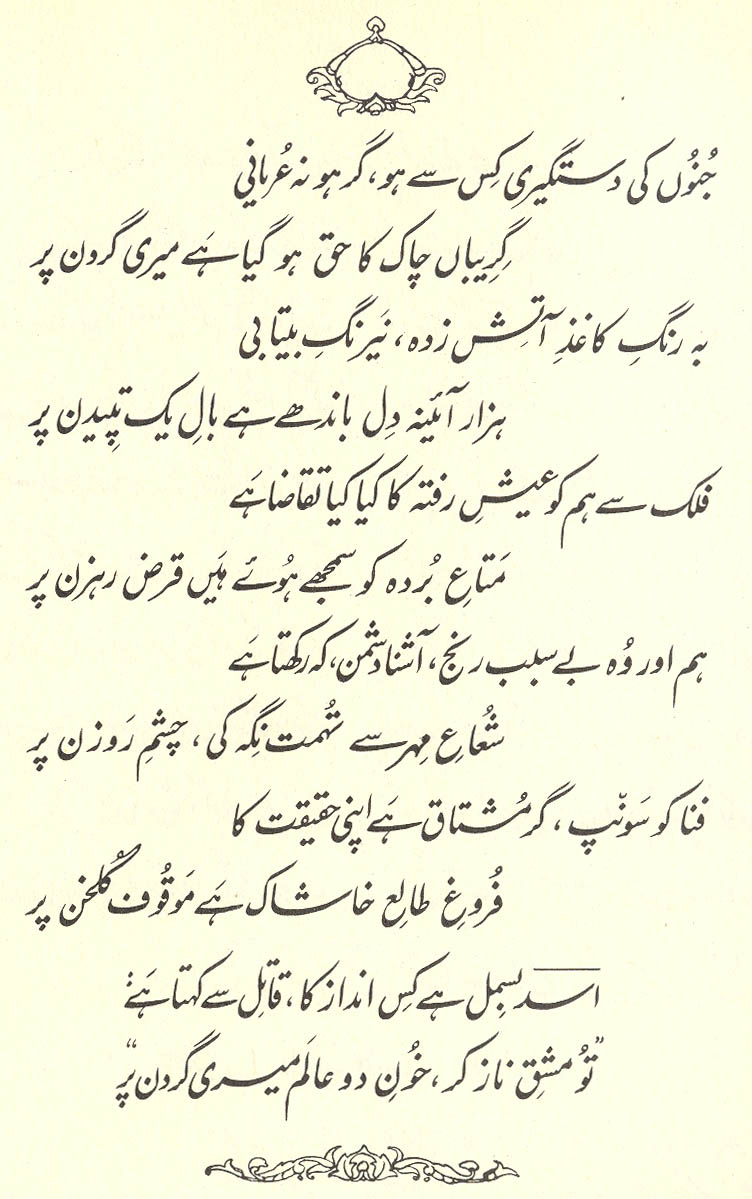
In the first line 'is' has been omitted . He says, 'the wonder of restlessness is like a fire-stricken paper, for the heart has bound a thousand mirrors onto every single wing-agitation'. In this verse he has used as a simile for the agitation of the moving mirror, the flame, which would be higher than the fire-stricken paper. (64)
== Nazm page 64

The prose of this verse is like this: the wonder of restlessness binds onto a wing-agitation a thousand mirror-hearts like a fire-stricken paper.... Upon a fire-stricken paper, after its burning up, thousands of points of lights can be seen glowing. Ghalib has constructed a 'wing of agitation' as a 'fire-stricken paper', and has compared its points of light to hearts. (63)
He says, just as star-like gleams begin to appear in a burned paper, in the same way the conjurer Restlessness has tieda thousand mirrors onto the wings of my heart. With a single agitation thousands of points of light become visible (112)
The heart, with the color/aspect of fire-stricken paper, is a wonder/trick of restlessness that ties a thousand mirrors to the wing of a single agitation. It's not a heart-- it's a miracle and enchantment of restlessness, of which every agitation presents such a scene of restless ones that it's like a fire-stricken paper. That is, the state that a fire-stricken paper is in only once, the restless heart remains in constantly, and the heart is always burning/melting from head to foot, and entirely wounded/scarred. (145)
Like the previous verse, this verse too is difficult/obscure []. What can be guessed from the words is that in the way that fire-stricken paper writhes, in the same way my restlessness, like a conjurer, has tied a thousand writhing hearts onto the wing of every agitation, and is showing off the spectacle of its restlessness. (148)
This verse is so difficult and obscure that it's difficult even to be sure that I've translated the commentators correctly.
In the first line we learn (with elegant word-and-meaning play) that the is . That is, the wonder/trick (see the definition above) of restlessness has the 'color' or aspect of 'fire-stricken' paper. A piece of paper that has been set afire first shows glowing spots here and there, then curls and writhes as it burns, showing flames of a variety of colors. Then it blackens into a frail tissue full of tiny surviving sparks, before it crumples into a grey ashy ghost of itself. Although basically means 'restlessness, agitation, impatience', it has the root (see the definition above), with all its associations of heat, radiance, grief, and anger.
For the second line, we have at least two possible readings. The subject is either the from the first line, which binds a thousand 'mirror-hearts' (2a), or else the heart, which binds 'a thousand mirrors' (2b). And in either case, where does it bind them? Onto the 'wing' of every 'agitation', of course. The 'wings' of each 'agitation' thus display thousands of 'mirrors' (or 'mirror-hearts'), so that they resemble a fire-stricken paper; and all this is the wonder/trick of restlessness! We're thus left with a pattern of imagery so tortuous and abstract that it's impossible to visualize.
Probably the verse means to leave us with the image of the burning, 'fire-stricken' piece of paper-- in its first glowing spots, its flaring up, writhing, crumpling, show of glittering sparks, and quick ashy death. (On this see 69,2 .) The lover's wonder/trick of betaabii , 'restlessness' (literally, lack of ) is actually full of , in all its senses. Is that why it can be a 'trick' as well as a wonder? It is as evanescent as the burning/burnt paper glowing with all those heart-sparks, yet renewed in every moment; it seems to be capturable in words, yet the words spiral off into extravagance while the feeling itself eludes us.
graphics/burningpaper.jpg