Verse 8x1816anpar
G2
1
courtesy is the disquietude/'thorn-thorn' of the entreaty of restlessness
2 a
for the string/thread binds a robe on the finger of the needle
2 b
for the robe binds a string/thread on the finger of the needle
Taking (anything) upon oneself gratuitously or without being required to do it, gratuitousness; taking much pains personally (in any matter); pains, attention, industry, perseverance; trouble, inconvenience; elaborate preparation (for); profusion, extravagance; careful observance of etiquette, ceremony, formality'.
'Disquietude'.
'Prayer, petition, supplication, entreaty, request'.
'Restlessness, uneasiness, anxiety, discomposure, disquietude; instability, inconstancy, variableness, fluctuation'.
'Covering, mantle; a long robe; a kind of loose vest, a shirt or shift (resembling the , but having buttons instead of strings at the neck and navel, and between the two)'.
| References | |
|---|---|
| Arshi, Imtiyaz Ali | Ghazal# 62 |
| Raza, Kalidas Gupta | 181-82 |
| Nuskhah-e-Hamidiyah | 108-109 |
| Asi, Abdul Bari | 119 |
| Gyan Chand | 208-209 |
| Hamid Ali Khan | Open Image |
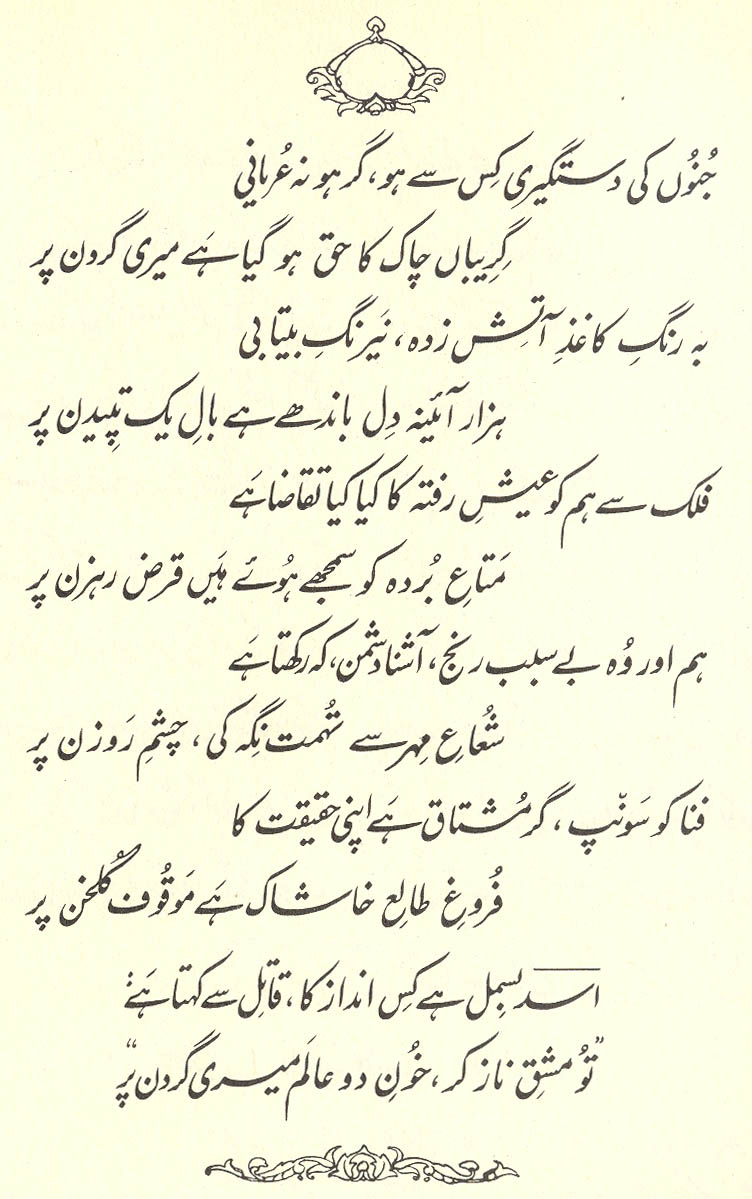
At the time of sewing a robe, one wraps a thread around the finger of the needle-- and this is a kind of courtesy. But this courtesy is in reality to present/manifest that restlessness with which the heart of the robe or the needle is filled, and shows that the heart is torn.
== Asi, p. 119
= to form a relationship, to establish friendship
The meaning is that to show courtesy is to entangle oneself in thorns and to purchase restlessness-- the way a robe, which is among the properties of courtesy/formality, even forms a relationship with the needle that constantly keeps on stitching it. The verse was created entirely through elaboration and artificiality.
In what simple language, and how clearly, Ustad Zauq has expressed this very same meaning:
[oh Zauq, in courtesy there is trouble from beginning to end
they are at ease, who do not show courtesy]
== Zamin, p. 171
= To desire.
= To tie a string on the finger is what people do in order to remember something....
Ghalib says, in his special style, that courtesy is a repeater of invitations to restlessness. For example. to wear clothing is courtesy, nakedness is discourtesy. In order to sew up a kurta, the thread wraps around the needle again and again, as if the kurta ties a thread around the finger of the needle. The pricking of the needle creates restlessness. The garment, having wrapped thread around the finger of the needle, reminds it, 'Prick again and again in my body'; and this is as if it's a summons to restlessness. In this way the kurta became a treasury of restlessness. It itself is restlessness, and it will also give a share of restlessness to the wearer. This is also a mark of courtesy; thus courtesy is nothing beyond a desire for restlessness.
== Gyan Chand, p. 209
For background see S. R. Faruqi's choices . For more on Ghalib's unpublished verses, see the discussion in 4,8x .
Here's a verse that without wordplay and what might be called image-play, would hardly even exist. And yet the wordplay is such a swamp that it still hardly exists. We have three commentators, and three quite different interpretations-- what more needs to be said?
The idea that the thread 'binds a robe on the finger of the needle' (2a) is not plausible, or even visualizable, to anyone who's ever done any sewing. (I'd bet that Ghalib never in his whole life did any real sewing.) Perhaps it's slightly easier to imagine that the robe 'binds a thread on the finger of' the needle (2b) because we can, as Gyan Chand suggests, take it as an idiomatic expressing for 'reminds'. (It's interesting that we have exactly the same 'tie a string around the finger' idiom in English.)
On Gyan Chand's (2b) reading, the robe apparently feels a commitment to courtesy or formality; it wishes to be decorously sewn up. Why is it torn in the first place? No doubt because of the lover's well-known habit of ripping open the his clothing; on this see 17,9 . The mad lover's passion is in any case associated with nakedness: remember the classic nakedness of Qais in 6,1 .
And of course, the that means 'anxiety, disquietude' literally means 'thorn, thorn', which does evoke a sewing needle (in both its shape and its piercingness). In addition, the constructions that appear in offer complexities of their own. For the meaning of is 'disquietude', which is also one of the basic meanings of . So does courtesy consist of the 'disquietude of the entreaty of disquietude'? This makes courtesy sound just as restless, in its own way, as 'restlessness' itself. Or are we to reflect on the subtle differences between and -- and if so, what are they?
Even more conspicuously, 'the entreaty of restlessness' is wildly multivalent. It can mean an entreaty made by restlessness (to someone else); or an entreaty made to restlessness (by someone else); or an entreaty that itself is restlessness; or an entreaty that pertains to restlessness in some other, unspecified way. By no coincidence, all these possibilities work variously with the second line, bringing out from it a remarkably and unfortunately diffuse array of interpretations. That first line is the kind of swamp where hypertrophied abstractions go to die.
graphics/needle.jpg