Verse 91821aa;Nhonaa
G5
In this meter the first long syllable may be replaced by a short; and the next-to-last long syllable may be replaced by two shorts.
1
alas for the 'cutting out'/destiny of that four measures of cloth, Ghalib
2
in the destiny/'cutting out' of which would be, to be a lover's collar!
'A division (one-sixteenth) of a gaz or yard, three finger-breadths'.
'Division, distribution, partition (of a thing); ... a portion, share lot; fortune, fate, destiny; divine decree'.
'Fissure, cleft, rent, slit, a narrow opening (intentionally left in clothes); —adj. Rent, slit, torn, lacerated: ... —, adj. Having the collar rent; afflicted, sad'.
'The opening at the neck and bosom (of a shirt, &c.); the breast-collar (of a garment); the heart; the bosom; (the Arabs often carry things within the bosom of the shirt, &c.; and hence the word is now applied by them to) 'a pocket' (in which sense the Turks, Persians, and Indians pronounce it )'.
'A collar; a cape; the opening or breast (of a garment); (fig.) the neck ... -- a pocket'.
'A collar, the opening or breast of a garment; a cape, a hood; (met.) the neck; a pocket'. (Steingass p.1086).
| References | |
|---|---|
| Arshi, Imtiyaz Ali | Ghazal# 23 |
| Raza, Kalidas Gupta | 327-328 |
| Nuskhah-e-Hamidiyah | 69-70 |
| Hamid Ali Khan | Open Image |
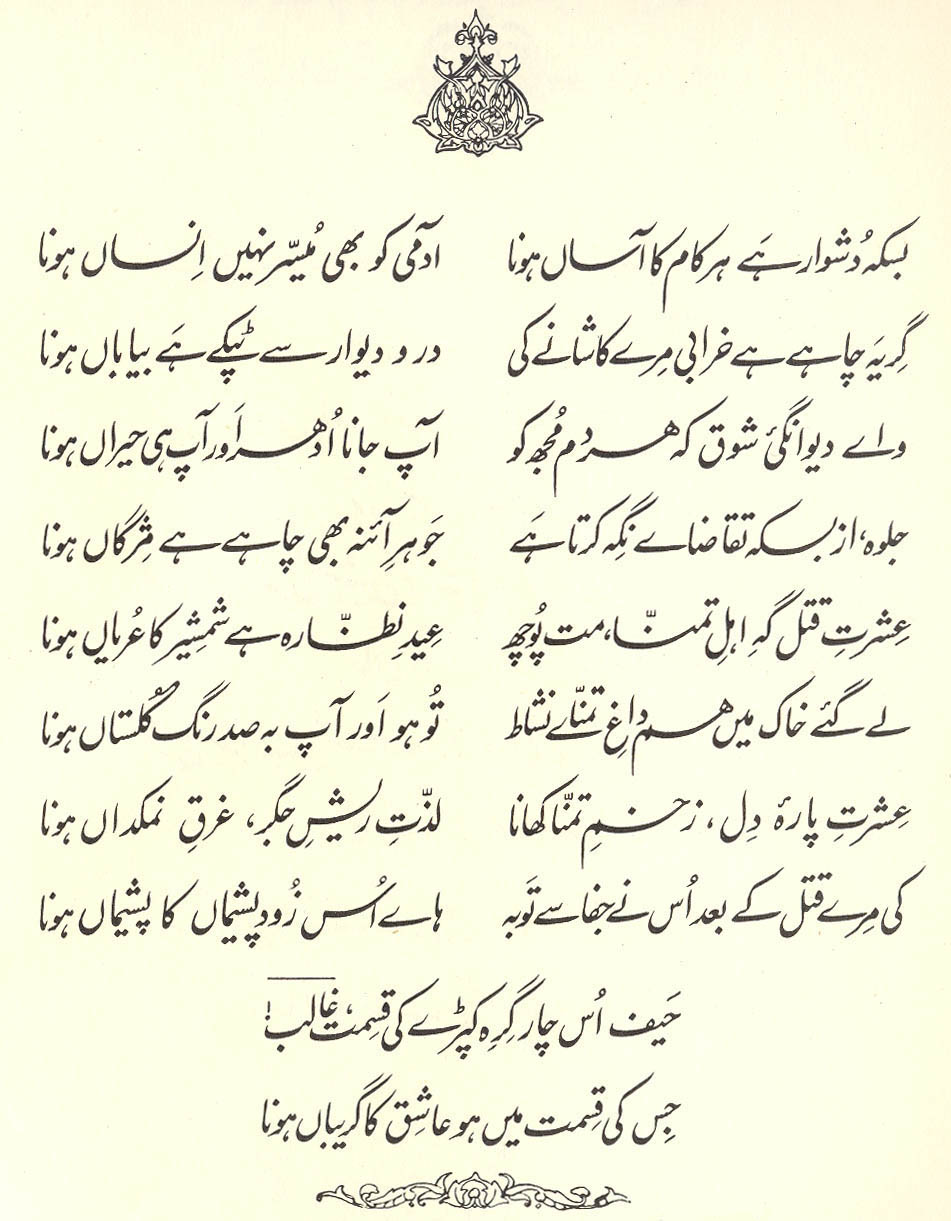
[Ghalib had served a prison term for holding illegal gambling parties in his house.] The day he was leaving there [=prison], and it was time for him to change his clothes, he tore up the kurta he had been wearing there and threw it down and recited this verse: {17,9}.
==Azad: Pritchett and Faruqi , p. 506
That is, if there's separation, then he himself tears it; and if there's union, then at the hands of the beloved's mischievousness it will be torn to shreds. (18)
== Nazm page 18

This verse is extremely fine, but the repetition of in both lines has created a somewhat unpleasing effect. (18)
This word [] cannot be changed. When things are such, then why complain of unpleasingness? Repetition of a word is not in every case a cause of unpleasingness. (43)
[On Azad's anecdote:] First, it's unhistorical, and second, even if he had been wearing prison clothes, then he wouldn't have been permitted to tear them up! (75)
If it is read in a correct way, then there is not a defect in this repetition, but a pleasure. (16)
For the lover's collar to become torn in union, and that too at the beloved's hands, is a very strange idea.... When the poet said 'a lover's collar', the vision of being torn became associated with it.... For some reason or other the use of the word in both lines of this verse is necessary; otherwise, not to speak of Ghalib-- even a poet of the second or third rank could easily have removed this word from one or the other line.... One is connected with the past, one with the future. (134-39)
An ordinary bit of cloth comes from nonexistence into existence, passes through the stages of being cut out and shaped and ornamented, and reaches the state of perfection and attains its identity (to be a collar). And then it again passes through the states and then loses its identity, and returns to being an ordinary bit of cloth.... In reality, is it four measures of cloth, or a symbol that offers us signs of the states of nonexistence, presence, perfection, decay, nonexistence?
== ( 1973: 134-39, 140-41 )
ABOUT 'PADDING': On the question of repetition and 'padding ' [], there's much to be said. Long ago when we read this verse in class, C. M. Naim pointed to Ghalib's use of a secondary meaning of , the cutting out of fabric before it is sewn into a garment; he described this as a deliberately-intended source of pleasure in the verse. Thus the verse is based not on repetition but almost on an in Mir's official sense: the use of a word with two meanings, and the reader is first led to think of the more common one, but the poet really intends (in one case) the more obscure one.
For another verse besides the present one in which Ghalib repeats a word in the second line to different effect, see 146,5x . For a verse in which Ghalib makes witty use of the idea of repetition [], see 53,11 . For a verse in which the commentators praise him for repetition (with variation in meaning) see 59,5 . For another case of repetition (one that may or may not involve padding), see the discussion in 111,13 . There's also 114,4 , in which the repetition is effective. Can we see padding in 4,6 , as Josh claims? Do we really need the in 145,3 , or the in 216,5x ? We certainly don't need the in 164,6 -- or, more egregiously, the one in 226,8x . Do we really need the in 147,3 , or the in 174,8 ? Consider 234,7 as well, though I think we can save the verse from the accusation. In 200,1 , Nazm actually praises Ghalib for a deliberate repetition. For a real case of padding, see 84,3x . Another real and flagrant case: in 360x,4 .
See also the discussions of padding in Mir's verses .
In the present verse, Azad's completely apocryphal anecdote (no doubt a back-formation from the verse itself and the fact of Ghalib's imprisonment) purports to show Ghalib's wit. Actually, since Azad dislikes Ghalib, the anecdote permits him to remind us of the poet's humiliation and disgrace. Mihr's literal-minded response tickled my fancy. For another such Azadian anecdote, see 90,3 .
Hearing or reading the first line, we would think of the common meaning, 'destiny'. But the second line would then cause us to go back and re-examine and re-imagine the use of the same word in the first line. For even in the work of a mediocre ghazal poet, there's no room for such blatant padding as to use the same word twice for no reason; and as Naiyar Masud observes, in the work of a master the possibility can be ruled out immediately. To reconsider and remember its literal meaning of dividing, making into pieces, sharing out (the obvious source of its metaphorical meaning of portion or 'destiny'), is the natural next step; we can hardly help but think also of the related , which has come to mean, among other things, 'Partition'.
At this point we become involved in examining the full range of meanings of a single word, from the most literal to the most metaphorical. How is the cutting out of fabric, and/or the ripping apart of fabric, like the cutting out and ripping apart of our destiny? Naiyar Masud waxes existential about the four measures of cloth and the four stages of life. We could of course keep on pointing out other similarities, one of the chief of which is our human helplessness and inability to escape either from the pain of creative change (as of fabric being cut out to make a collar) or from the irreversible suffering of destruction (as of a collar being ripped apart and destroyed).
Compare 145,12x , another verse about the cutting-out of garments. Compare also Mir 's whole ghazal with the refrain of : M 318 .
ABOUT : Being cut out, stitched into a garment, and later ripped apart into a rag might seem to be the destiny of many kinds of fabric (and, metaphorically, of all of us)-- so why the emphasis on the evil destiny of the lover's collar in particular? No doubt because its lifespan is destined to be so abnormally short, and its ripping-apart so elaborate and painful. The lover tears it because he's in deep grief, and rending one's garments is a classic sign of grief; and also because in his madness he feels suffocated, and wants to remove all constrictions so that he can breathe; and also just because he's mad, and madmen often do tear off their clothes, in a classic symptom of their condition.
The English word 'collar' is not an ideal translation: what's really meant is the kind of long, narrow, vertical, slit-shaped neck-opening that a kurta has. This kind of neck-slit used to be called a (see the definition above); then by extension the word came to refer to a pocket made along a seam (the kind that are found in kurtas), and then to any pocket, so that in modern Urdu chiefly means 'pocket'. An amusing back-formation account of this process is provided by Zamin in 24,10x .
An opening with this neck-slit shape is especially, invitingly, tearable: grabbing the two sides and giving a strong pull would make a long, dramatic rip that would start at the bottom of the opening and run all the way down the chest. It's also important to think of this kind of long, narrow neck-opening because of other 'tearing of the collar' verses that make significant use of the shape, comparing it for example to the first bright 'crack of dawn' that lies like a white line along the dark horizon; on this see 67,1 .
Here's a nineteenth-century fine muslin kurta, embroidered with white knotwork flowers too delicate to be seen in this photo:
graphics/kurta.jpg
And here's another nineteenth-century kurta, from the Met's collection:
graphics/kurta2.jpg