Verse 61821aa;Nhonaa
G5
In this meter the first long syllable may be replaced by a short; and the next-to-last long syllable may be replaced by two shorts.
1
we took away into the dust the wound of the longing for growth/vitality/joy
2
may you live/be! and [your]self must, with a hundred colors, {rejoice greatly / 'be a garden'}
t>> : 'Liveliness, sprightliness, cheerfulness, gladness, glee, joy, pleasure, exultation, triumph'.
t>> : 'Growing; being produced; springing up, appearing; —anything growing, or produced; —a product; a creation; —a creature'.
'Self, himself, oneself, itself; he himself, you yourself, they themselves'.
'To be delighted, to rejoice exceedingly'.
| References | |
|---|---|
| Arshi, Imtiyaz Ali | Ghazal# 23 |
| Raza, Kalidas Gupta | 327-328 |
| Nuskhah-e-Hamidiyah | 69-70 |
| Hamid Ali Khan | Open Image |
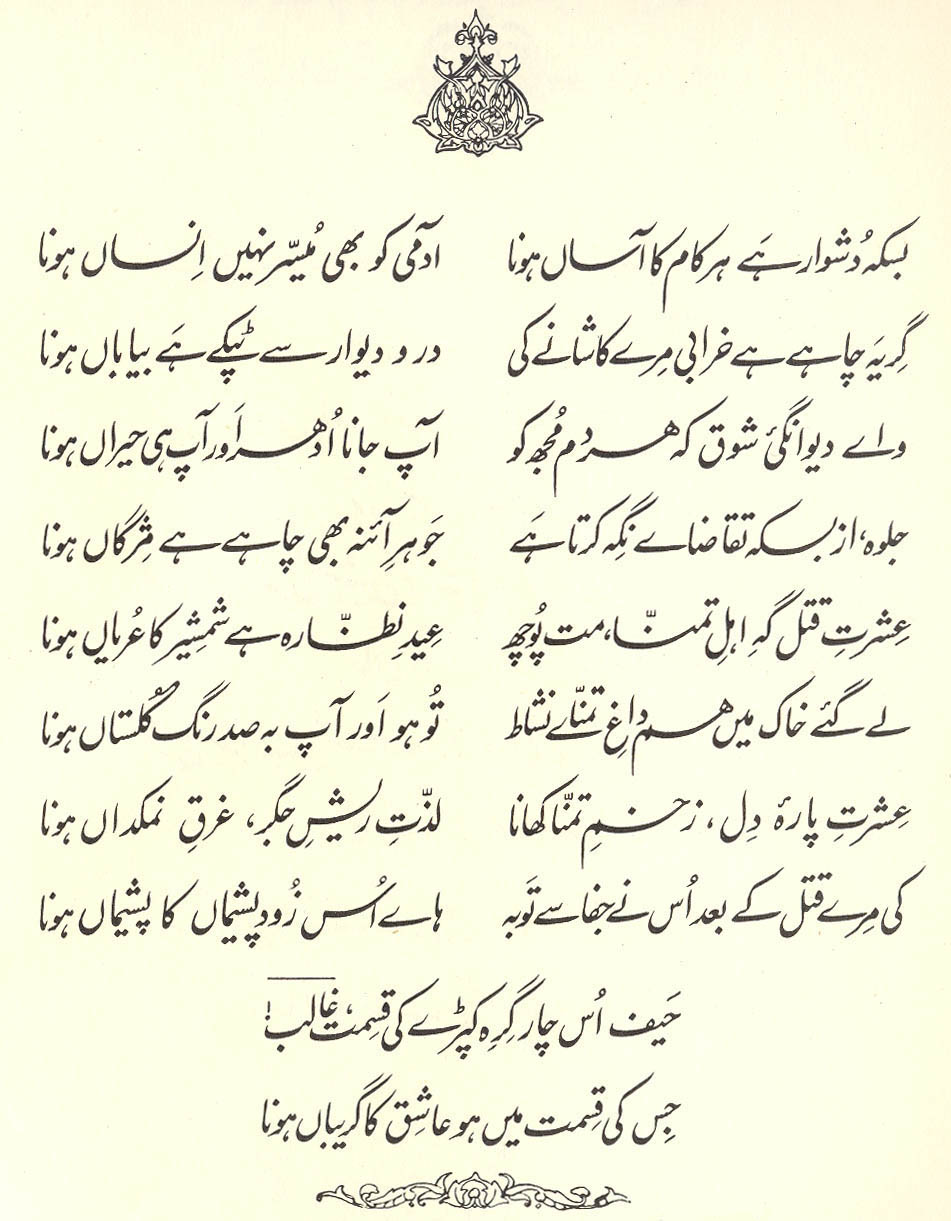
That is, I have taken my wound and departed; now you can flourish, and you're welcome to it; and this is the idiom. Replacing 'to flourish' [, lit. 'to become gardens'] with 'to become a garden' [] is the writer's special usage. (18)
== Nazm page 18

That is, you have killed the people of desire by keeping them in a state of longing. Now, be the only observer of your own springtime.... should be considered a translation of [the Persian] [which means] 'an extremely flourishing spring'.
[Or:] Well, you deprived me of the joy of union, but I'm not your ill-wisher. Even now I give you this blessing: may you ever flourish. (42)
A wound has been given the simile of a rose. Here, 'color' has the meaning of 'style'. But this too has come from the wordplay of wound and rose, and like this usage too is very captivating. He says, we have taken the wound of our longing for repose into the dust. Now you're welcome to remain and flourish in a hundred ways. (74)
As Nazm notes, 'Replacing 'to rejoice greatly' [, lit. 'to become gardens'] with 'to become a garden' [] is the writer's special usage'. Ghalib evokes the familiar idiom-- and also gives it a twist, by paraphrasing it. By hovering over the verse the idiom becomes far more piquant than it would be if it were simply present. Thus the idiom is both there and not there; it's somewhat like an usage.
The lover took the wound of longing 'into the dust' or dirt, so that he will be 'pushing up daisies'. Or, more elegantly, he will become the ground of the kind of lavish joy that the beloved is to feel. But why exactly? To show her that his passion continues beyond the grave? To shame or punish her, by reminding her that she has slain a lover with such a longing for 'vitality'? Or simply to make sure that she remembers him?
The possible questions go on and on. Is his death from the wound of longing perhaps the source of her brilliance and glory? Will she be more radiant and joyous after (and because of) his death than she ever was before? Will the red blood of his wound help to color her garden?
And above all, what is the tone of the second line-- is it a blessing ('may you flourish!'), or a curse ('take your fancy garden and shove it!)? The mood is (designedly of course) impossible to pin down. For a verse that follows similar lines of imagery about dust and flowers, see one of his all-time masterpieces, 111,1 .
For more 'you and I' verses, see 71,2 .
Compare Mir 's line, which is another tour de force of ambiguity: M 178,4 .
graphics/rosecolors.jpg