Verse 4after 1847uukyaa hai
G9
In this meter the next-to-last long syllable may be replaced by two shorts.
1
the robe is sticking onto the body with blood
2
now what need does our neck-opening have for darning/stitching?
'The opening at the neck and bosom (of a shirt, &c.); the breast-collar (of a garment); the heart; the bosom (the Arabs often carry things within the bosom of the shirt, &c.; and hence the word is now applied by them to) 'a pocket'.'
| References | |
|---|---|
| Arshi, Imtiyaz Ali | Ghazal# 219 |
| Raza, Kalidas Gupta | 404-05 |
| Hamid Ali Khan | Open Image |
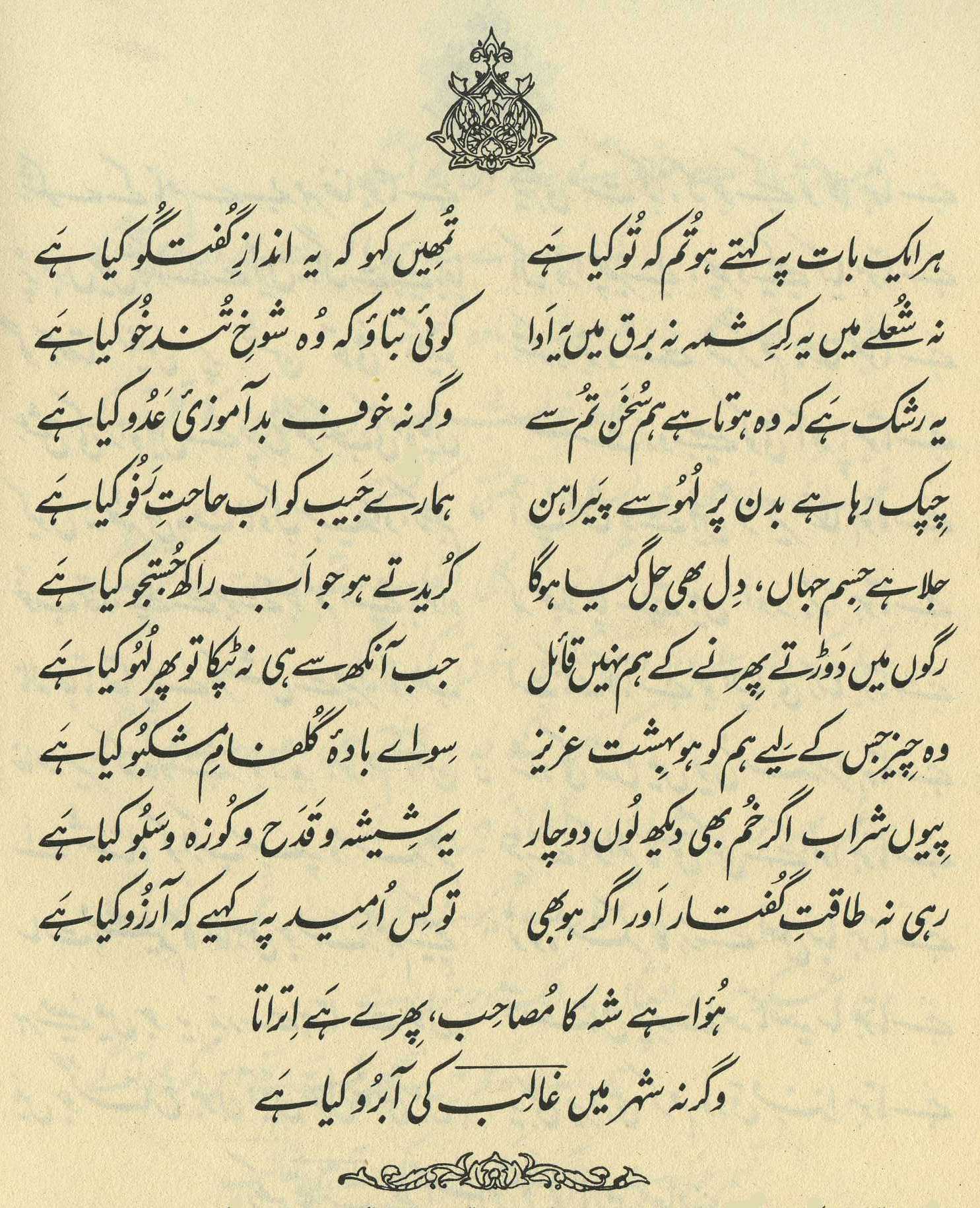
In this verse one error is that he did not give any reason for the blood flowing out. That boys struck him with stones and made the blood flow; or that he himself has bashed his head against a wall, or wept tears of blood, or kept beating his breast till he wounded it, or when tearing his collar scratched himself with his fingernails-- all these are possible. But from not providing a reason, an unenjoyableness has been created in the verse. (200-01)
== Nazm page 200 ; Nazm page 201


In this verse the excellence has been created that because of madness, the cause of the outflowing of the blood is not known to Mirza Sahib himself. For this reason, he cannot express it. No telling whether at the time of tearing the collar his breast has been scratched by his fingernails, or it was because of boys' throwing some stone; or he may have heedlessly fallen into some thorn-bushes, or wept tears of blood. From their not being mentioned, all these specific causes become more enjoyable. (259)
[Disagreeing with Nazm:] I want a hundred-thousand-fold to understand, but I don't understand. My worthless opinion is that not to mention any special reason is precisely eloquence []. If the reason is specified, then all these ideas that Nazm mentions, and those that remain (for example, for the lancet to slip when he is being bled for the frenzy of his madness)-- how could they be contained within one verse? The verse is a depiction of the state of a madman-- there is a 'proof' in it, but with the power of madness. And this was just the thing that ought to have evoked love. I'm astonished at how Janab the Commentator sees unenjoyableness in such a focused and attractive verse.... On the state of a madman, this verse is peerless. (352)
Bekhud Mohani likes nothing better than to take on Nazm, so it's no surprise to see him join battle here. But it's unusual to see him seconded by Bekhud Dihlavi, who ordinarily borrows heavily from Nazm. I can hardly recall that Bekhud Dihlavi has done anything like this since all the way back in 1,1 . The discussion illustrates the fine line in a verse between the kind of bland, un-grounded vagueness criticized by Nazm (a substantial flow of blood, sufficient to saturate a whole garment, requires some explanation), and the kind of desirably subtle multivalence envisioned by the two Bekhuds (the reader is left to imagine, enjoyably, which of the many possible causes might have produced the sticky blood).
This is also a verse of what I call 'grotesquerie', one in which the somewhat revolting physicality detracts from the literary effect. The vision of the lover's whole body coated in blood, such that his robe is literally plastered to his skin with sticky blood, is, to me at least, distracting and off-putting. That verb is so strong, so plain, so vivid! And its being in the present progressive tense makes the whole thing seem to happen before our eyes.
The second line asks a question that has two obvious answers. On the direct physical level, perhaps the lover's clothing indeed doesn't need any stitching any more, because it adheres so well to his body by means of the sticky blood. (Though in that case it will probably stiffen and cease to adhere once the blood has thoroughly dried-- though, again, if the blood is constantly flowing, perhaps it will never dry.) And on the more abstract level, if the lover is now so far gone that his whole body is bathed in blood, he'll never need to worry about his garments any more, since he'll soon be wrapped only in a shroud-- so indeed, why should he bother about his torn collar?
graphics/bloodyshirt.jpg