Verse 5after 1847uukyaa hai
G9
In this meter the next-to-last long syllable may be replaced by two shorts.
1
where the body has burned, even/also the heart will have burned
2 a
since you now rake/poke the ashes, what is the 'search' [for]?
2 b
if you now rake/poke the ashes-- this is hardly a 'search'!
'To scratch, scrape, rake, poke, stir (a fire, &c.); to scrape or scratch up (with a rake or other instrument); to grub up or out, to explore'.
'Searching, seeking; search, inquiry, quest, scrutiny, examination, investigation'.
| References | |
|---|---|
| Arshi, Imtiyaz Ali | Ghazal# 219 |
| Raza, Kalidas Gupta | 404-05 |
| Hamid Ali Khan | Open Image |
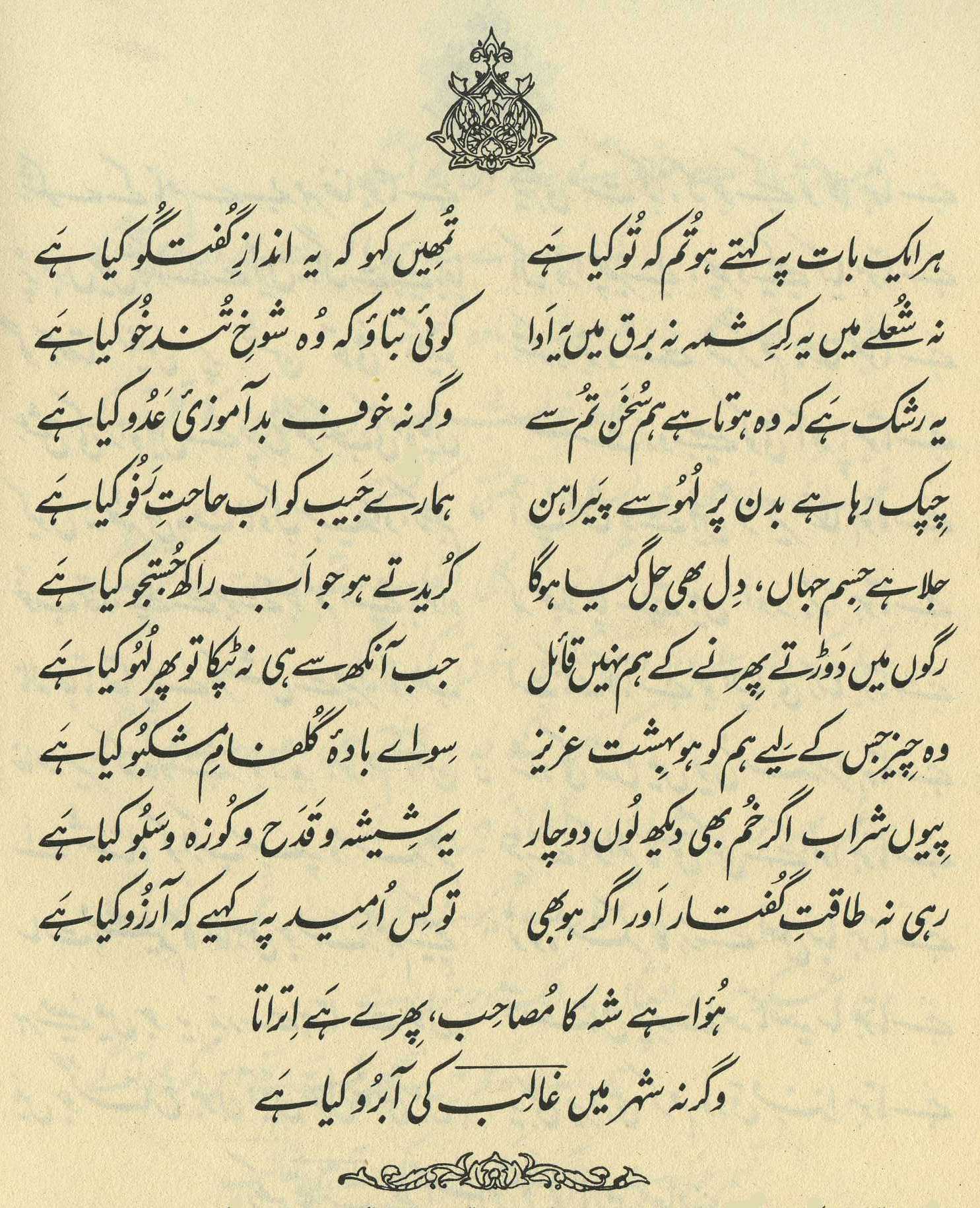
Among Urdu-knowers there are very few people who can look at a book on rhetoric [] and understand it; rather, they themselves have decreed some faults of poetry according to their own taste, the foundation of which is on wordplay [].... Such nit-picking people will certainly say about this verse of the author's, 'Is it a chicken, that it pecks at [] the ground?'
The meaning of the verse is that from the burning of grief I have burned and become ashes. The heart too will have burned up. The practice of stealing hearts has put in your mind the illusion that the heart will not have burned, and it ought to be searched out and taken away for burning. And this theme is unreal from start to finish, and is not one of the normal actions; for this reason it's unpleasurable. In verse, something that has passed away gives more pleasure. (201)
== Nazm page 201

He says, 'Where the body has burned, there the heart too will have burned. Now, since you are sitting there and raking/poking the ashes, what is your 'search', for what are you seeking?' (259-60)
The poet composes not merely his autobiography, but also the history of his times []. Mirza too is Indian [], and neither Arab nor Persian. Among the Hindus there's the custom of burning the corpse, and among them only/especially the woman has been accepted as a lover....
[Disagreeing with Nazm:] Hazrat the Commentator has given such a meaning that the power of investigation can't be content with it. About this verse he has decided that this theme is entirely unrealistic and is not one of the normal actions. But after looking at what the unhappy Bekhud has written, probably [] nobody will any longer doubt that this theme is entirely realistic. A historical event has also come to mind-- here it seems necessary to write it too:
EVENT: When Ala ud-Din brought his army against Rana Chitor for Padmini, and destiny defeated the Rajputs, then Padmini took her husband's head in her lap and became a Sati. When Ala ud-Din arrived in the royal palace, then in Padmini's place he saw a heap of ashes, which he was absent-mindedly poking here and there with the tip of his sword, and Padmini's spirit, in the 'language of her state', was saying to him, {178,5}.
Another historical example of enmity and revenge is worth keeping in mind. When in battle Hazrat Hamzah, the uncle of the Prophet, was martyred, then Hindah chewed on Hazrat Hamzah's liver; and beyond that, what she did-- good manners don't permit it to be written. While such events are there, to call such themes unrealistic and abnormal is great presumptuousness. The words of the verse have not required anybody to close his eyes, while explaining the meaning, to all the world besides lover and beloved.
Janab Hasrat: is a commonplace/vulgar [] word. [Hasrat has not said this in his commentary, however. --FWP] In this situation, no other word of this meaning will be able to be found. And eloquence [] will not permit the use of any other in this situation. This word is on the tongues of common people, just as it is on the tongues of the elite. (353-54)
That plain, forceful, physical, almost chicken-scratching word indeed seems to be at the center of the verse. The commentators read it as describing a search for something that might be lying there amidst the ashes-- something like a scorched, blackened, shrivelled heart. But has another sense as well (see the definition above): that of poking up a fire, of stirring up embers-- of perhaps seeking to rekindle old passions. And it has a final sense of groping around in something, exploring it-- a sense that is elegantly echoed in . On the versatility of , see 12,2 .
Needless to say, all those senses work well with the protean question . The range of meaning here is even greater-- in fact, it's truly remarkable. Here are some possible readings:
='What or whom are you searching for?'
='What is the meaning of the 'search' itself?' (In a situation of such total devastation and impossibility, can there even be such a thing?)
='It's not as if this is a search-- this is hardly a search!' (It's something else entirely-- cruelty? attempted torture? idle curiosity? passing nostalgia?)
='What a search it is!' (How extraordinary, or quixotic, or doomed, or admirable, or infuriating, etc.)
Moreover, these questions are real, and arresting, and quite compelling once you start thinking about them; in all their glory they open up a whole range of possibilities. They open them all up-- and, needless to say, don't shut any of them down.
All the words beginning with create a nice kind of sound effect, and culminate of course in . There's also a kind of rushed sense in which sounds as if what has burned is 'the body, the world, the heart too'. Of course we go back and retrospectively redo our reading of , but the first time through, there's almost have the sense of a cosmic conflagration.
Compare the radical nature of the destruction in 5,2 ; and the 'digging/investigation' in 13,7 . But above all the present verse reminds me of 17,8 : it could very well embody the 'repentance of that quick-repenter'.
We know of course that Ghalib greatly admired Bedil . In a discussion on the Urdulist (Nov. 2015), Kamal Abdali observed that the present verse was often considered to be influenced by Bedil's only known Urdu verse:
[it's been ages since it has become dust in an inner burning
now you seek for the heart-- now where in us is the heart?]
For those interested in further Bedil-and-Ghalib research, he recommended the papers in this * volume edited by Shaukat Mahmud *.
graphics/ashes.jpg