Verse 21816ilkaa
G2
1
in proportion to capacity, Cupbearer , is even/also the intoxication/hangover of thirsty-throatedness
2
if/since/when you are a sea of wine, then I am the stretch/yawn of the shore
'Greatness, dignity, honour, rank, power; importance, consequence; worth, merit; estimation, appreciation, account; value, price; —measure; degree; quantity; magnitude; bulk, size; portion, part; —whatever is fixed or ordained of God, divine providence, fate, destiny'.
zarf>> : 'Ingenuity, skill, cleverness; beauty, excellence; ... capacity, capability; a receptacle, vessel, vase'.
'Intoxication; the effects of intoxication, pain and headache, &c. occasioned by drinking, crapulence, crop-sickness; headache or sickness (arising from want of sleep, &c.); languor; languishing appearance of the eyes (the effect of drinking, or of drowsiness, or of love, &c.); languishing look'.
'Who, which, that, what'.
'When (= ); whenever'.
'If, if that, that; in that, inasmuch, since'.
'Stretching; yawning, gaping'.
| References | |
|---|---|
| Arshi, Imtiyaz Ali | Ghazal# 16 |
| Raza, Kalidas Gupta | 151 |
| Nuskhah-e-Hamidiyah | 59-60 |
| Asi, Abdul Bari | 64 |
| Gyan Chand | 95-97 |
| Hamid Ali Khan | Open Image |
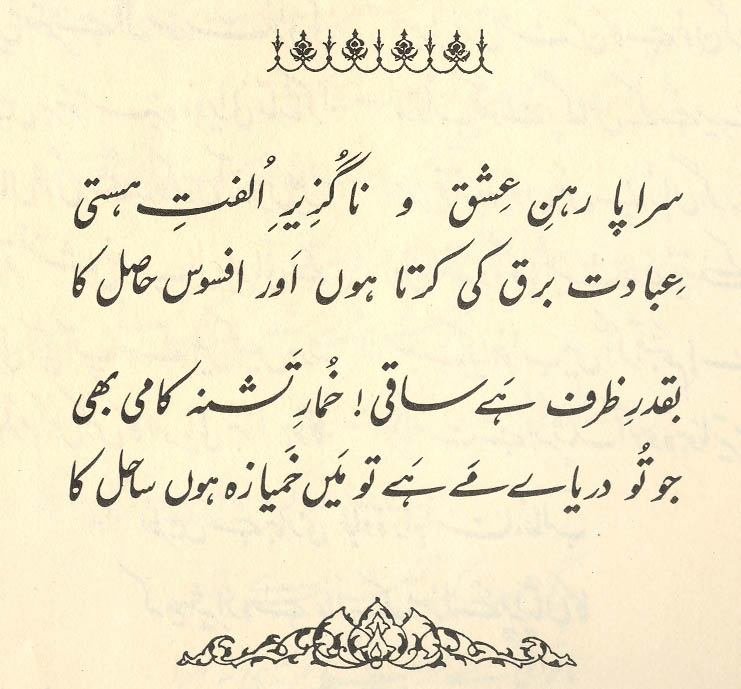
The thirst of the shore is well-known, and its twisting and twisting back create the aspect of stretching. And stretching is a symbol of intoxication. The meaning is that however great your zeal may be in serving wine, my zeal in drinking is equally great. (13)
== Nazm page 13

Urdu text: Vajid 1902 {12}
The Cupbearer can be God Most High.... Compare 60,11 . (25)
If you are a sea of wine, then I am the shore of that sea of wine, and the characteristic of a shore is that despite the nearness the generosity of the sea, it's never filled. Rather, by its crookedness it stretches, for its intoxication is waning and it needs more wine. (40)
[Discussing 47,2 :] One interesting thing is that Ghalib, at this same period, had composed a verse that was based on entirely an opposite theme from this verse. But its aspect and metaphor s are precisely those of the verse under discussion: {12,2}.
== 2006: 60-63
ABOUT : On the multivalence of , see Platts's three definitions given above. The first one is the usual relative pronoun one, while the others range through 'when, whenever, if, since, in that'. In this latter, non-relative-pronoun use, is a substitute for , and thus can be temporal ('when'), causal ('since'), or propositional ('if'). This wide range offers the poet further degrees of interpretive flexibility. Compare the similar flexibility of , in 39,4 ; and of , discussed in 53,8 .
ABOUT AND : Both words are associated with intoxication, in idiomatic, complex, and often ambiguous ways (see the definitions above). See for example how Nazm uses in his commentary on 169,7 . Of the two words, is particularly multivalent, since it can mean both 'intoxication' and something like a 'hangover' (which in widespread folk belief may often be 'cured' by drinking more wine, the ' hair of the dog ' treatment); for examples of such ambiguous use of the term, see 3,6 ; 170,2 ; 278x,3 ; 372x,2 ; 441x,8 . For other linkings of , , the , and a sea of wine, see 18,1 and 360x,7 . A verse with all those elements except the Cupbearer: 29,9x . Verses with both and : 228,13x *; 440x,5 . More examples: 16,9x ; 29,9x ; 42,11x ; 44,4x ; 67,3 // 361x,5
These colloquially complex words and are wonderfully evocative here-- the speaker has now drunk up whatever the Cupbearer has poured out, but is already feeling bored, sated, ready for some new thrill. He yawns and stretches, and looks about him restlessly. Will he crave another whole bout of drinking, beyond what even the Cupbearer can provide, or will he turn in some other direction?
Bekhud rightly points to 60,11 for its mystical implications, but both verses also emphasize the importance of as 'capacity' in a broad sense, as a measure of what someone can hold or bear. The 'intoxication of thirst' suggests that even without (enough) wine-- and it seems that there can never be enough-- the man of knows the intoxication of his own thirst, his own passion and desire.
That second line is the chief glory of the verse. The first line is so abstract that the listeners can hardly process it quickly or make much sense of it. By contrast, the second line is-- when, after the usual tantalizing mushairah delay, the listeners finally get to hear it-- vivid and colloquial, setting up a strong visual and aural image of the way the shore endlessly 'drinks' the lapping waves. How could the seashore not be a match for the sea, in breadth and depth and sinuousness? As is proper in a true 'mushairah verse', the line withholds its punch-word, , until the last possible moment. Only when the listeners hear the very end of the second line can they put the whole image together. It's easy to imagine that they would have called out !
graphics/seashore.jpg