Verse 21821aarnahii;N hai
G17
1
they/we give Paradise in exchange for the life of the world/time
2
the intoxicant/intoxication is not in the proportion/style of the hangover/intoxication
'Time; a long period of time; an age; eternity; fortune, fate; chance, adverse fortune, misfortune, calamity, adversity; danger; — custom, habit, mode, manner; care, solicitude; the world'.
'To change, alter; to exchange, barter; to substitute one thing for another'.
'Intoxication (lit. and fig.), drunkenness; --headache or crop-sickness (from over-drinking); --intoxicating liquor or drug, an intoxicant'.
'Measure, measurement; quantity; weighing, weight; degree, amount; valuing, valuation, value; rough estimate; conjecture, guess; proportion, symmetry; elegance, grace; mode, manner, style, fashion, pattern'.
'Intoxication; the effects of intoxication, pain and headache, &c. occasioned by drinking, crapulence, crop-sickness; headache or sickness (arising from want of sleep, &c.); languor'.
| References | |
|---|---|
| Arshi, Imtiyaz Ali | Ghazal# 145 |
| Raza, Kalidas Gupta | 348-49 |
| Nuskhah-e-Hamidiyah | 207 |
| Hamid Ali Khan | Open Image |
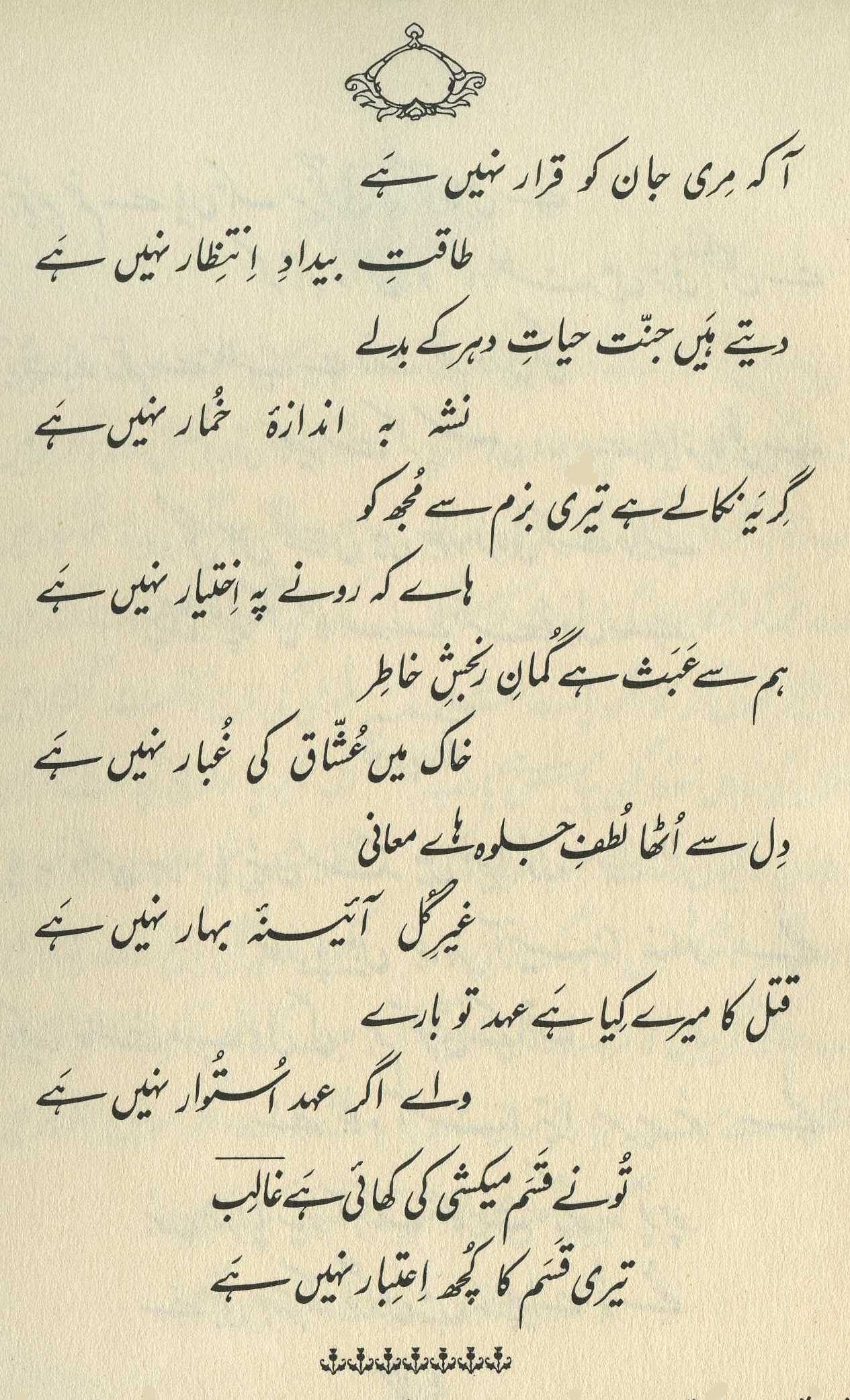
That is, those troubles that are in the life of the world-- they cannot receive compensation by going to Paradise. Then he gave an illustration [] of this: that person who would have experienced the trouble of a great hangover [], if he would get a little wine, then what intoxication [] will he experience? (191)
== Nazm page 191

He says, in recompense for the life of the world, Paradise will be bestowed. But the recompense for worldly troubles cannot be received from Paradise. And the illustration of this saying he presents as: the one who would have experienced to the extreme the difficulty of the decline of intoxication, and after that a little wine would be given to him-- what intoxication will he experience? (246)
[Nazm's interpretation, or:] Paradise cannot compensate for the life of the world, because the pleasures of this place are considerably greater than the pleasures of that place. There, there will be full power over Huri s. Here, there is the complete danger of dealing with beloveds. There, is there fear of being displaced by the Rival , the fear of separation, the thought of disgrace, the anxiety of waiting, etc. etc.? These things are such as give pleasure to mankind. And the world knows that when there is full control over the thing desired, then ardor no longer remains. (333)
The rule is that to whatever extent the intoxication [] has abated, to that extent the drinking of wine gives comfort. He has given the illustration of life as a hangover [] and Paradise as intoxication []. (292)
Only the habitual drinker can properly realize, that when intoxication [] abates, with regard to body and mind what a Doomsday occurs. However severe the hangover [] would be, if to that extent wine would not be available, then the troubles will not be removed. Exactly this reality has been presented in this verse. (562-63)
The first line tells us merely that 'they' or 'we' give A in exchange for B. The sense of 'in exchange for' [] is neutral (see definition above); there's not the smallest hint as to whether this exchange is good or bad, desired or undesired, fair or fraudulent. Nor do we know who or what the (masculine plural) subject is-- God? Human destinies? Theologians? People could even be arranging the matter for themselves (by giving up Paradise and preferring worldly life).
The second line seems to present an 'illustration' []-- something offered as an aphorism or colloquial saying or lively example drawn from the real world. Except, of course, that this particular one, when juxtaposed to the first line, is undecideable. It has the logical form of 'C is not in the proportion/style of D'. Both C and D are complex, multivalent words, and the relationship between them is also variable (does 'not in the proportion/style of ' mean too great, too small, too different, or something else?). Thus it's possible to choose among their meanings, and match them up interpretively with A and B, in a number of ways. For it's not even clear whether C should be the world, and D should be Heaven-- or the other way around.
The commentators generally seem to rely on the cultural notion of a hangover cure, something like 'the hair of the dog that bit you': according to how bad your hangover is, and/or how much your previous intoxication has abated, that's how much wine you should then drink, in order to restore your equilibrium. On this reading, the re-intoxication or fresh wine (of Heaven) is not 'in proportion to' the hangover or previous intoxication (of worldly life). But why is it not? Maybe because it's insufficient, since the 'hangover' of earthly life was so bad that Paradise doesn't suffice to make up for it (as most commentators claim). Or maybe because it's unsatisfying, since the 'intoxication' of earthly life was so full of relish that Paradise can't match it (as Bekhud Mohani argues).
And there are still many more possibilities, since both ( with the doubled to fit the meter) and have a variety of meanings: both can mean 'intoxication' in general, and both can refer to the unpleasant side effects or aftermath of intoxication (see the definitions above). The former can also mean an 'intoxicant' (a sense that works very enjoyably in the present verse); the latter has more overtones of a physical hangover.
Here are a few additional obvious readings:
=We're only allowed to have a brief, brilliant time of 'intoxication' in the world, and then we're stuck with a hugely disproportionate 'hangover'-- a draggy, headachey interval that we're forced to spend in Paradise.
=Indeed we're a bit 'hung over' from our life in the world, but the 'cure' offered by a stint in Paradise isn't at all suitable or appropriate-- what we need for a hangover cure is more of the same wine, not something else completely different.
=We give up all claims to Paradise, in favor of living in and for this world; for we know that Paradise is not all it's cracked up to be. Visions of Paradise (or maybe even Paradise itself) can be compared to bad wine: the 'intoxication' isn't delightful enough to compensate for the 'hangover'.
This verse belongs to the 'snide remarks about Paradise' set; for discussion, see 35,9 .
graphics/hangover.jpg