Verse 91821aryaad aayaa
G11
In this meter the first long syllable may be replaced by a short; and the next-to-last long syllable may be replaced by two shorts.
1
what a fight there will be with Rizvan !
2
if your house, in Paradise, would come to mind/recollection
the perfect, is a colloquial substitute for the subjunctive ( GRAMMAR )
| References | |
|---|---|
| Arshi, Imtiyaz Ali | Ghazal# 27 |
| Raza, Kalidas Gupta | 328 |
| Nuskhah-e-Hamidiyah | 74-75 |
| Hamid Ali Khan | Open Image |
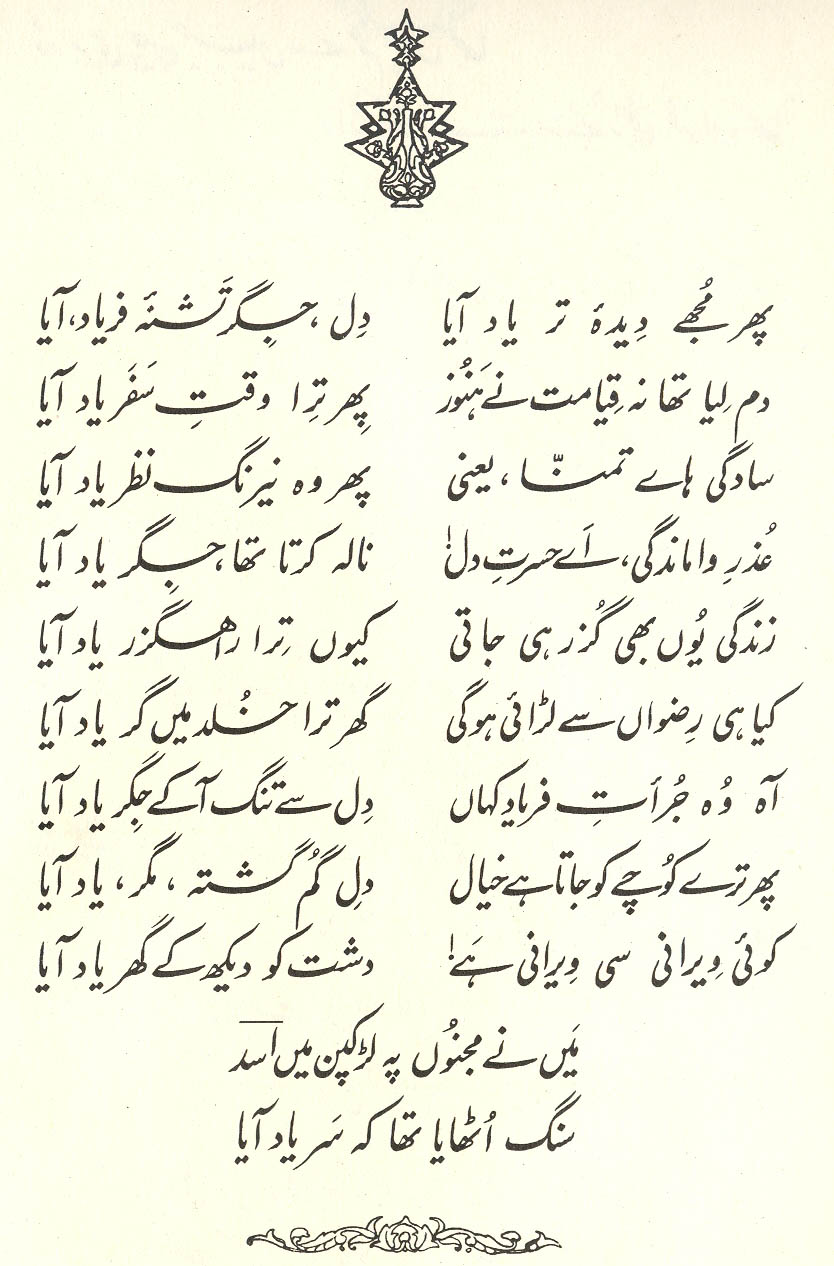
That is, he will give preference to Paradise, and I to your house. Or else that I will want to come out of Paradise and he will stop me. (35)
== Nazm page 35

In this verse Mirza Sahib has used his customary mischievousness, through which two meanings have been created for the verse. One is that when in Paradise I remember your house and mention it to Rizvan, Rizvan will prefer Paradise to your house. What the hell []-- how could I accept that? There will certainly be a fight between us: he will give me the lie, I will give him the lie, until it goes so far that a fight takes place.
The second subtle meaning that emerges is that when in Paradise I remember your house, then I will want to run away from Paradise; Rizvan will stop me, and we'll have a fine wrestling match. (68)
Two things in this verse are very praiseworthy. One is that the poet has complete confidence about going to Paradise. The second is that in Paradise he has no hope of seeing the radiance and flourishingness of the beloved's house. (102)
Compare 101,9 . (176)
SNIDE REMARKS ABOUT PARADISE: This is one of a number of verses that make snide remarks about Paradise. It's the direction of comparison that makes for the wit. Instead of the earthly, human derivative being seen as borrowing or reflecting a tiny fraction of the excellence of the superior heavenly paradigm, it's the other way around. More examples: 10,1 ; {35,9}; 100,6 ; 101 ,9 ; 111,7 ; 118,2 , throw it into Hell; 124,6 ; 154,2 ; 159,1 ; 170,2 ; 174,10 , 'to keep the heart happy'; 178,7 ; 219,3 ; 231,3 // 280x,3 ; 348x,5 , extra trouble (Hell too); 413x,4 ; 413x,6 ; 413x,7 *, add Hell to it. For many examples of similarly snide remarks about Doomsday, see 10,11 .
ABOUT THE PERFECT TENSE USED FOR THE SUBJUNCTIVE: In the second line, is clearly a perfect form. But from the context it's equally clear that the intended sense is the future subjunctive, . The use of the perfect for the future subjunctive in 'if' clauses is very common nowadays, and obviously was so in Ghalib's day as well. A few more examples, out of many: 4,1 ; {7,5 ; 10,4 ; 25,5 ; 25,6 ; 51,1 ; 71,9 *; 102,1 ; 111,7 ; 111,12 ; 111,15 ; 111,16 ; 136,1 ; 174,3 . Compare 73,4x , in which seems to be used for the contrafactual.
Besides its charm, playfulness, and ease, this would be a good mushairah verse for another reason as well: because we can't tell from the first line where the second will go.
In Paradise, the beloved's house might or might not come to mind. After all, her house is so much more desirable than Paradise that only at its best might Paradise manage to evoke a memory of her house. But the lover is prepared for the occasion to arise. He imagines himself standing in the same relationship to the beloved's house as Rizvan does to the Garden of Paradise, and having as much reason to defend its honor as Rizvan has to defend that of Paradise. What else would they do but fight?
Or else, as Bekhud Dihlavi proposes, the lover might even seek to run off from Paradise to return to the beloved's house, and Rizvan might try to stop him.
The relish is in the lively colloquialness of the first line; there are also the enjoyable sound effects of and (short for ) in the second line.
Here's my long-ago attempt at a translation (1985) .
graphics/paradise.jpg