Verse 11after 1826aa;Nkaa
G2
1
no telling which ones' blood will have turned to water--
2
it's a disaster/'Doomsday'-- your eyelashes' being tear-wetted!
'The resurrection, the last day; --confusion, commotion, tumult, uproar, extraordinary to-do; anything extraordinary; a scene of trouble or distress; a great calamity; excess; --adj. & adv. Wonderful; excessive, very great; heavy, grievous, oppressive; --wonderfully; excessively, extremely, very'.
| References | |
|---|---|
| Arshi, Imtiyaz Ali | Ghazal# 37 |
| Raza, Kalidas Gupta | 369 |
| Hamid Ali Khan | Open Image |
That is, who has the strength to see your eyes full of tears? And he has also suggested that since the beloved's eyelashes always prick the lovers' hearts and livers, and her tears are those very tears that were produced in the lover's heart and wanted to come to the eyelashes. That is, the tears on your eyelashes did not come from your heart, but rather are those that were produced in the lovers' hearts and livers. (12)
== Nazm page 12

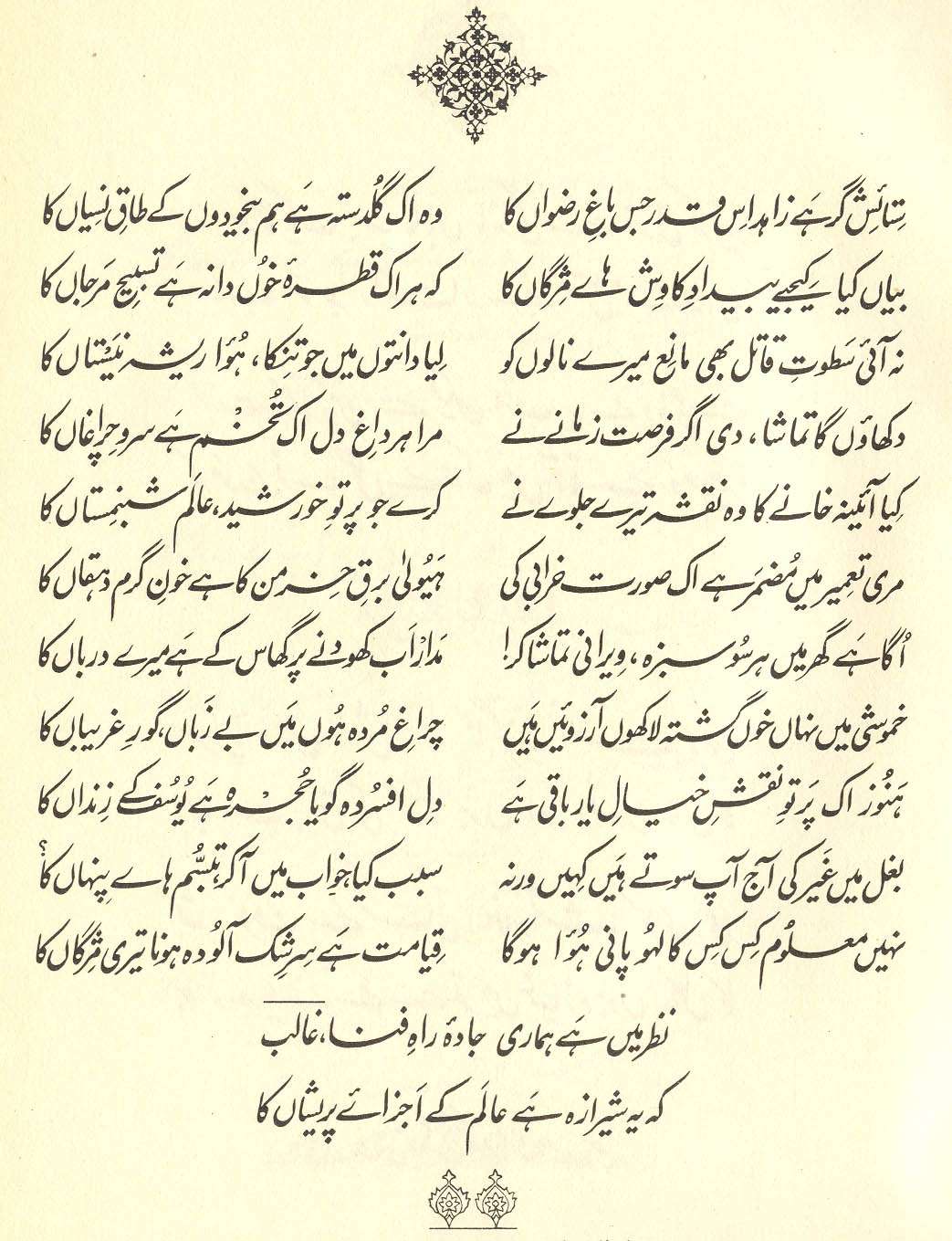
Urdu text: Vajid 1902 {10}
That is, which innocent ones must you have killed? Your eyelashes becoming wet with tears is in no way less than Doomsday. (25)
Compare 193,2 . (291)
ABOUT 'DOOMSDAY': Of course the official, theological meaning of is the day of resurrection . It also has a literal etymological sense of 'rising up' (see , Platts p.796), since on that day the dead will rise again to face God's judgment. From that center, its metaphorical range readily extends to a range of chaotic, dangerous, violent 'Doomsday-like' events (see the definition above). At one extreme of that range it can even be used as a compliment, just as in English we can speak of a 'devastating' beauty. Compare the similarly wide metaphorical range of : 'Angry, wrathful, offended, &c.; fearless, daring; outrageous; great, excessive, intense, tremendous, awful, fearful, dreadful, shocking; woeful, calamitous, injurious, hurtful, detrimental ... ;—too good; very fine, splendid, dazzling, very beautiful; wonderful, rare, extraordinary, unique' (Platts p.771).
There's a strong affinity between water and tears. Lovers shed tears of blood anyway, and for someone's 'blood to turn to water' conveys almost the same panic, dread, and helplessness in Urdu that it does in English. The lovers' bloody tears now become water, since their blood itself has turned to water. Where did those tears on the beloved's eyelashes (and not, be it noted, in her eyes) come from? For a clear case of how those cruel eyelashes pierce blood-drops (which, as we learn in the first line, have now turned to water-drops), we need look no further than 10,2 .
Of course, the tears could also come, even more dangerously perhaps, from her own eyes, as they do in 193,2 .
Do we read the first line as a result of the second (the lovers become distraught when they see the beloved's tears), or the second line as a result of the first (the beloved has reduced more poor victims to a liquid pulp, as we know from seeing their blood-'tears' skewered on her cruelly piercing eyelashes)? In either case, the result is a major disaster, a Doomsday, the 'wrath of God'.
Note for grammar fans: This verse is an example of the 'presumptive', the future tense used for present or past action that is probable, and that is assumed, but that cannot be asserted on the basis of complete knowledge.
Compare Mir's vision of the disaster caused by the beloved's batting her eyelashes: M 1123,7 .
graphics/teardrops.jpg