Verse 8after 1826aa;Nkaa
G2
1
in silence, hidden, (re)turned to blood, are all the hundreds of thousands of longings
2
I am the burnt-out/'dead' oil-lamp, tongueless, of the tomb of {strangers / the poor}
'Returned; turned; inverted, reversed; converted; perverted; changed; --become; formed'.
'A stranger, foreigner, an alien; --a poor man; a meek or humble person'.
| References | |
|---|---|
| Arshi, Imtiyaz Ali | Ghazal# 37 |
| Raza, Kalidas Gupta | 369 |
| Hamid Ali Khan | Open Image |
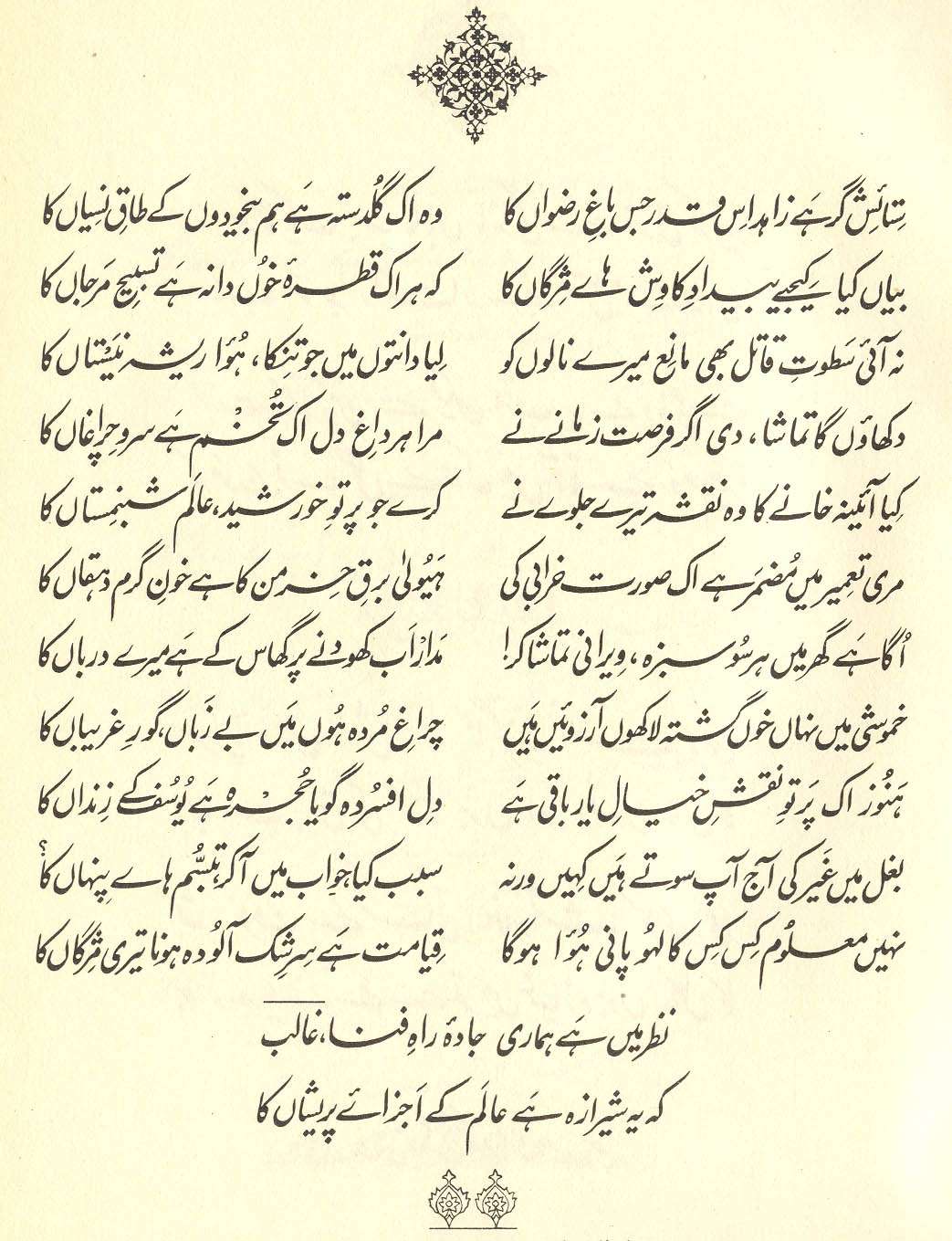
They call a silent man 'tongueless', and they use the simile of a 'tongue' for the flame of a lamp. So the extinguished lamp is compared to a tongueless man. (11)
== Nazm page 11

Urdu text: Vajid 1902 {10}
[The commentator Asi says:] The theme has been expressed in words extremely full of longing. (35)
This image is exactly appropriate and extremely full of rhetorical effect []. (62)
Lighting a lamp on someone's tomb is an act of piety and remembrance. It's an oil lamp, so it has a 'tongue' of flame. Or at least, it would if it were lit; but in this verse the speaker is a burnt-out or extinguished, literally 'dead', lamp. Here are some of the points of comparison; as various ones are emphasized, the nuances of interpretation change, in a process I call 'stress-shifting':
=A lamp has a 'tongue', but the speaker's longings are all 'in silence', like those of a poor man or a stranger.
=A lamp has a tongue of flame, but the speaker's longings are all 'hidden' in the dark, like the grave of a poor man or a stranger.
=A lighted lamp has a steady flow of liquid oil that emerges into fire, but the speaker's longings have all turned (or returned) into a mere pool of blood in his heart that is going nowhere, like the longings of a poor man or a stranger.
=A lighted lamp is in some sense alive, but the speaker is a 'dead' or burnt-out or extinguished lamp-- just the kind that would be on the grave of a poor man or a stranger.
It's a verse of mood . The verse is also full of sonorous long vowels, making for fine sound effects and great flowingness .
It's the kind of verse that a traditional audience could enjoy immediately; if Ghalib had written nothing but verses like this, he would never have become the controversial figure he did become.
Compare Mir 's shorter and simpler verse M 12,2 .
graphics/burntoutlamps.jpg