Verse 12after 1826aa;Nkaa
G2
1
in our sight/gaze is the path of the road of oblivion, Ghalib
2
for this is the binding-thread of the scattered/distracted parts/signatures of the world
'The stitching of the back of a book'.
'Part, portion; particle; component part, ingredient; part or section of a book (consisting of eight leaves)'.
'Dispersed, scattered; disordered, confused; dishevelled, tossed (as hair); amazed, distracted, perplexed, bewildered, deranged; troubled, distressed, wretched; ruined'.
| References | |
|---|---|
| Arshi, Imtiyaz Ali | Ghazal# 37 |
| Raza, Kalidas Gupta | 369 |
| Hamid Ali Khan | Open Image |
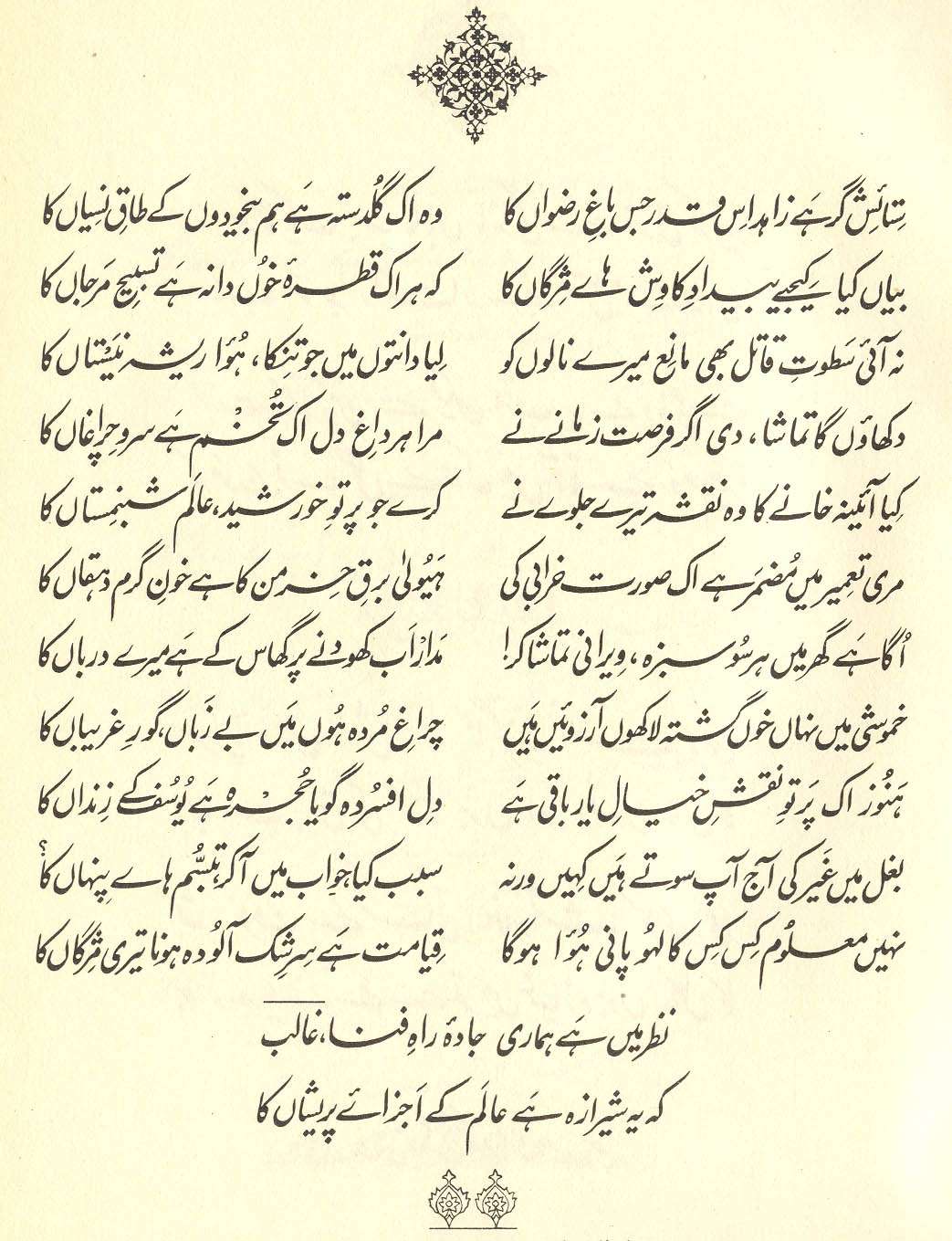
That is, the thread of oblivion with which all the pages of the world are sewn together-- I have not forgotten it. That is, oblivion is always before my eyes. (12)
== Nazm page 12

Urdu text: Vajid 1902 {10}
The meaning is that all the things in the world, no matter how incommensurate and opposed they may be, become one in oblivion. It's as if all the pages of the world were sewn on the thread of oblivion. (38)
Between 'path' and 'road', one word is unnecessary. Nothing else but a 'path' is called a 'road'. (63)
Compare 18,2 . (183)
ABOUT BOOKBINDING AND THREADS: In traditional bookbinding , a string or thread (the ) attaches each of the folded page-sets called signatures ( , sing. ) by stitching them to each other and/or to the spine. In the present verse, without the binding-thread the pages of the world are both literally and in all the extended meanings. For more examples of the use of and related book-binding terminology see 18,2 **; 18,5 ; 42,10x ; 190,2 ; 197,3x * // 352x,1 ; 352x,3 ; 360,2 *; 374x,4 ; 431x,5 *.
See also the 'thread of the gaze' [] in 65,2x and 171,1 ; similar images: 190,2 // 251x,1 . Then there's also the literal use of the 'thread of a breath' in 173,9 ; 253x,6 ; 286x,1 ; 297x,1 ; 311x,1 ; 421x,3 ; in 206,3 we find a 'thread of security'; in 211,6x we find the 'strings' of an instrument, of Laila's strands of hair, and of kinship. By contrast, in 230,12x we find the (unpersuasive) 'thread of the agitation of the heart'; in 237x,2 there's a 'thread of the path of the road' (similarly in 145,16x and 389x,5 ) and a 'thread of the path' in 410x,2 ; 376x,6 gives us the 'thread of a sun-ray'. Such threads are also very likely to become tangled; on 'knot' imagery see 8,2 . Then, 373x,4 , 381x,1 , 397x,5 , 410x,2 (with a 'fiber of madness'), and 436x,2 (with a 'fiber of fame'), all feature an unusual underground road that's like a 'fiber' []. In 378x,3 the jugular vein itself becomes a 'thread'; in 417x,1 the 'vein of sleep' is likened to 'eyelashes'. Threads are also involved in the 'tearing of the collar' [], and its repair; on this see 17,9 .
In Ghalib's lexicon, the word seems almost always to signal a high order of abstraction; for more examples, see 9,4 . The similar phrase occurs in 92,3 .
On first hearing, we tend to take 'in our sight/gaze' as conventional, as meaning 'in our view'-- that is, in the view before the speaker, the one that his eyes now see: what he sees before him is the path of the road of oblivion.
But when we finally-- and under mushairah performance conditions, that would mean after a suitable delay-- hear the second line, we realize that there's some of what I call 'stress-shifting' going on. For the second line tells us that 'this' is the binding, etc. etc. What is the 'this'? The best guess is that it's something in the first line. But what? The line seems to offer three obvious candidates: the 'path', the 'road', and 'oblivion'. Any of them could act in some sense as a binding-thread for the book of our lives: the path (since it's long and straight like a binding-thread), the road (since it can either echo, or perhaps somehow contrast with, the path), or oblivion (because it's a final cancellation of the need for any binding at all). There's no reason not to read the verse with one of these emphases, if we choose.
And then we suddenly realize that 'in our sight/gaze' is no mere stylized expression like 'in our view', but is in fact the best potential binding-thread of them all: the binding-thread of our lives is to be found 'in our sight/gaze'. We can take it as literally locative-- the binding-thread, and/or the path of the road of oblivion, is actually located 'in' our gaze. Our gaze itself is directed and linear: its trajectory points to, or moves along, or even itself constitutes, the doubly long and linear, even string-like, 'path of the road' leading to oblivion. (Compare the literal 'thread of the gaze' [] in 15,3 and 124,4 .)
Our long straight gaze becomes the binding-string that collects all the disparate sights it sees, and orders and unites them with the sure knowledge of their common destiny, the (Sufistic?) fate of oblivion. There's also a distinct suggestion that there's no other binding-thread except our gaze: it's only that gives our fragmentary lives, and our disordered world, any sense of unity at all. (On the radical disjointedness of our lives, compare 81,2 .) But then, on the brighter side, what our gaze unifies is not utter chaos (countless loose sheets of paper blowing in the wind), but at least somewhat orderly 'signatures' that lack only the binding-thread before they assume the orderly form of a book.
Is this not a verse to die for? Provocative, evocative. Serene, calm, unflinching-- and unreadable. Is it bleak? Is it strangely triumphant in its awareness? Is it hopefully anticipatory? You decide. In some sense it feels endless, like a for the signatures in our heads.
graphics/roadway.jpg