Verse 21821 [and 1816]aa;Nmujh se
G5
In this meter the first long syllable may be replaced by a short; and the next-to-last long syllable may be replaced by two shorts.
1
the lesson of the title of the spectacle is better with negligence/heedlessness
2
the gaze is the thread of the stitched-binding of the eyelashes, through me
'Superscription, title, or title-page (of a book, &c.); preface; anything that serves as an indication (of another thing); that which is understood (by anything); — mode, manner'.
'Unmindfulness, heedlessness, forgetfulness, neglect, negligence, inattention, inadvertence, indifference, listlessness'.
'The stitching of the back of a book'.
| References | |
|---|---|
| Arshi, Imtiyaz Ali | Ghazal# 158 |
| Raza, Kalidas Gupta | 346-47,257 |
| Nuskhah-e-Hamidiyah | 230-232 |
| Asi, Abdul Bari | 235-237 |
| Gyan Chand | 363-364 |
| Hamid Ali Khan | Open Image |
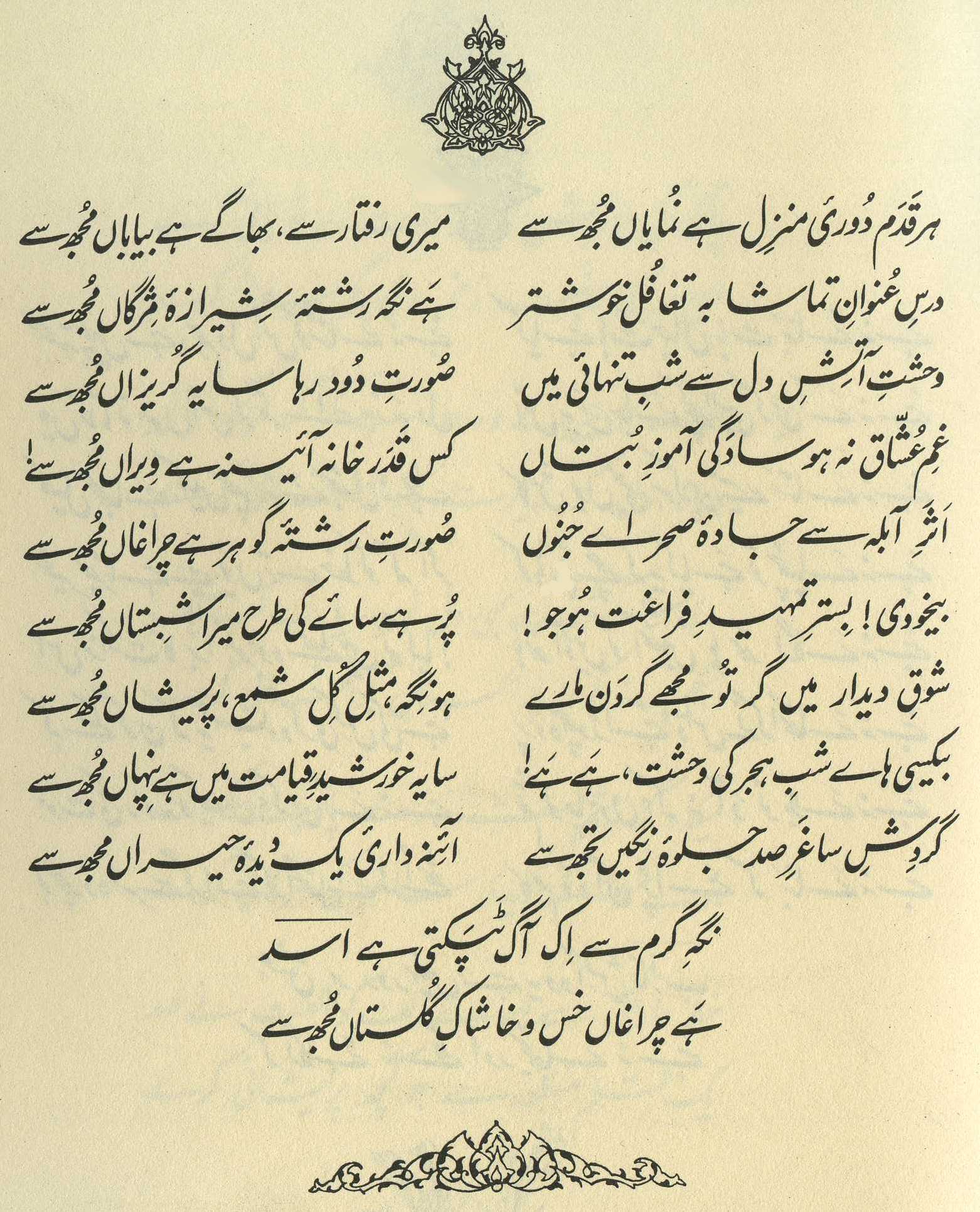
That is, my gaze has become the thread of the stitched binding of the eyelashes. The result is that because of being fond of negligence, it does not emerge from the eyes; and to take a lesson from the spectacle of the world is better with negligence. And he has brought in the world 'title' in order to create exaggeration -- that is, the whole spectacle is a volume, and who's in the mood to look at it? Here he's negligent about looking even at the title of the spectacle. (212)
== Nazm page 212

He says, 'Even to take an instructive lesson from the spectacle of the world is better with negligence'. That is, to look at the beginning of the spectacle with an averted gaze is enough to draw a conclusion. Therefore my gaze has become the thread of the stitched-binding of the eyelashes. The meaning is that I am so fond of negligence that my gaze too does not emerge from the veil of the eye, and does not derive a lesson from the marvels of the world. (271)
We've made our gaze into the stitched-binding of the eyelashes. Upon the world and the things in the world we don't cast even a cursory glance. Because it's good to see them through the eye of the heart-- thus I've closed the outer eye. That is, one ought to meditate on His reality and consider Him important. These [wordly things] are neither worthy of being looked at, nor worthy of having the heart given to them. (371)
Usually it's the beloved who shows 'negligence', rather than the lover; but don't forget 182,1 , in which being a 'negligence-{lover/friend}' seems to be a point of pride for the lover.
The imagery in the second line-- the gaze, and the thread used for the stitched binding of a book-- has been discussed in 10,12 , with other examples. But this is the only verse to add 'eyelashes' to the mix. The eyelashes of closed eyes easily evoke the stitched binding of a book. But the thread that does this stitching is-- in a maneuver somewhat hard to visualize-- the gaze itself. The gaze is imagined to be, above all, lowered-- it occupies itself in twisting in and around the eyelashes, 'binding' rather than 'opening' the book of sight.
And all this is done exemplarily, deliberately, 'through' the speaker himself. Thus the present verse seems to be part of what I call the 'independence' group-- a set of verses that endorse the use of one's own resources, even if inferior, rather than those of others, no matter how desirable. In the present verse the whole world becomes a single 'spectacle' of such a nature than not only it but even its 'title' or introduction-- and not only its title, but even whatever 'lesson' might be provided by that title-- should be regarded with disregard, heeded with heedlessness, treated with disdain or 'negligence'.
Really too many abstractions have been too tortuously linked together, so the verse remains both inert and obscure.
The 'book' wordplay-- 'lesson', 'title', 'thread', 'stitched-binding'-- is of course conspicuous as well.
graphics/bindingstitches.jpg