Verse 41821 [and 1816]aa;Nmujh se
G5
In this meter the first long syllable may be replaced by a short; and the next-to-last long syllable may be replaced by two shorts.
1 a
may the grief of/for lovers not be simplicity-teaching to idols!
1 b
might/would the grief of/for lovers not be simplicity-teaching to idols?
2 a
to what an extent the mirror-chamber is desolate because of me!
2 b
to what extent is the mirror-chamber desolate because of me?
'Teaching; learning; taught (used in compounds)'.
| References | |
|---|---|
| Arshi, Imtiyaz Ali | Ghazal# 158 |
| Raza, Kalidas Gupta | 346-47,257 |
| Nuskhah-e-Hamidiyah | 230-232 |
| Asi, Abdul Bari | 235-237 |
| Gyan Chand | 363-364 |
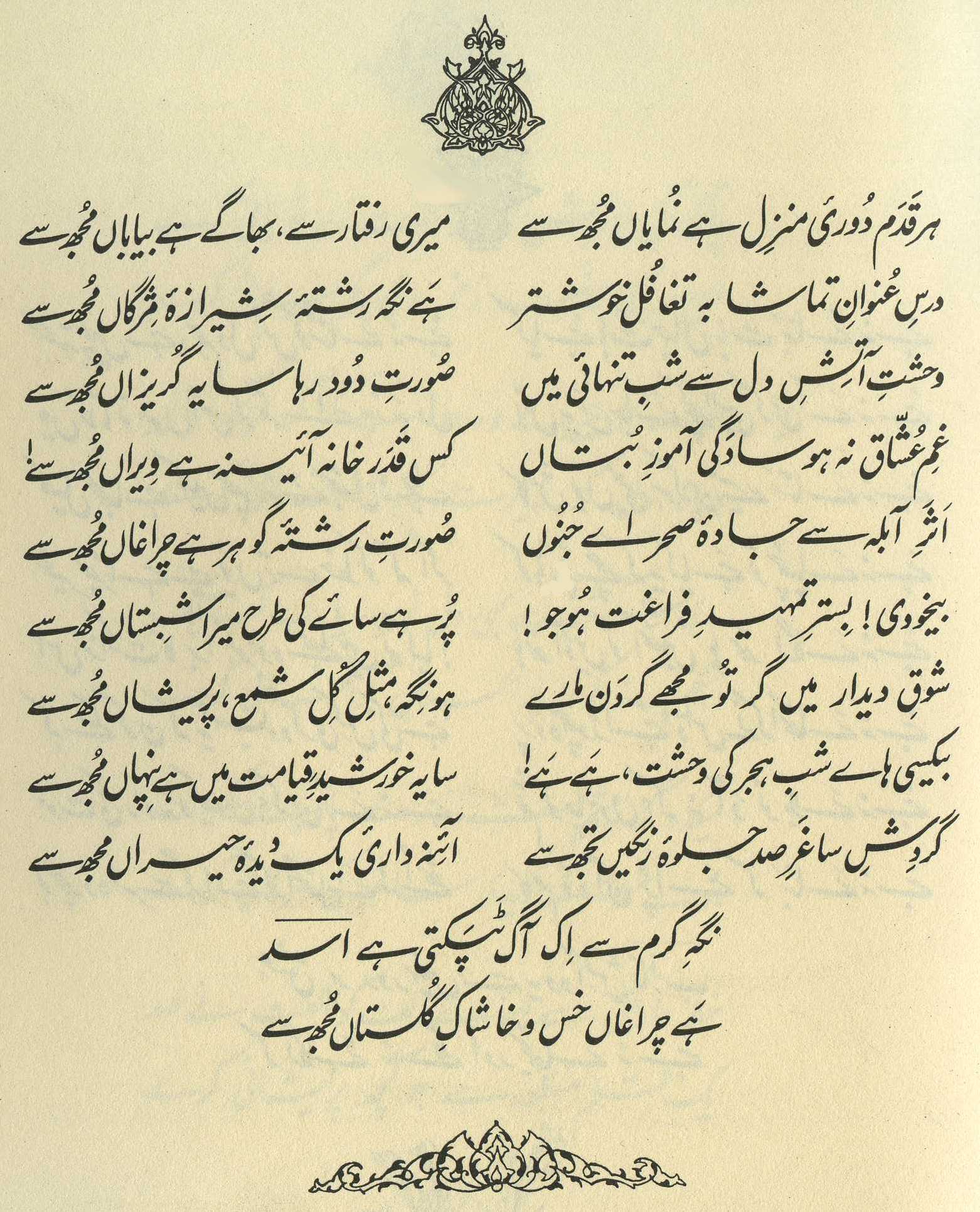
| Hamid Ali Khan | Open Image |
In the first line is a prayer, that is, may the Lord not cause the grief of lovers to teach simplicity to the beautiful ones, and cause them to leave off adornment and ornament. First, from my dying how desolate the mirror-chamber has become, since now in it the glory/appearance of beauty is not to be seen; and in mourning for me the beautiful ones have left off looking in the mirror and adorning themselves. (212)
== Nazm page 212

He says, may the Lord not cause the grief of lovers to instruct beautiful beloveds in simplicity, and cause these people to renounce ornament and adornment. First, merely from my own dying, how desolate the mirror-chamber has become! Now the glory/appearance of beauty is not seen in it. That is, in mourning for me the beloveds have entirely renounced looking in the mirror and decorating themselves. (272)
This too is a new idea! Everybody in the world longs for the beloved to mourn for him. (372)
The commentators' meaning is only one of a number of formally undecideable choices created within a cleverly arranged grammatical structure. In the first line especially, the ambiguities are multiple. 'X Y ' can open up a whole range of possibilities.
=X would not be Y (in some particular situation yet to be specified).
=Would X not be Y? (the colloquial interrogative form of the above).
=X might not be Y (an expression of 50/50 possibility, it might or might not be).
=Might X not be Y? (the colloquial interrogative form of the above).
=May X not be Y! (a prayer or wish that can apply in general or to some particular situation).
When in this complexly structured line we consider the 'X', we realize that can, thanks to the versatility of the , mean with equal ease either 'grief for lovers' (which is felt by somebody else), or 'grief of lovers' (which is felt by the lovers themselves).
And then when we consider the 'Y', , we realize that has the double meanings of both 'teaching' (as the commentators prefer) and 'taught' (see the definition above); and when the is factored in, the result is a phrase that can mean either 'teaching simplicity to idols' or 'taught simplicity by idols'. We hope, a little wistfully perhaps, for further illumination in the second line.
But the second line, also , is not eager to help us out. It exclaims over, or questions, a completely different situation: the desolation of the 'mirror-chamber' (on mirror-chambers, see 10,5 ) because of the speaker/lover. Nazm, whom the other commentators more or less follow, envisions two possibilities: that after the lover's death the mourning beloveds, who have been taught simplicity, no longer go into the 'mirror-chamber' and brighten it with their radiant presence; and/or that the mourning beloveds no longer use a mirror, because they no longer adorn themselves. This second meaning is created only by pretending that 'mirror-chamber' is the same as 'mirror'-- which is a reductionist thing to do. (Although Nazm might point to 73,1 , in which a 'mirror-chamber' is combined with a reference to the 'polish-marks' on a real metal mirror.)
In short, in this verse simplicity is something that either might be taught by 'the grief of lovers' (as felt either by or for the lovers) to idols; or else might conceivably be taught by idols to 'the grief of lovers'. In either case, the verse then asks about, or exclaims at, the extent to which the mirror-chamber has become desolate, as the lover says, 'because of me'-- since it is devoid either of the beloved's beauty (as a sun), or of the lover's burning heart (as a fire). Ultimately, it doesn't seem to make much difference which we choose. The point is how unresolvably difficult, how endlessly rearrangeable, the verse is. It's kind of fascinating in its own way, like a kaleidoscope, but it's not deeply exciting or memorable. We notice the clever, unstoppably shifting patterns of the device, but we certainly aren't overwhelmed with delight by anything very special that emerges from it.
graphics/mirrorchamber.jpg