Verse 101821 [and 1816]aa;Nmujh se
G5
In this meter the first long syllable may be replaced by a short; and the next-to-last long syllable may be replaced by two shorts.
1
from a hot/warm gaze/glance a single/particular/unique/excellent fire drips, Asad
2
the sticks-and-straws of the garden are a {lamp-display / light-show}, {through / because of} me
'Look, glance, sight, view, regard; consideration; --look, aspect (of); --watching, observation, attention;--custody, care'.
'Hot, warm; in a state of heat; burning; glowing: fervid; ardent, zealous, fervent; excited; eager, intent on; fiery, choleric, virulent; active, lively, brisk'.
'One, single, sole, alone, only, a, an; the same, identical; only one; a certain one; single of its kind, unique, singular, preeminent, excellent'.
'Lamps; lights; a display of lamps, a general illumination'.
'Sticks and straws, litter, rubbish'.
'Sweepings, chips, shavings, leaves, rubbish, trash'.
| References | |
|---|---|
| Arshi, Imtiyaz Ali | Ghazal# 158 |
| Raza, Kalidas Gupta | 346-47,257 |
| Nuskhah-e-Hamidiyah | 230-232 |
| Asi, Abdul Bari | 235-237 |
| Gyan Chand | 363-364 |
| Hamid Ali Khan | Open Image |
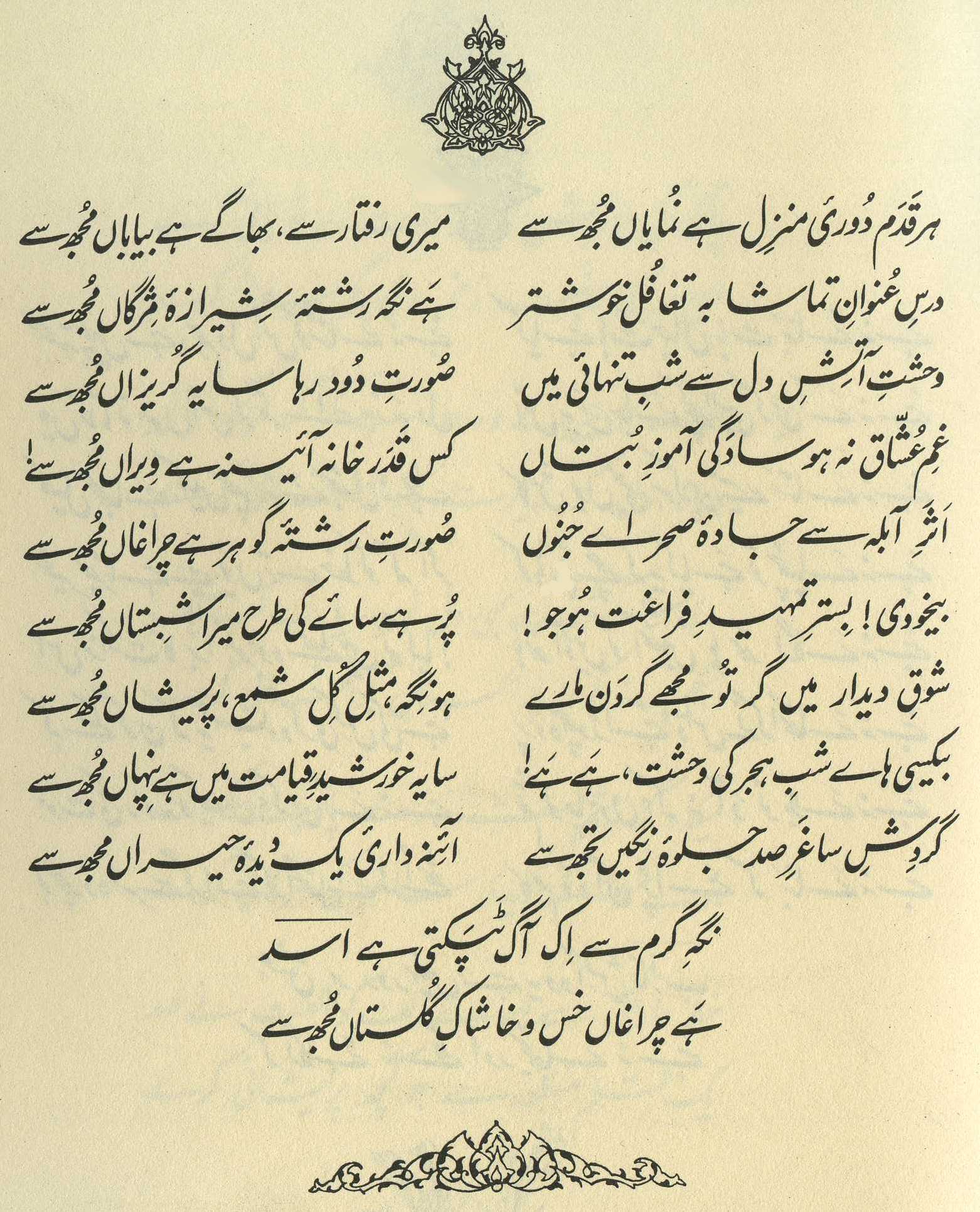
That is, my warm/hot gaze has lit a fire in the garden; but we do not learn anything of why the gaze is warm/hot. (214)
== Nazm page 213 ; Nazm page 214


He says, 'Oh Asad, when in separation from the beloved I've gone for a stroll in the garden, in my body a fire has started, and on seeing the flowers such a flame has shot out of my eyes that the dried grass and woodchips of the garden have become a light-show'. (273)
As Insha says,
[with regard to my presence, fire has started in the garden--
my gaze had hardly fallen, alas, on the moist roses!] (374)
In Urdu, the meaning of 'hot gazes' [] is 'gazes full of anger'.... The truth is that [Nazm] Tabataba'i has asked a correct question, but his question was unnecessary, because he ought to have known that to have a 'hot gaze' or a 'hot eye' [] is among the qualities of a lover. The reason is that they give for the beloved's face the simile of the sun and fire, and especially flame that is flaring up.... Thus it's clear that into the eye of the lover of one with a face like the sun or like flaring flame, heat will definitely come.... A cause for further pleasure is that flowers are always used as a metaphor for the beloved, and these are called 'hot' as well. In this way in Ghalib's verse an ' affinity of meaning' [] has also been created.
== 2006: 338-41
[See also his discussion in M 366,8 .]
Just look at the complexities (see the definitions above) we'll have to choose among, in order to put this verse together! The whole first line demands to be considered almost literally word by word:
First, (shortened from for metrical reasons) can refer to either a single 'look' or 'glance', or a steady continued 'gaze' or 'watching'; or it can mean 'care' or 'attention'.
Second, has a wide range of meanings, ranging from the mild ('lively', 'brisk') through the emotional ('ardent', 'excited'), to the dangerous ('fiery', 'virulent'). Faruqi points out that the idiomatic sense of a 'hot look' as a sign of anger is especially relevant here, but there's no reason for it to override all other possibilities.
Third, consider that little word (short of course for ) that appears so centrally in the first line, and emerges at such an emphatic point in the meter. If we take it to mean 'single', then it's elegantly counterpoised to the Persian plural in the next line. If we take it to mean 'particular', that might explain its remarkable effects in the second line. If we take it to mean 'unique' or 'singular', then we are well prepared for its bizarre behavior in the very next word, as it 'drips'. And if we take it to mean 'preeminent' or 'excellent', that too works well in showing admiration for its powers described in the second line.
Fourth, of course is that 'dripping' of the fire. As a rule, 'dripping' is a highly unlikely thing for a flame to do: flames go up and drips go down; flames shoot out in tongues and drips shape themselves into little spheres; flames pop and crackle, drips merely go 'plop'. Then, of course, fire will roast you, drips will drown you-- is that a difference (in means), or a similarity (in ends)? What in the world does it mean for fire to 'drip'? Fire is not the oddest of Ghalib's dripping things, however: remember there's also the 'to be a desert' that 'drips' in 17,2 .
In the second line, we find an astonishing conversion. Something maximally trashy and rubbishy has been made into something maximally elegant and sophisticated; something merely crudely inflammable has been made into not one but many spectacular flames; something that's natural and a mere byproduct has been made into something that's artificial and an elaborate result of artistic skill. And of course we discover the whole array of fire wordplay: 'hot/warm', 'fire', 'light-show', and the kindling: 'dried-grass-and-woodchips'.
Then, all these effects are created 'through me' or 'from me' or 'by means of me' []. Which opens up, once again, various choices. The rich patron who sponsors a theatrical show can quite well say, 'The show is put on by me'. The choreographer can make the same claim; so too can the troupe of dancers. In the case of the creation of this light-show, we'll have to decide for ourselves how closely involved the speaker might be, and what his role might be-- is he merely commanding the show, or is he spinning it out of his own burning heart's blood? Is he doing it effortlessly, or even involuntarily, with a single glance (as in 5,4 ), or is he doing it carefully over time, with 'watchfulness'? And of course we'll also have to decide what his mood might be, whether 'lively', 'ardent', or 'virulent'. As so often, Ghalib gives us a set of building blocks and then goads or charms us into creating the verse-- or rather, many permutations of the verse-- for ourselves.
For another meditation on and fire, see 210,5 . (There's also and water, in 171,5x .) For more on , see 5,5 .
graphics/grassfire.jpg