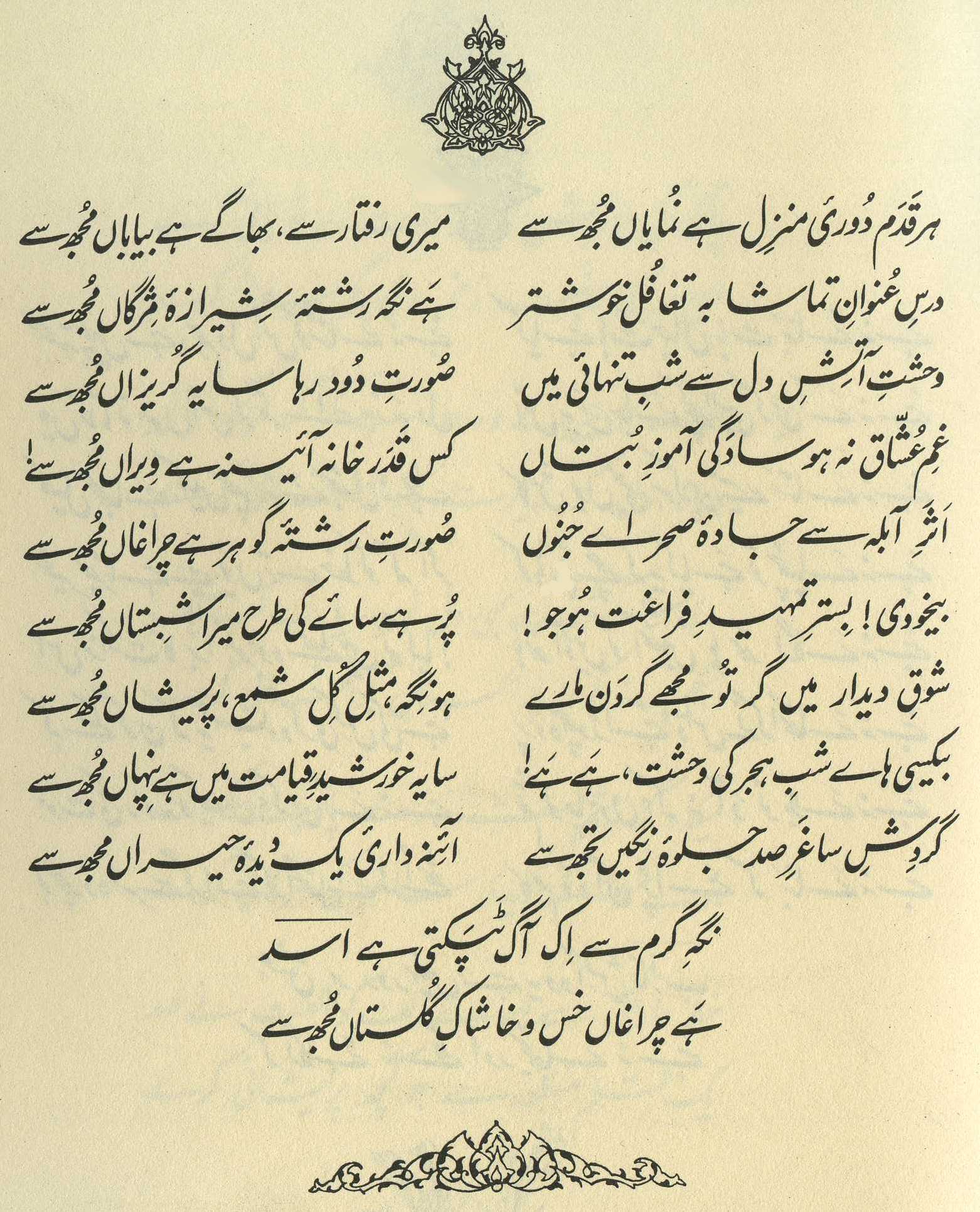
Verse 91821 [and 1816]aa;Nmujh se
G5
In this meter the first long syllable may be replaced by a short; and the next-to-last long syllable may be replaced by two shorts.
1
the going-around of a colorful hundred-gloried flagon, from/through you
2
the mirror-possessing of one amazed eye, from/through me
'The eye; the sight; a wanton, or impudent eye'.
| References | |
|---|---|
| Arshi, Imtiyaz Ali | Ghazal# 158 |
| Raza, Kalidas Gupta | 346-47,257 |
| Nuskhah-e-Hamidiyah | 230-232 |
| Asi, Abdul Bari | 235-237 |
| Gyan Chand | 363-364 |
| Hamid Ali Khan | Open Image |
Your colorful glory/appearance is doing in this gathering the work of the going-around of the flagon, and my amazed eye that of a mirror. He has called the glory/appearance a flagon because it too, like a flagon, is sense-stealing. (213)
== Nazm page 213

The meaning is that from your beauty people are becoming intoxicated, and having seen my passion, a man is enveloped in amazement. (273)
Thus the cup of colorful glory/appearance is going around because of you. That is, every one of your glories/appearances is sense-stealing. Through the eye of amazement I am performing mirror-possession. That is, worldly wisdom is adorned with only two things: (1) the flagon of your glories/appearances and the mirror of my amazed eye; (2) you show a colorful glory/appearance and I always remain amazed. (373)
What an elegant multiplicity of circles! The wine-flagon or wine-glass itself is round, and it 'makes the rounds' by going round in circles among the company; the eye is round, and the mirror that it resembles is also round. The wine-flagon of the beloved's is unique and single, all the more so because it constantly flashes out its hundred vivid glories in all directions; the speaker's eye too is unique and single, in its fixed mirror-holdingness of attention. (On the nature of , see 51,9x .) Both of these foci are thus point-like-- and a point can be imagined as the tiniest possible circle.
In its serene parallelism the verse doesn't even bother with verbs. Nor do we know how the two lines fit together. Are they linking similar situations, or polarizing opposite ones? (Or perhaps both at once?)
The two lines might be equal, interdependent, like bookends: there are two parts of some unnamed experience, and we matter-of-factly cooperate to create it-- the addressee supplies or constitutes one necessary part, the speaker supplies or constitutes the other.
Alternatively the two lines might represent a poles-apart depiction: ! The beloved is so unbearably glorious, that the lover can't react at all-- he can only watch in frozen stupefaction, like a single huge eye. She is all activity-- going around, radiating glory, intoxicating people-- while he is passive to an absolutely ultimate degree. Yet of course, the mirror itself is valuable, to the self-adorning beloved and also in a sufistic reading: God has willed to be known, and so on.
Moreover, just as the action in the first line happens 'through' or 'from' or 'because of' the beloved, it's perfectly possible that the action in the second line happens 'through' or 'from' or 'because of' the lover-- that is, he might not be simply a mirror or even a mirror-holder or mirror-wielder. He might be a deep, archetypal source of 'mirror-possession' (by others? by the beloved? by the world?). He might be as cosmic a source of 'mirror-possession' as the beloved is of 'glory/appearance'. (After all, we learn in 62,8 that what people think is the dawn is really just the lover's display every morning of one more fresh scar.)
For more 'you and I' verses, see 71,2 .
graphics/winecarafe.jpg