Verse 61821 [and 1816]aa;Nmujh se
G5
In this meter the first long syllable may be replaced by a short; and the next-to-last long syllable may be replaced by two shorts.
1
let self-lessness be the bedding of the introduction of completion/rest/ease
2
my bedchamber/'night-place' is filled, like (a) shadow/shade, with me
'Arranging, disposing; arrangement, disposition, adjustment, settlement, management; confirmation; preliminary, preamble, introduction, preface, preparative; pleading an excuse'.
'Freedom (from business, &c.), cessation (from work, &c.), finishing and ceasing (from), disengagedness, leisure, rest, repose; freedom from care or anxiety, ease, convenience, comfort, tranquillity, happiness'.
is a third-person future imperative of ( GRAMMAR )
'Shadow, shade; shelter, protection; apparition, spectre; influence (of an evil spirit)'.
| References | |
|---|---|
| Arshi, Imtiyaz Ali | Ghazal# 158 |
| Raza, Kalidas Gupta | 346-47,257 |
| Nuskhah-e-Hamidiyah | 230-232 |
| Asi, Abdul Bari | 235-237 |
| Gyan Chand | 363-364 |
| Hamid Ali Khan | Open Image |
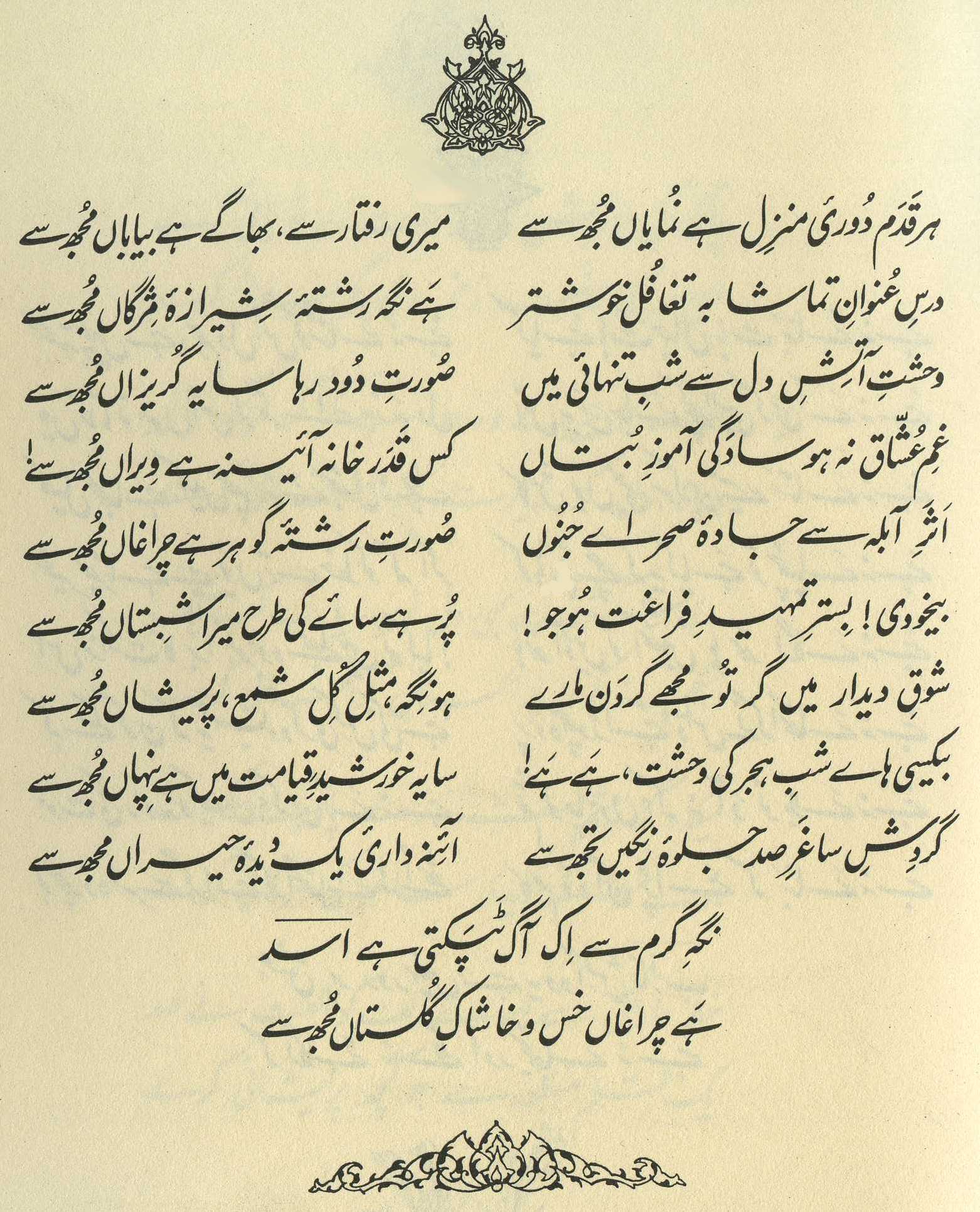
He says, may it be my fate for self-lessness to be the bedding of the preface of completion, for thanks to it, my bedchamber is filled with me the way a shadow is a flat/fallen [] thing. That is, it's a fine thing, whatever self-lessness has caused me to lie flat, senseless, like a shadow. The dictionary meaning of is 'spreading', and and this is part of the affinities with 'bedding'. And as a term, they use it for expressing some ideas that come before some task, and upon which that task depends; and this is the meaning that the author intends-- that is, self-lessness is the 'preface' of the obtaining of completion/leisure. The dictionary meaning of is 'to be empty', and this is part of the affinities with 'full'; and as a term it is used to mean 'rest, ease', and this is the meaning intended here. is the established word; the late author has transformed and shortened it into . (212-13)
== Nazm page 212 ; Nazm page 213


The meaning of this verse is that in the state of self-lessness, through ease and rest, I would be lying on my bedding in my house-- may the Lord make it so! (272)
May self-lessness continue to be fated to receive the bedding of completion/rest/ease, for in its beneficence my bedchamber is full the way something shadowed is full of shadow. That is, be grateful to self-lessness, through the beneficence of which today I am in my own house and the embrace of my bedchamber is filled with me. The conclusion is that as long as awareness remained, I was not fated to remain in my own house; it's the grace of self-lessness that I was able to remain here....
[Disagreeing with Nazm:] This usage [of ] is judicious. The elders of Delhi used to die for the excellence of the theme , and considered words to be fit for their manipulation. (372)
[He discusses the grammar and history of , and demonstrates from early manuscript and printed versions that the original reading could arguably have been . He also agrees about the wordplay that Nazm points out.]
The question can arise, if my bedchamber is filled, like a shadow, with me, then from that how will self-lessness be obtained? The [first] answer to this is that as long as I wandered around in the state of wildness and madness, I had no relationship to bedchambers and resting-places. Now that I've come and sat down in my own bedchamber, it's clear that I've already renounced wildness/madness. Now I'm in the stage of passion that's the stage of absorption and stupefaction. It's clear that now self-lessness, and the resulting attainment of freedom from wildness/madness, distraction, and desolation, will be my hope.
The second answer is that as long as I was aware of my existence and my being, there was madness/wildness and tumultuousness in me. Now when I am about to attain self-lessness, it's clear that I will obtain freedom/release from my own existence too. When my bedchamber will become filled with my shadow, then I will have self-lessness and then perfect repose. When I will have no awareness of existence (self-lessness will exist), then freedom/release too will be attained.
This is all very well, but what does 'my bedchamber is filled, like a shadow, with me' mean? The commentators have tried very hard to solve this difficulty, but without result.... In reality, the phrase on which to concentrate is 'with me'. My bedchamber is filled 'with me' the way my shadow is filled with me. Now it's clear that nobody plays any part in anybody's shadow except the person whose shadow it is. That is, few things are more personal and individual than the shadow. The shadow is dark-- that is, entirely filled up-- because darkness fills up an empty place.... Now with what thing is the shadow itself filled up? It's clear that it's filled with that thing of which it is a shadow. Thus I pervade my bedchamber like a shadow. The whole bedchamber is filled with me, the way in my shadow only my body or my existence is operative. The simile is very eloquent [], but it is so farfetched that the pleasure has been lessened.
== (1989: 309-12) 2006: 334-37
As Nazm and Faruqi observe, this verse is a particularly brilliant network of sets of affinities. I'd like to add even more than those they mention. To take them in order:
='self-lessness'; 'my'; and 'me'
='bedding' (on , see 194,1 ); 'spreading out or arranging' []; rest []; 'bedchamber'
='introduction' []; and 'completion' []
='cessation, freedom' []; and 'filled, full' []
='shadow'; and 'night'-chamber []
Since participates in two such sets, and in three, we have the subtle pleasure of watching them shift back and forth among their meanings, effortlessly changing gears as we redirect our attention. Even for Ghalib, this array of word- (and meaning- ) play is exceptional.
The speaker's bedchamber is filled with him the way a shadow is filled with him. Since a shadow isn't really substantial, isn't really 'filled' with anything, couldn't that also mean that he's not really in his bedchamber? If he's becoming self-less, perhaps he's not really anywhere? Perhaps the whole vision is a kind of dream?
Or could it be that his bedchamber is filled with him the way it itself is (also?) filled with shadow. That would be because he's so shadowy, so not-there, so pervasive and evasive and flimsy and protean and already thinning out into self-lessness.
Or could it be that he fills his bedchamber the way a 'shade' in the sense of a 'specter' or 'apparition' or other ghost visitor might fill it-- ominous, hovering, a last lingering reminder of another era of passionate vigils and nights of tossing and turning? Would the bedchamber uneasily sense his presence? Would it be waiting, hoping, for him to move on into another and fully 'self-less' world?
The real multiplier of possibilities is that 'midpoint' phrase , 'like a shadow' or 'like shadow', which can modify a number of different elements of the verse. Here are some of its possibilities:
=His bedchamber is filled with him in the manner that (a) shadow is filled with him.
=His bedchamber is like (a) shadow in that both are filled with him.
=His bedchamber is filled with him the way it is filled with (a) shadow.
=His bedchamber is filled with him as if he is (a) shadow.
=His bedchamber filled with him is like (a) shadow.
(Note for grammar fans: Do you doubt that an adverbial phrase like can be taken to apply to the object of a postposition, 'me', rather than to the subject, the bedchamber? I don't blame you a bit, I had some doubt myself. To overcome it, consider the first line of the next verse, 190,7 .)
That second line! It lodges in my mind and won't go away. To me, it suffices all on its own to make this really a verse of mood . Of course, I don't know what it actually means, and all the cleverness of the commentators doesn't persuade me that they really know either. My own analytical efforts too feel somewhat beside the point; I can't put my heart into the kind of analysis that I usually enjoy. In this verse, the mood is too powerful. Maybe you feel it too, and you know what I mean. If you don't feel it, then there's no point in my going on and on; I don't think I can put it into words. It's just the penumbra of mystery: -- 'my night-chamber, like shadow, like a shadow, is filled with me'.
Note for grammar fans: For discussion of , see 72,5 .
graphics/shadowyroom.jpg