Verse 81821 [and 1816]aa;Nmujh se
G5
In this meter the first long syllable may be replaced by a short; and the next-to-last long syllable may be replaced by two shorts.
1
the wildness/madness/fear of the forlornnesses of the night of separation-- alas!
2
shadow/shade/shelter is hidden in the sun of Doomsday, from me
'Forlorn state, friendlessness, destitution'.
'A desert, solitude, dreary place;--loneliness, solitariness, dreariness;--sadness, grief, care;--wildness, fierceness, ferocity, savageness; barbarity, barbarism;--timidity, fear, fright, dread, terror, horror;--distraction, madness'.
'Shadow, shade; shelter, protection; apparition, spectre; influence (of an evil spirit)'.
| References | |
|---|---|
| Arshi, Imtiyaz Ali | Ghazal# 158 |
| Raza, Kalidas Gupta | 346-47,257 |
| Nuskhah-e-Hamidiyah | 230-232 |
| Asi, Abdul Bari | 235-237 |
| Gyan Chand | 363-364 |
| Hamid Ali Khan | Open Image |
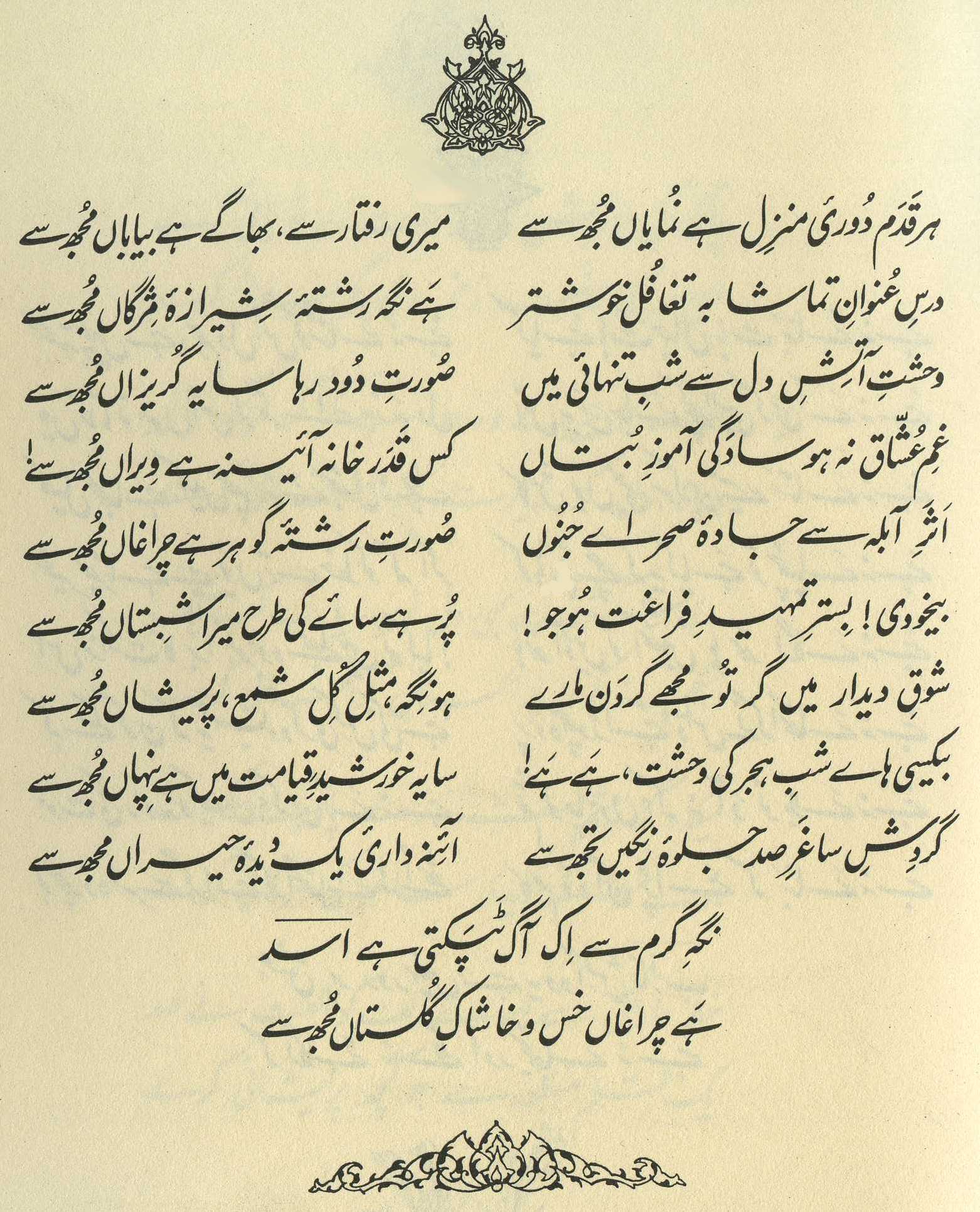
That is, having become mad/wild from the forlornness and sorrow of the night of separation, my shadow has fled from me, and has gone and hid in the sun of Doomsday. Although shadow flees from sun, my shadow has fled from me in such a way that it became hidden in the sun-- and in the sun of Doomsday. (213)
== Nazm page 213

He says, 'From the sorrow and forlornness of the night of grief, my shadow showed madness/wildness toward me and fled in such a way, and felt fear to such an extent, that it went and hid in the sun of Doomsday'. Besides the fact that the shadow flees from sun, my shadow was in such flight from me that it went and hid in the sun of Doomsday. (272-73)
This is like the proverbial case when someone would advance a knife toward a goat, and from extreme fear and agitation and panic it would flee toward a wolf. The point is that the end/conclusion of this night will be when the sun of Doomsday would emerge. In this way he has expressed a famous idea. (373)
Is it 'the' shadow-- his own personal shadow-- or even more radically, is it 'Shadow' or 'Shade' itself that is fleeing and hiding from the speaker? Both possibilities are open.
But even more intriguingly, why is (the) shadow fleeing and hiding? The versatility of (see the definition above) is perfect; here are some of the possibilities that it opens up:
=The shadow is 'fearful' of the 'helplessnesses' that the 'night of separation' imposes on the speaker, and doesn't want to share them. Perhaps the absolute darkness of his night deprives the shadow of any existence (since there's no light to define and reveal it). Perhaps it's afraid that where he is , dawn will never come.
=The shadow has actually been driven 'mad' by the 'helplessnesses' of that terrible night, so that it's running frantically away in what is surely a suicidal direction.
=The speaker himself is 'wild', mad, ferociously and primitively violent, in the 'helplessnesses' of that terrible night, to the point that even his own shadow fears to remain in his company, and flees at all costs.
=Even in the darkness of night the speaker can find no shelter, no rest, no coolness of 'shade' or comfort-- the darkness itself torments him. It seems that his 'forlornnesses' are so profound that all 'shade' has fled from him, and he'll find no peace, no 'shelter', till Doomsday.
Why 'forlornnesses', rather than merely 'forlornness'? Ghalib is fond of these pluralized abstractions; for more examples, see 1,2 .
And of course, the 'sun of Doomsday' will be of such irresistible and compelling power that it will annihilate all shadow. So as Bekhud Mohani observes, for the shadow to flee toward this certain annihilation, and hide in it as a refuge, is like a goat fleeing toward a wolf. By a most powerful use of implication , the image establishes the far greater terrifyingness of the (lover in his) 'night of separation'.
The dangerous powers of human thought, especially thought about , are well established; for the locus classicus, see 5,4 . Perhaps it's not surprising that the shadow is desperate to get away.
graphics/doomsdaysun.jpg