Verse 12x1821 [and 1816]aa;Nmujh se
G5
In this meter the first long syllable may be replaced by a short; and the next-to-last long syllable may be replaced by two shorts.
1
fire-scatteringness of a single flame of suggestion/allusion, from/through you
2
wink-adorningness of a hundred cities of lamp-display, from/through me
'Sign, nod, beck, hint, suggestion, indirect reference or allusion; emblem, symptom'. (Platts p.115_
| References | |
|---|---|
| Arshi, Imtiyaz Ali | Ghazal# 158 |
| Raza, Kalidas Gupta | 346-47,257 |
| Nuskhah-e-Hamidiyah | 230-232 |
| Asi, Abdul Bari | 235-237 |
| Gyan Chand | 363-364 |
| Hamid Ali Khan | Open Image |
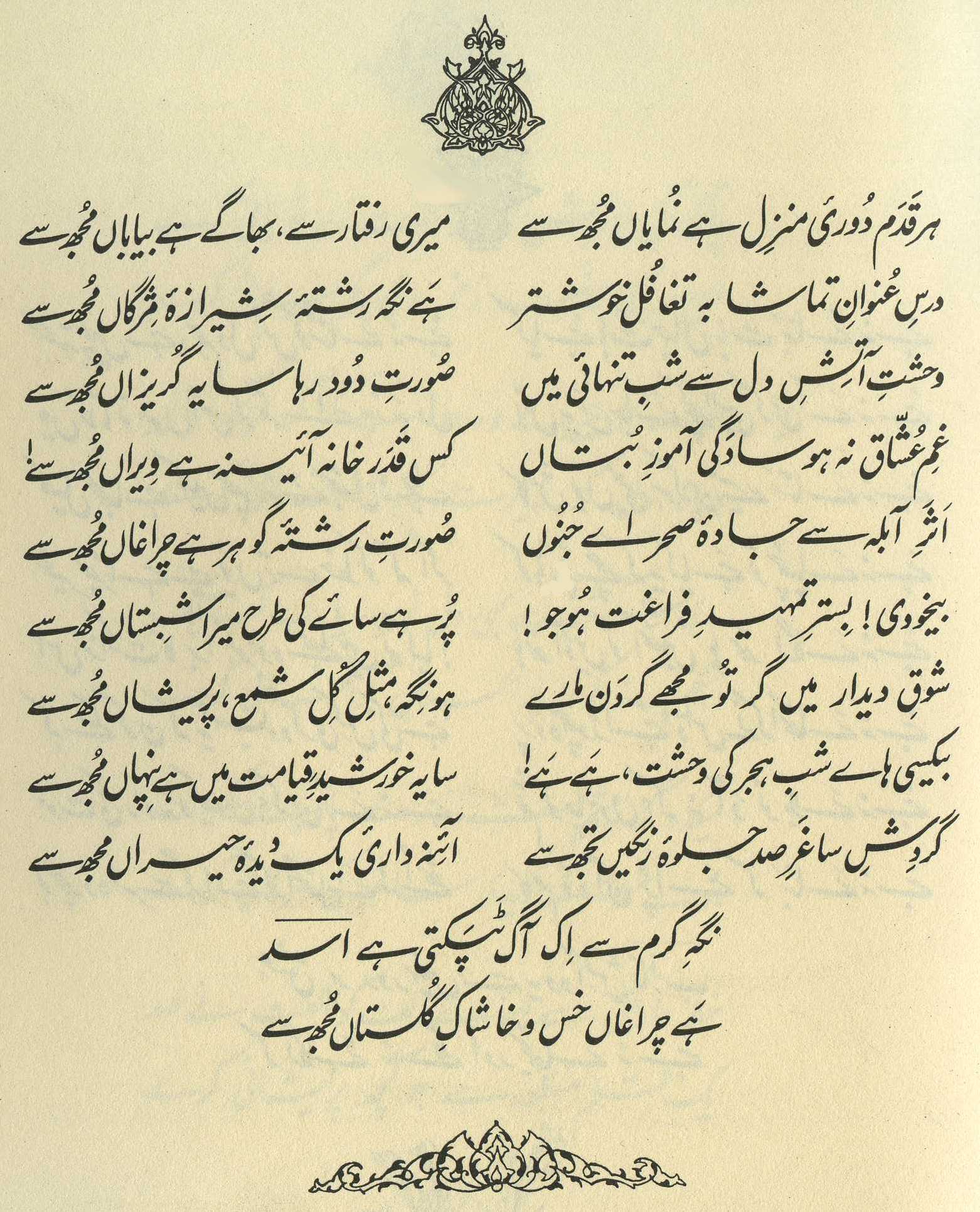
The addressee of the first line cannot at all be some [ordinary] beloved, it can be that self/essence who is the True [divine] Beloved. The meaning is that since you have illumined in my heart a single flame of suggestion, I have begun to fill the whole world with winks. For a whole world of the light of suggestion he has given the simile of a lamp-display, since in the first line he has said 'flame-scatteringness of suggestion'. 'A hundred cities' is for expressing the abundance of the lamps.
== Zamin, pp. 356-357
You make a single sign/gesture, and I make a hundred-cities lamp-display. That is, I start a fire. This is an example/allegory, as in the case when someone would prepare a single flame, and from this flame hundreds of lamps would be lit. The beloved, through her airs and graces, causes this fire to flame up, and from it I light hundreds of wounds and make them a lamp-display. A sign/gesture of the eyes is called a 'wink'. The [flickering] light of a lamp-display is like a wink. Thus to adorn the wink of a lamp-display-- that is, to light a hundred lamps.
== Gyan Chand, p. 364
For background see S. R. Faruqi's choices . For more on Ghalib's unpublished verses, see the discussion in 4,8x .
On the nature of , see 5,5 . In addition, it's worth taking a close look at that 'hundred cities' of lamp-display. A well-established Persian (though not Urdu) idiomatic pattern, often imported by Ghalib into his verses, is that of the ' - something' of something, which establishes a sense of wholeness, completeness, or a very large quantity. An especially relevant example is the 'cityful of longing' [] of 16,2 ; for more examples and discussion, see 11,1 .
In the present verse, this idiomatic pattern in the second line is suddenly multiplied a hundred-fold, perhaps for a new and piquant degree of emphasis; and then we belatedly notice that the has been moved up into the first line. In fact in the first line the phrase might itself structurally be another example of the same idiom; apart from quantity, another possible sense of the idiom is 'suddenness', so perhaps the 'flame' might be counted.
Like so many verses with structural parallelism between the lines, this one leaves it up to us to decide about the relationship between the lines. Are they two coexistent and equally legitimate roles (the beloved does her part, the lover does his)? Is the first line the cause, and the second line the effect (because she suggests, he winks)? Is it about cooperation in lighting a fire (she supplies the match, he supplies the lamps)? Or is there an implied complaint-- or perhaps even an implied boast-- about disproportion (she offers merely a single flame, he responds with a hundred cities' worth of light-show)?
graphics/flame.jpg