Verse 11821 [and 1816]aa;Nmujh se
G5
In this meter the first long syllable may be replaced by a short; and the next-to-last long syllable may be replaced by two shorts.
1
at every footstep, the distance of the destination is apparent, through/from me
2
with/through/from/like my movement, the desert flees from me
'A place for alighting, a place for the accommodation of travellers, a caravansary, an inn, a hotel; a house, lodging, dwelling, mansion, habitation, station; ... — a day's journey; — a stage (in travelling, or in the divine life); — place of destination, goal; boundary, end, limit'.
'Appearing; apparent, evident; conspicuous, prominent'.
is an archaic form of ( GRAMMAR )
| References | |
|---|---|
| Arshi, Imtiyaz Ali | Ghazal# 158 |
| Raza, Kalidas Gupta | 346-47,257 |
| Nuskhah-e-Hamidiyah | 230-232 |
| Asi, Abdul Bari | 235-237 |
| Gyan Chand | 363-364 |
| Hamid Ali Khan | Open Image |
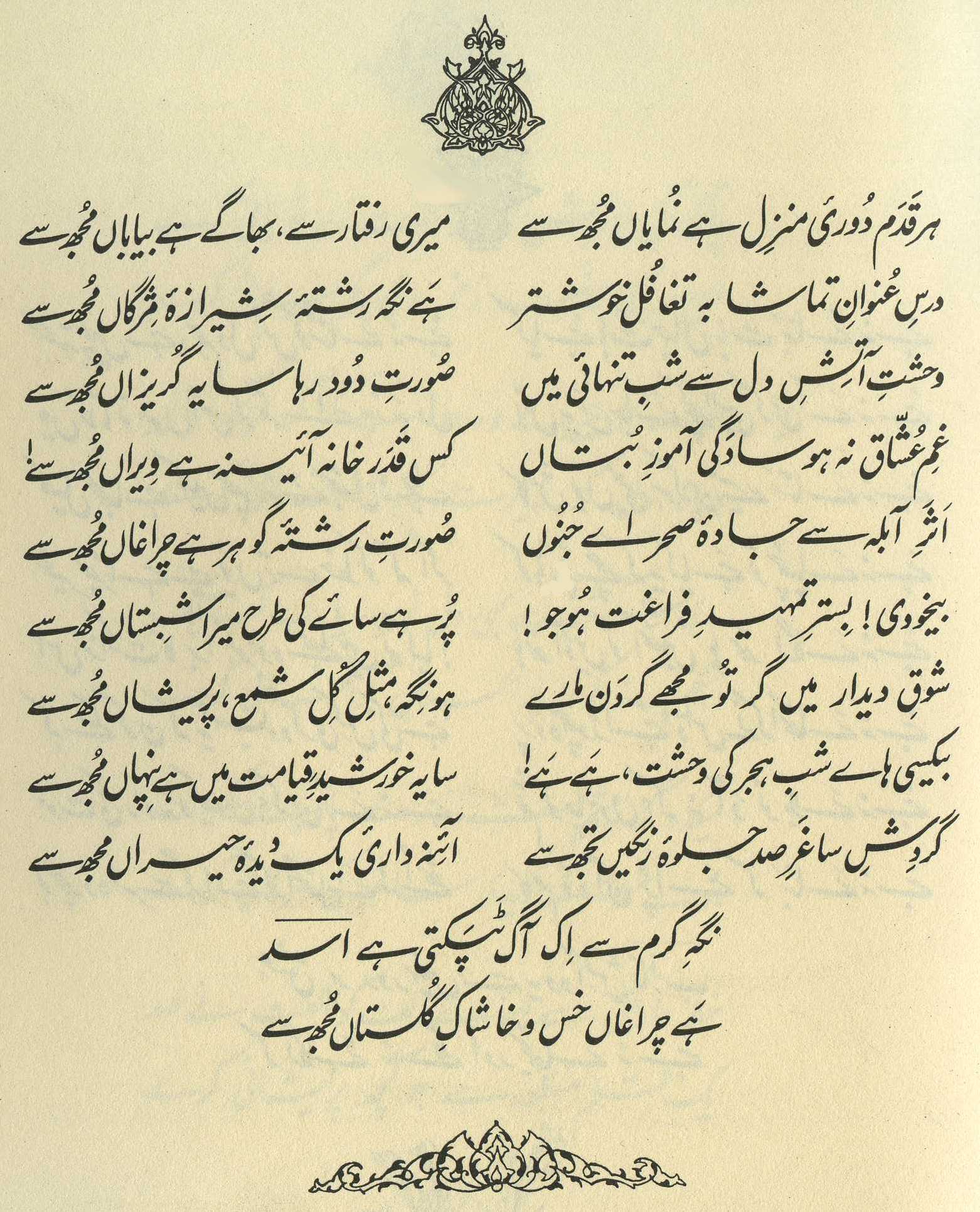
That is, the same gait with which the wilderness is fleeing, that is a gait like mine. That is, as much as I move, by just that much the road becomes farther away, and at every step the distance of the destination keeps on increasing. (212)
== Nazm page 212

He says, to the extent that I move forward, just that much the destination keeps becoming farther from me. It seems that with the same gait with which I am traveling-- with that same gate the desert too is fleeing ahead of me. (271)
With every single step the destination keeps becoming farther from me. The desert too is fleeing with just the same gait as mine. That is, I have lost the road-- as much as I go forward, to that extent the destination keeps growing farther. (370)
That is, however fast the speed may be, the desert will keep becoming distant at that very speed. Accordingly, the speed of the movement is the same, and the existence of the desert is comprised within its very nonexistence.
== , p. 68
In the second edition of , Faruqi disagrees with Raza's dating of this ghazal: rather than 1816, he argues for 1821 (pp. 334-37).
What a brilliant, enigmatic verse! It might also be described as a tribute to the versatility of the protean little postposition , with its basic 'from / with / by means of' range being pressed into service three separate times, to yield such a multiplicity of meanings.
Just consider some of the possibilities it opens up for the second line! Since this line contains two occurrences of , each half becomes versatile-- not to say elusive-- quite independently of the other half. The first half:
=With the speaker's movement-- that is, to the extent of his movement
=Through his movement-- that is, by means of his movement
=From his movement-- that is, because of his movement
=Like his movement (taking as short for )
And the second half:
=The desert flees by means of him-- that is, the desert uses his movement to enable it to flee
=The desert flees because of him-- that is, the desert seeks to escape from him
We're presented with all these mix-and-match complexities, with so many ways to put them together that I won't even try to list them. As Faruqi suggests, the unreachability of the desert may become part of its essence, like the uncapturability of the Anqa . Or maybe not-- maybe the desert flees because it fears the speaker; or maybe the desert's fleeing is a function of his own movement, since the desert moves only by drawing energy from him. Moreover, 'distance' might be a short form either of 'greatness of distance' (provoking the exclamation 'How far it is!'); or of 'exactness of distance' (answering the question, 'How far in fact is it?').
And as if all this weren't enough, we're also forced to decide for ourselves about the relationship of the two lines. Is the 'destination' in line one the same as the 'desert' in line two? We have no way to tell. For a normal traveler in the desert, a 'destination' would probably be an oasis, or some sort of halting-place, that would be beyond the desert, or at least different from the desert around it (in having water, or in some other distinctive way). But for a lover, of course, the desert itself might well be a 'destination', and it would be a source of further wretchedness if he were not even able to reach it.
For another memorable, gnomic verse about footprints, movement, and the desert, see 11,1 .
graphics/desert.jpg