Verse 41816aajal gayaa
G1
1 a
how would the heat/fervor of the temper of thought/doubt be conveyed/expressed?
1 b
where would the heat/fervor of the temper of thought/doubt be conveyed/displayed?
1 c
as if the heat/fervor of the temper of thought/doubt would be conveyed/expressed!
2
somewhat of a thought of wildness had just come-- when the desert burned up
from an Arabic root meaning 'to show the breadth'. 'Presenting or representing'; also, 'breadth, width' .
is an archaic form of ; GRAMMAR .
'A gem, jewel; a pearl; essence, matter, substance, constituent, material part (opp. to accident), absolute or essential property; skill, knowledge, accomplishment, art; excellence, worth, merit, virtue; secret nature; defects, vices; --the diversified wavy marks, streaks, or grain of a well-tempered sword'.
'Thought, consideration, meditation, reflection; solicitude, anxiety, concern...; doubt, misgiving, suspicion; apprehension, dread, fear'.
'Heat, warmth; ... fervour, fervency, ardour; activity ... fieriness, vehemence; passion, rage, anger, excitement; attachment, warm affection; sexual passion, lust'.
'A desert, solitude, dreary place; --loneliness, solitariness, dreariness; ...wildness, fierceness, ferocity, savageness; ... distraction, madness'
'A desert, waste, wilderness; a jungle, forest; a plain'
'To burn; to be burnt; to be on fire; to be kindled, be lighted; to be scorched, be singed; to be inflamed, to be consumed; to be touched, moved, or affected (with pity, &c.); to feel pain, sorrow, anguish, &c.; to burn or be consumed with love, or jealousy, or envy, &c.; to take amiss, be offended, be indignant; to get into a passion, be enraged, to rage'.
'(intens.) To be burnt up, be consumed (with, -)'.
| References | |
|---|---|
| Arshi, Imtiyaz Ali | Ghazal# 26 |
| Raza, Kalidas Gupta | 166-167 |
| Nuskhah-e-Hamidiyah | 73-74 |
| Asi, Abdul Bari | 69-70 |
| Gyan Chand | 109-110 |
| Hamid Ali Khan | Open Image |
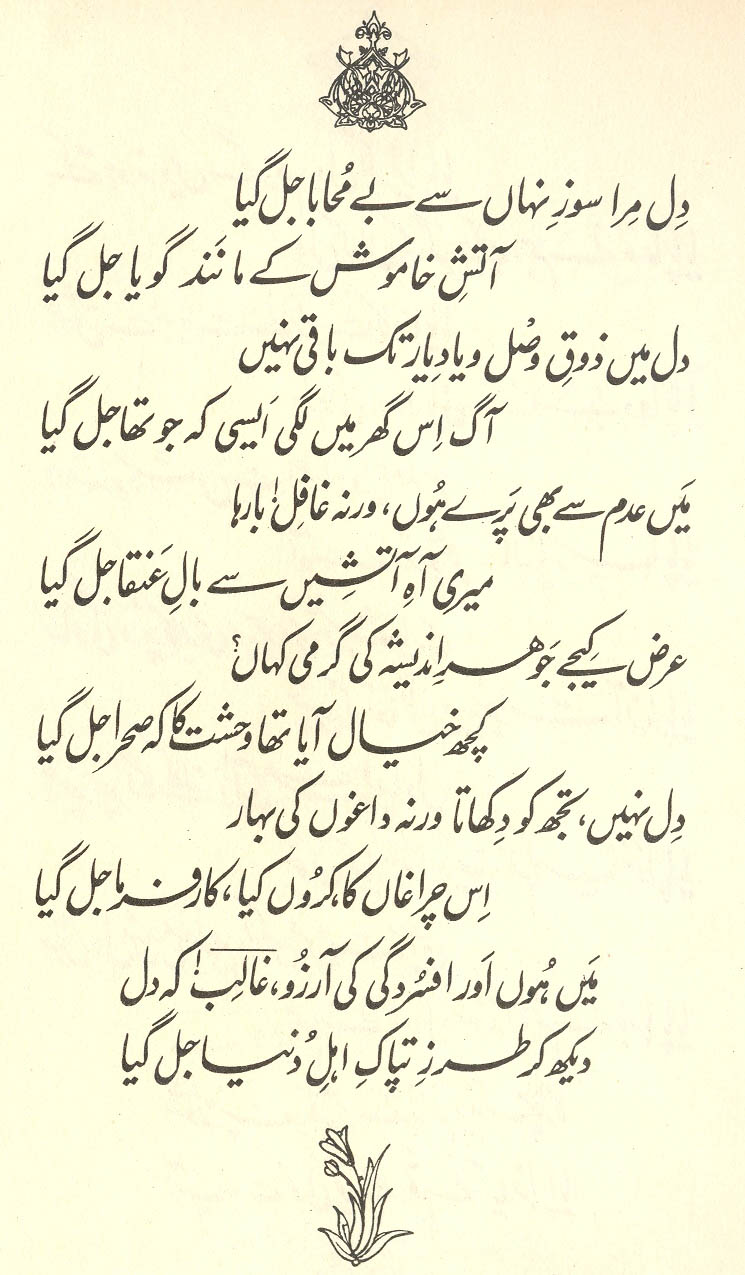
That is, how is it possible for me to manifest the heat of my temperament-- I just had a little thought of wandering in the desert, when the desert caught fire. And this exaggeration is contrary to custom-- that there should be such heat in the temperament that anything that is thought of would burn up. People consider to be a word for the of , although in an affinity with , has 'movingness' [], not 'stillness' []. (6)
== Nazm page 6

He says, where might I go to utter the heat of my turbulent theme s? I had thought that I could leave the city and utter it in the jungle. The moment a thought of madness occurred, fire burst out in the jungle. Mirza Sahib's goal in this utterance is: seeing the numerousness of those without understanding, it's as if my inner self wants to write melting verse, but cannot do so, and cannot see the fullest possible extent of the high-flyingness es of its thought. That is, I hesitate to express accomplishment before those without understanding. (15)
It is quite impossible that I would be able to express the heat of my temper of thought. Because I had hardly formed the thought of renouncing the world, when the heart-attraction of the world began to look contemptible. That is, renunciation of the world is no large matter; it's done in the time it takes to form the thought in the heart. (10)
In the present verse, the pattern of mutual echoes and affinities among the four words defined above is simply astonishingly rich.
{How / where / as if!}
would be {spread out / presented}
the {heat / fervor / anger / lust} of
the {essence / accomplishment / well-temperedness}
of {reflection / thought / doubt}?!
At the merest thought of {madness / wildness / desert},
the {desert / wilderness}
became {burned / moved / anguished / envious, jealous / passionate / enraged}
A word like 'convey', which similarly evokes both heat and thought, is a small reminder of the complex, uncapturable wordplay-- and meaning-play-- of the original. Really, you can mix and match the possibilities until the verse is about either rationality and thought, or irrationality and emotion, or anything in between.
And what sort of 'thought' was it that happened to come to the speaker? Merely , just a bit of a thought. But it could have been: 1) a first step toward yielding to madness in his own mind; 2) a fearful thought of the danger that madness might overtake him; 3) a desire to express the heat of somewhere-- say, in the wilderness; 4) a concern about the fate of the wilderness, if anyone ever unleashed the power of in it. Any or all of these are possible, and so many others besides. This verse is a 'meaning machine' if there ever was one, though it is based partly on multivalent individual words, and not just on cleverness with the grammar.
This verse belongs to the 'snide remarks about the natural world' set; for others, see 4,8x .
Compare 57,5 , which also uses both and . And there's 141,6 , which also complains of the limited space available to in merely the whole world. Then, 214,15x invokes both the of tears and the vulnerability of the desert. Compare also 241x,1 , in which the desert is threatened with 'compression'. And there's also 307x,6 , which meditates on both and .
Compare Mir 's take on the natural world's vulnerability in the face of human passion-- he imagines it as accidentally drowned: M 100,1 . And on the world's inadequacy to the expansive scope of human needs, see M 1219,7 .
graphics/burningdesert.jpg