Verse 61816aajal gayaa
G1
1 a
I am and the longing of coldness/sadness [is], Ghalib, since the heart
1 b
it's come down to me and the longing of coldness/sadness, Ghalib, since the heart
2
having seen the style of warmth/fervor of the people of the world, burned up
'Frozenness; frigidity, coldness; numbness; dejection, melancholy, lowness or depression of spirits.' (Platts, p. 62)
'Warmth, ardour, fervour, zeal; the anguish of love; solicitude of friendship; love, affection, friendship; apparent cordiality; --affliction, distress, uneasiness, disquietude; consternation; palpitation'.
'To burn; to be burnt; to be on fire; to be kindled, be lighted; to be scorched, be singed; to be inflamed, to be consumed; to be touched, moved, or affected (with pity, &c.); to feel pain, sorrow, anguish, &c.; to burn or be consumed with love, or jealousy, or envy, &c.; to take amiss, be offended, be indignant; to get into a passion, be enraged, to rage'.
'(intens.) To be burnt up, be consumed (with, -)'.
| References | |
|---|---|
| Arshi, Imtiyaz Ali | Ghazal# 26 |
| Raza, Kalidas Gupta | 166-167 |
| Nuskhah-e-Hamidiyah | 73-74 |
| Asi, Abdul Bari | 69-70 |
| Gyan Chand | 109-110 |
| Hamid Ali Khan | Open Image |
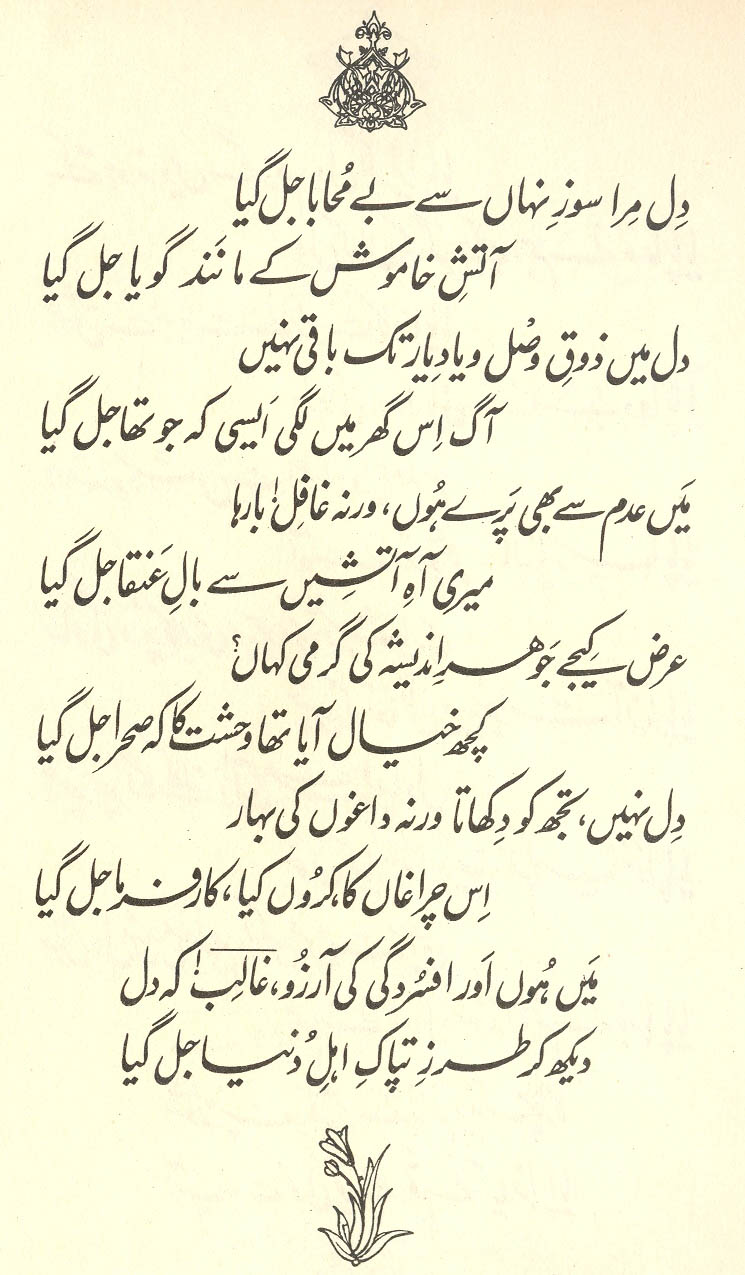
By 'style of warmth' he means outer warmth, inner hypocrisy. And there are the affinities of and , 'to burn'. (6)
== Nazm page 6

Urdu text: Vajid 1902 {5}
Now I am, and the longing is to live separately from the people of the world. Because seeing their outward love and inward enmity, the heart has grown cold. If we read it with the emphasis on 'I', then the interpretation will be that an individual like me, who was a slave of love-- now this is the shape he's in. (11)
The verse is clear, but only to the extent that the poet has become disgusted with 'the style of warmth of the people of the world', which is entirely hypocrisy. But this is a commonplace theme that has been trampled on by many feet. The real mood of the verse is in its first line, to the meaning of which the commentators have given much less attention....
The notable thing is that the first line is a reaction to a reaction. The reaction to the style of warmth of the people of the world is that my heart burned. The reaction to the burning of the heart is that now I long for coldness [].
....But this longing for coldness doesn't look as if it's being fulfilled.... Even the burning of his heart doesn't let him remain in coldness. He is very much inflamed, and being very much inflamed is the opposite of coldness.... Doesn't this situation keep getting more and more convoluted?
== ( 1973: 104-08 )
In this style there are also verses in which the juxtaposition is of 'here' [] with the lover, versus 'there' [] with the beloved; for more on such verses, see 71,2 . 'I and' verses are a special kind of 'list' verses; on 'list' verses see 4,4 .
In this verse Ghalib makes fine use of the idiomatic 'I (am), and' [] expression. The effect of the expression is usually either something like 'imagine-- me, and X!'; or else, grimly, 'it's come down to me, and X'. There is some powerful, often unexpected, usually sad or bleak, sometimes entirely deplorable connection between the speaker and X that is being remarked on with such intensity that its exact nature doesn't even have to be spelled out. Once in a while, as in 97,8 , the juxtaposition can be miraculously wonderful instead of terrible, but this is much rarer.
This ghazal originally had a closing-verse , 5,9x , that contained Ghalib's earlier pen-name of 'Asad'. Later he re-framed that verse into the present one.
Nazm could have added , 'warmth', to his list of affinities. The evocative versatility of , meaning both coldness and sadness, gives rise to the complexities of wordplay outlined by Naiyar Masud. This is also a melancholy, bitter, powerful verse of ' mood '.
For another comparative heat-study of the hearts of the lover versus the worldlings, see 138,4 . Within the divan , the closest verse for comparison is surely 230,3 . But take a look also at the cousin of this verse, the unpublished 5,9x .
graphics/burningheart.jpg