Verse 8x1816aajal gayaa
G1
1
to what extent regret/grief for the enthusiasms/'hotnesses' of companship, oh Thought?!
2
the heart, with the burning/inflammation of the fire of the wound of longing, burned up
'Sorrow, grief, concern; regret; vexation'.
'Companionship, society, company; an assembly, meeting, association; a fair; discourse, conversation, intercourse; carnal intercourse, coition, cohabitation'.
'Burning; heat, inflammation; ardour, passion; affection; heart-burning, vexation'.
'To burn; to be burnt; to be on fire; to be kindled, be lighted; to be scorched, be singed; to be inflamed, to be consumed; to be touched, moved, or affected (with pity, &c.); to feel pain, sorrow, anguish, &c.; to burn or be consumed with love, or jealousy, or envy, &c.; to take amiss, be offended, be indignant; to get into a passion, be enraged, to rage'.
'(intens.) To be burnt up, be consumed (with, -)'.
| References | |
|---|---|
| Arshi, Imtiyaz Ali | Ghazal# 26 |
| Raza, Kalidas Gupta | 166-167 |
| Nuskhah-e-Hamidiyah | 73-74 |
| Asi, Abdul Bari | 69-70 |
| Gyan Chand | 109-110 |
| Hamid Ali Khan | Open Image |
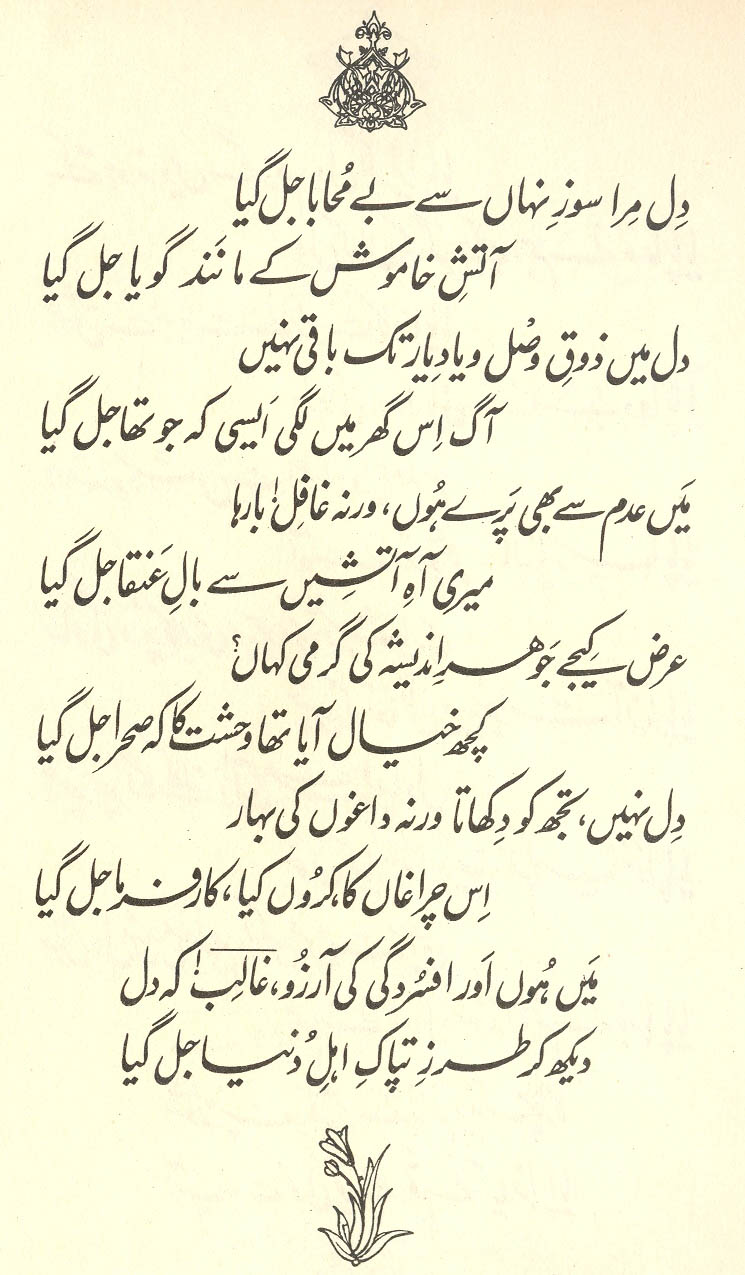
Addressing Thought, he says, 'Why do you remember the 'heat'/enthusiasms of former gatherings and regret them? Why, viewing and viewing those very gatherings has made the wounds of longing flare up-- with their fire-kindling that has burned the heart down into ashes.'
== Zamin, p. 75
Oh imagination, how long will you keep remembering the liveliness of gatherings of the past, and feeling regret? The fire of the wound of unfulfilled longings has burnt up the heart.
== Gyan Chand, p. 110
For background see S. R. Faruqi's choices . This verse is NOT one of his choices; I thought it was interesting and have added it myself. For more on Ghalib's unpublished verses, see the discussion in 4,8x .
The first line, with its interrogatory and exclamatory vigor, opens up an enjoyable set of possible connections to the second line. And -- the Persian equivalent of -- is the key to its versatile possibilities, which mirror those of the 'kya effect' (on this see 15,10 ).
For the 'A,B' structure of the verse leaves it up to us to determine the relationship of the two lines. The verse offers two particularly striking possibilities. If A is the cause ('Oh Thought, why such hotnesses of grief?') and B the effect ('They have caused the heart to burn up!'), then Thought is being reproached for its destructive behavior. While if B is the cause ('The heart is now burnt up and gone') and A the effect ('Why, oh Thought, do you still keep on suffering grief?'), then Thought is being reminded that without the emotional power of the heart, all this mental angst is meaningless.
The first case (line A is the cause, line B is the effect) also opens up two powerful possibilities, for what exactly is it that caused the heart to burn up? It could be the itself (regret/grief has created the longing that destroyed the heart), or it could be the (these 'hotnesses' have burnt up the heart), or it could be the itself ('companionship' or 'intimacy' has given rise to wounds of longing that have burnt up the heart).
Here are a few possible readings:
=Oh Thought, how long will you keep feeling the regret/grief caused by 'companionship'?! It caused the heart to burn up with longing!
=Oh Thought, how powerful are those 'hotnesses' of intimacy-- they caused the heart to catch fire and burn up with longing!
=Oh Thought, how long will you keep tormenting yourself with regret-filled visions? Look-- now you've caused the heart to burn up!
=Oh Thought, what's the use of those visions anyway? All they do is fill the heart with vexation [] and cause it to 'burn' [] with frustration, sorrow, and rage.
=Oh Thought, you won't be able to keep tormenting yourself with passionate visions any more, because the heart that felt them has now burned up!
Zamin and Gyan Chand maintain that the speaker's 'Thought' is tormenting him with nostalgia, with vain longings for the past. But nothing in the verse requires us to think of nostalgia for the past . It's equally possible that the concern is over the all-too-present efficacy of the 'hotnesses' of the speaker's (see the definition above) in the sense of a longing for intimacies with the beloved.
And why the address to 'Thought'? Is Thought a sympathetic bystander, watching the drama of high passion unfold but helpless to prevent it? Or is the speaker reproaching Thought for fostering, or even creating, the deadly 'wound of longing'? Or perhaps after the heart and the passions have burnt up, Thought will be all that's left.
graphics/burningheart2.jpg