Verse 21816aajal gayaa
G1
1
in the heart not even taste/relish for union and memory of the beloved/friend remain
2
fire took hold in this house in such a way that what was [here], burned up
'To burn; to be burnt; to be on fire; to be kindled, be lighted; to be scorched, be singed; to be inflamed, to be consumed; to be touched, moved, or affected (with pity, &c.); to feel pain, sorrow, anguish, &c.; to burn or be consumed with love, or jealousy, or envy, &c.; to take amiss, be offended, be indignant; to get into a passion, be enraged, to rage'.
'(intens.) To be burnt up, be consumed (with, -)'.
| References | |
|---|---|
| Arshi, Imtiyaz Ali | Ghazal# 26 |
| Raza, Kalidas Gupta | 166-167 |
| Nuskhah-e-Hamidiyah | 73-74 |
| Asi, Abdul Bari | 69-70 |
| Gyan Chand | 109-110 |
| Hamid Ali Khan | Open Image |
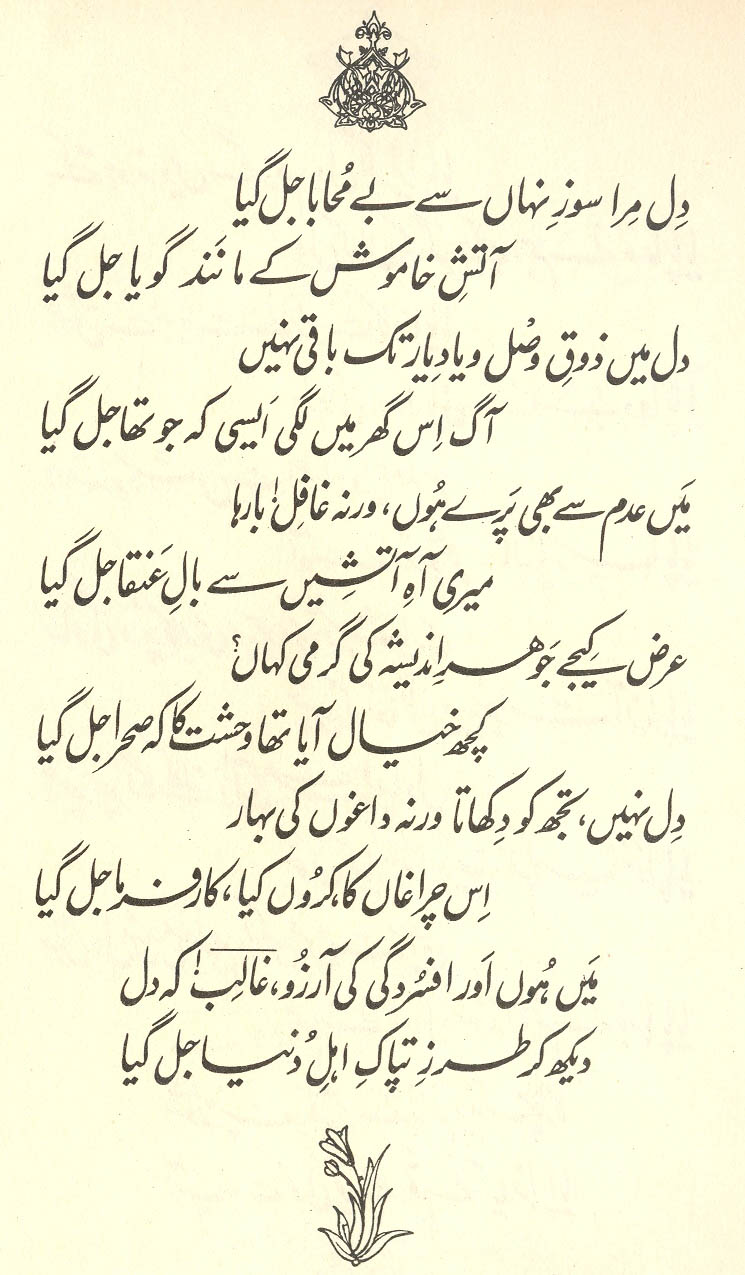
That is, the fire of jealousy/envy was such that it caused the heart to forget the beloved, and having seen her meeting with the Other , the taste for union waned. By house he means heart; and by fire, envy of the Rival . (5)
== Nazm page 5

Urdu text: Vajid 1902 {5}
The rule [] is that when hopelessness passes beyond a limit, then hope/expectation always vanishes, of its own volition. As if the onslaught of despair made me lose heart to such an extent that now no longing for your coming remains-- neither hope, nor desire is left. (14)
[Quoting the commentator Suha:] It points toward that stage of passion, when hope and despair, union and separation, memory of the beloved-- in short, the feeling of every emotion-- no longer remains; and that's the stage of astonishment and forgetfulness of the world. (17)
[See his discussion in Mir's M 66,1 .]
This verse belongs to a group that I am going to call ' mushairah ' verses, for their ideal suitability to the kind of oral performance style characteristic of mushairahs. The first line is shocking: how can such an inconceivable state of affairs exist in the heart of any lover with even the smallest self-respect? We wait impatiently for an explanation. Of course, we are made to wait as long as conveniently possible, during many obligatory expressions of admiration and appreciation, and maybe a repetition, before we're allowed to hear the second line. For more on 'mushairah' verses, see 14,9 .
Then even when we hear the second line, until we reach the final 'punch'-word (since ghazal verses are too short to have punch-lines), , which is also the rhyme -word and thus the last available element of the line, we still can't really be sure what's going on. Then all at once we get it: everything that was there, burned up. While it's a tribute to the depth of the lover's passion that the longing for union and the memory of the beloved should be buried irremovably deep in his heart, it's equally a tribute to the fieriness of his passion that his heart should be so fiercely flame-destroyed that even those deepest things would be reduced to ashes.
In short, it's a case of 'the irresistible force meets the immovable object'. The longing for union, and the memory of the beloved, are the deepest things in the heart-- how can they possibly burn away? Yet the fire of passion is so unassuageably ferocious-- how can it not destroy absolutely everything in its path? And how witty of the poet to have pitted them against each other so cleverly! A mushairah-verse like this gives up all its pleasure at once, in a single burst, and then the listener is ready to move on to the next verse.
graphics/burninghouse.jpg