Verse 31816aajal gayaa
G1
1 a
I am beyond even/also nonexistence-- otherwise, heedlessly, more than once
1 b
I am beyond even/also nonexistence-- otherwise, oh heedless one, more than once
2 a
from my fiery sighs the wing of the Anqa burned up
2 b
from my fiery sighs the wing of the Anqa would have burned up
'Unmindful, forgetful, neglectful, negligent, heedless, inadvertent, inattentive, remiss, thoughtless, careless; indolent; imprudent; senseless, unconscious;-- negligently, thoughtlessly, inadvertently, unconsciously, &c.'.
'Imprudent, inconsiderate, careless, incautious, off one's guard; negligent, indolent, incurious, inattentive, thoughtless; unconscious; soundly asleep'. (Steingass p.879)
'To burn; to be burnt; to be on fire; to be kindled, be lighted; to be scorched, be singed; to be inflamed, to be consumed; to be touched, moved, or affected (with pity, &c.); to feel pain, sorrow, anguish, &c.; to burn or be consumed with love, or jealousy, or envy, &c.; to take amiss, be offended, be indignant; to get into a passion, be enraged, to rage'.
'(intens.) To be burnt up, be consumed (with, -)'.
| References | |
|---|---|
| Arshi, Imtiyaz Ali | Ghazal# 26 |
| Raza, Kalidas Gupta | 166-167 |
| Nuskhah-e-Hamidiyah | 73-74 |
| Asi, Abdul Bari | 69-70 |
| Gyan Chand | 109-110 |
| Hamid Ali Khan | Open Image |
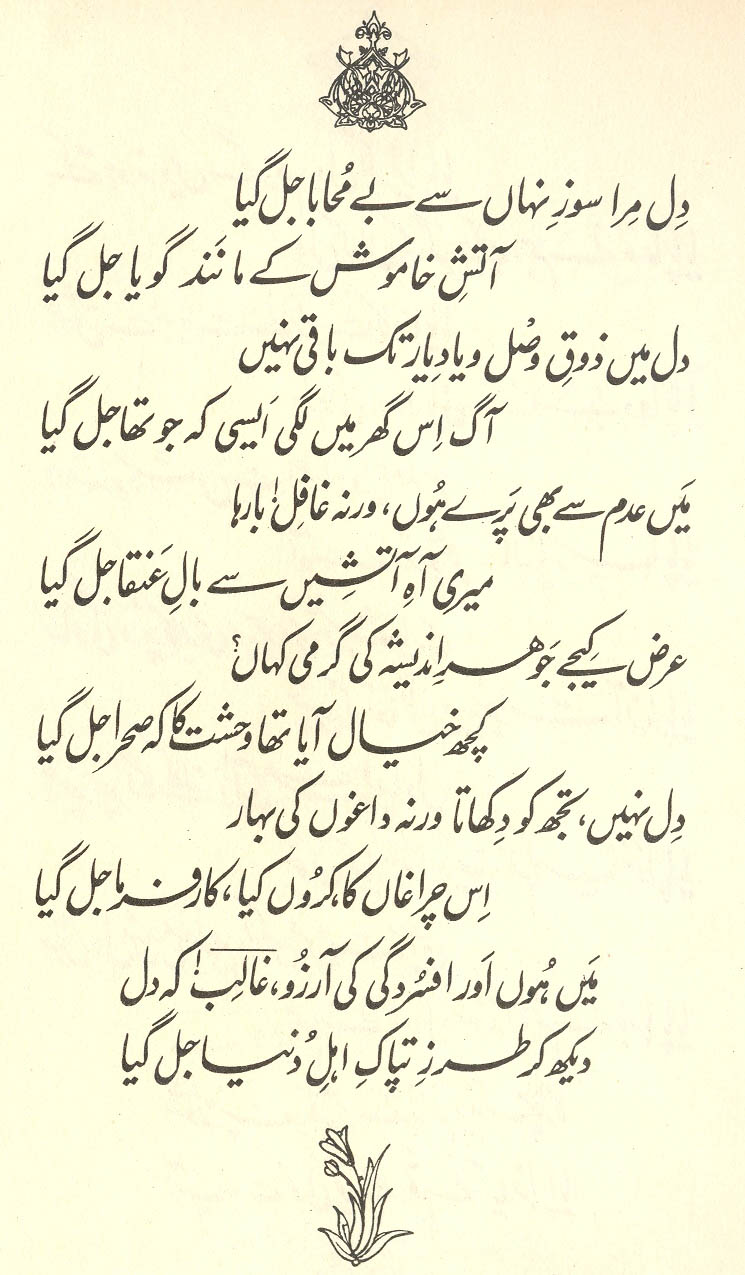
[See his use of in the letter quoted in 234,9 .]
Anqa is the name of a nonexistent bird. And when he [=the speaker] became nonexistent, he too was in nonexistence, and the fiery sighs and the wing of the Anqa could come together in the same field. For this reason the wing of the Anqa burned from his sighs. But the poet's saying 'I am outside even nonexistence'-- the result of this is that I neither exist nor do not exist, and I transcend opposites.
Perhaps it's about just such verses that people in Delhi always used to say, 'Ghalib constantly composes meaningless verses ', and in reply to that the poet recited this verse: 175,6 . The word is now rejected []; in Lucknow, since the time of Nasikh it has not been in the colloquial language.
== Nazm page 5 ; Nazm page 6


He says, I've emerged even somewhat beyond nonbeing; that is, I've attained 'oblivion in God' []. No doubt, when I was passing through that stage, then more than once, from my fiery sighs, fire spread to the wing of the Anqa. The meaning is that in the beginning of my education in oblivion, I destroyed the reputation of the Anqa, who is considered one of the greatest proofs of being nonexistent. Here refers to those people who cannot understand human progress. (15)
The truth is that I have an inadequate understanding of this verse. And not to speak of my worthless self-- other worthy commentators too, according to my imperfect mind, have not been able to understand it. (108)
It seems that the Anqa lives in the realm of nonexistence []. The speaker used to be there too, and in those days his fiery sighs often burned the Anqa's wings (2a). Or, alternatively, the speaker is simply beyond that realm, which is fortunate for the Anqa because if the speaker had been there, his fiery sighs would often have burnt the Anqa's wing (2b). Not surprisingly, Ghalib's other Anqa verses tend to be similarly difficult and complex.
The phrase-introducer is not only used to contrast past with present situations (as in 2a), but also signals possible contrafactual situations (as in 2b). 'Otherwise' is the best available translation, but it's not as flexible. For discussion, see 3,5 .
Here, can be an adverb describing the heedless, careless way in which the speaker burned (or would have burned) the Anqa's wings. Or it can be an epithet: someone might be addressed as a 'heedless' or 'careless' or 'negligent' one. If so, that person is perhaps being warned: 'Take care-- someone who could burn the Anqa could do something dire to you too!' You (the beloved?), like the Anqa, are perhaps safe from the consequences of your own rash negligence only because the speaker is so far 'beyond even Nonbeing' that he might not (bother to) do anything dire to you.
In other words, this verse need not be read pompously and abstractly. It could just as easily be a kind of teasing one, playfully threatening a companion (the beloved?) with implausibly grandiose-- and also conveniently self-negating-- dangers.
Compare Mir 's play with the possibilities of existence vs. non-existence: M 254,1 . And on the flight of the 'bird of thought': M 431,7 .
graphics/fierysighs.jpg