Verse 51821uudthaa
G3
1
the shroud covered the scar/stain/stigma of the flaws of nakedness
2
otherwise, in every attire/guise I was a shame/honor to existence
'A mark burnt in, a brand, cautery; mark, spot, speck; stain; stigma; blemish; iron-mould; freckle; pock; scar, cicatrix; wound, sore; grief, sorrow; misfortune, calamity; loss, injury, damage'.
'And if not, otherwise, or else; although'.
'Garment, vesture, raiment, robe, apparel, clothes, dress, attire, habit; appearance; guise; a veil'.
'(Persian) Honour, esteem, reputation; —shame, disgrace, infamy, ignominy'.
'(Hindi) Naked, nude; bare; ... —shameless; —s.m. A naked person; a shameless person; —a disgraced person'.
'Shameless'.
'Honour, esteem; —shame, disgrace'.
'Reputation, fame, renown; esteem, honour, grace, dignity; —disgrace, reproach, shame —the female part of a family'.
'Reputation, fame, renown, esteem, honour; dignity; law; divine decrees or judgments; disgrace, reproach, shame; bashfulness, modesty, chastity'. (Steingass p. 1380)
| References | |
|---|---|
| Arshi, Imtiyaz Ali | Ghazal# 4 |
| Raza, Kalidas Gupta | 318 |
| Nuskhah-e-Hamidiyah | 29 |
| Asi, Abdul Bari | 51-52 |
| Gyan Chand | 65-67 |
| Hamid Ali Khan | Open Image |
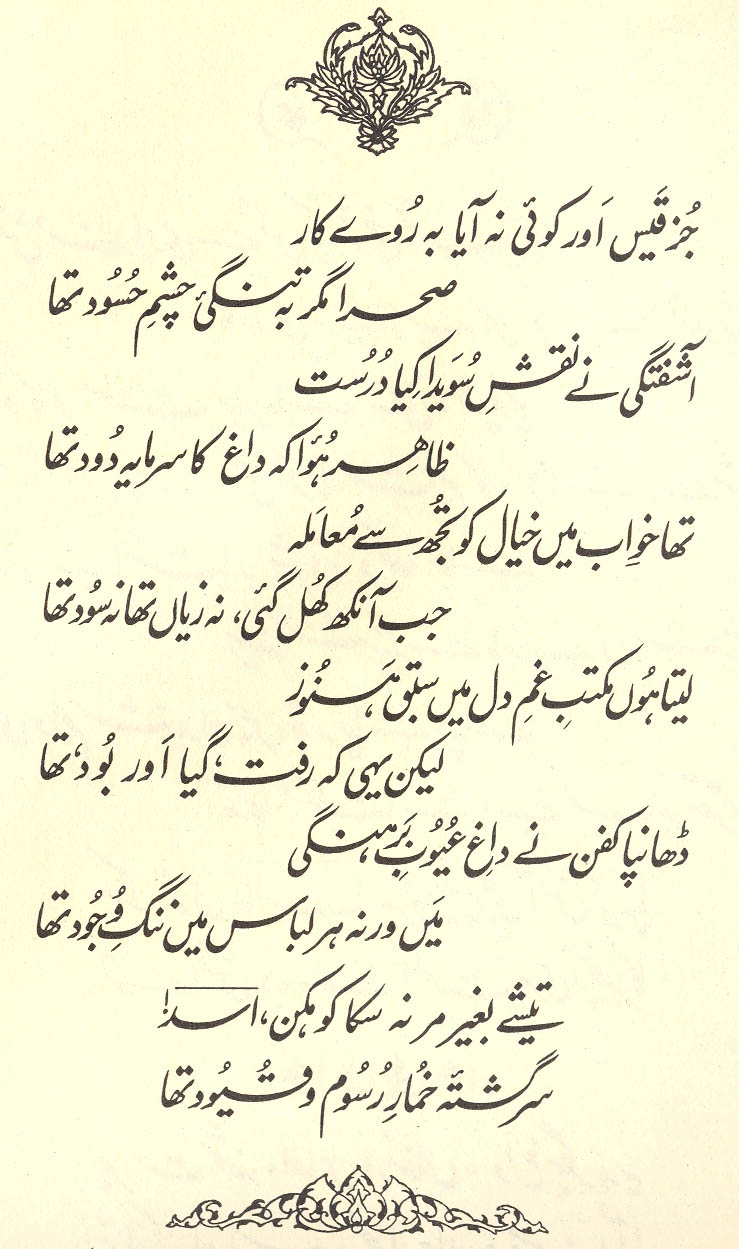
That is, only by dying was the flaw of nakedness erased; othewise, in every attire I was a shame to existence.... It's only a similarity of words that carried his mind aloft and away. (3)
== Nazm page 3

That is, I was so devoid of human qualities that my existence was a cause of shame to the world. (6)
This verse points the mind toward that verse of the Holy Qur'an, in which it is said, 'Oh ye Children of Adam! We have bestowed raiment upon you to cover your shame, as well as to be an adornment to you. But the raiment of righteousness,-- that is the best' (Qur'an 7:26). (23)
CLOTHING/NAKEDNESS: 1,1 ; {3,5}; 6,1 **, on the rhyme -word positioning of ; 6,7x ; 6,11x ; 64,8x ; 82,4x *, tightness; 84,2x (on vs. ); 84,3x ; 87,1 ; 108,5 ; 111,3 ; 145,16x ; 171,1 ; 178,4 ; 192,1 ; 202,1 // 282x,6 ; 312x,3 ; 314x,6 ; 331x,1 ; 332x,1 ; 335x,2 ; 335x,4 ; 377x,5 *; 377x,6 ; 378x,3 *; 381x,4 ; 388x,5 ; 389x,6 ; 400x,4 ; 400x,4 , shoes; 412x,1 ; 433x,7
ABOUT SHAME/HONOR: The powerfully bi-valent Persian-derived word means 'honour, esteem, reputation; —shame, disgrace, infamy, ignominy' (see the definition above); it thus flips back and forth according to context between the two possible forms of public judgment and (dis)repute. It seems clear that for Ghalib the 'shame' meaning is primary: consider 47,4x , 87,1 , and 91,8 , in which only the 'shame' meaning seems to be relevant. But then, to prove the duality of the word, consider 99,5 , in which not but , 'shameless', is clearly a powerful reproach. (The related Hindi-side or means both 'naked' and, secondarily, 'shameless'; see the definitions above.)
The similarly bi-valent term is often conjoined to make the pair , meaning 'Honour, esteem; —shame, disgrace' (see the definitions above). (Though can also be used alone with the same double sense, as in 222,3x .) Behind the duality no doubt is the obvious psychological fact that whatever is a source of pride can easily become, if jeopardized, a source of humiliation and disgrace. (Compare the similar ambivalence in English: 'Doesn't that cause you shame?', in which a feeling of 'shame' is an undesirable thing; versus 'Have you no shame?', in which a feeling of 'shame' is a desirable thing.) For discussion of the same concept(s) in Mir , see M 1896,9 .
In the present verse Nazm, like Chishti, accuses Ghalib of mere wordplay, but the verse is certainly doing 'meaning-play' as well. The similarly two-faced word 'shame' [] can even explicitly become a source of pride, as in 24,1 or especially 83,1 , where this doubleness is discussed in more detail. Then {83,1} should be contrasted with 83,2 , in which 'shame' clearly means something like 'honor'. See also 98,8 for another piquant use of 'shame'; and there's 159,3 as well.
In their discussions of the present verse, the commentators insist on reading only as 'disgrace', but the possibility of 'honor' works perfectly well too, and adds another dimension to the verse. If we take this alternative reading, we have something like, 'The shroud covered the flaws of nakedness after my death; otherwise, while I was alive, no matter what kind of clothing I wore I {was / would have been} an honor to existence'. Now perhaps the lover is saying this semi-sarcastically, but there's no reason he wouldn't or couldn't say it; we have many examples in which the lover speaks sarcastically about worldly prestige. (For a few examples among many, see some of the verses in which the lover confronts the Advisor .)
The speaker may also be proud of his nakedness, as he is proud of that of Majnun in 6,1 . And in 378x,3 , the speaker says flatly that it is his 'attire of nakedness' [] that is 'glory-augmenting' []. Faruqi points out (in ) that sounds to a listener like , 'naked'. The speaker may thus suggest that only the shroud was able finally to cover him; otherwise, his whole life long he flaunted his nakedness and disgrace, even when he (outwardly? seemingly?) wore clothing. This is in fact just the kind of thing the lover so often does; his pride in his passion, and his rejection of the fine facades of the worldly, are at the heart of the ghazal world. The commentators make the speaker grovel. But Ghalib's speaker/lover is just as often unimaginably arrogant; and sometimes, as in this verse, he may be both at once. See for example 7,7 , in which Asad's corpse lies unattended and perhaps even naked, with no shroud at all, while the sorrowful speaker describes him as a 'strangely/remarkably free man'.
The can here suggest either a past condition or a contrafactual situation. It's also a key to the whole structure of the verse, for it signals a contrast between the clause before it and the clause after it-- but what contrast, exactly? The possibilities include: being 'covered' with something versus wearing 'attire'; death (in a 'shroud') versus life (in 'existence'); 'scars' and/or 'flaws' versus either 'shame' or 'honor'; 'nakedness' versus wearing 'attire'.
Compare 220,2 , which is also about issues of shame and honor, life and death.
See also the discussion of Mir's use of in M 1896,9 .
graphics/pragueshroud.jpg