Verse 81847aabme;N
G3
1
shame is a single/particular/unique/excellent sign/charm/gesture of coquetry, even if only/emphatically toward oneself
2 a
how unveiled/shameless they are, who by chance/whim are in a veil!
2 b
how unveiled/shameless they are, who are like this in a veil!
'Grace, beauty; elegance; graceful manner on carriage; charm, fascination; blandishment; amorous signs and gestures, coquetry'.
'Unveiled, immodest'.
'Thus, in this wise, in this manner; --just so, for no particular reason; without just ground, vainly, idly, causelessly, gratuitously; to please oneself'.
| References | |
|---|---|
| Arshi, Imtiyaz Ali | Ghazal# 110 |
| Raza, Kalidas Gupta | 392-93 |
| Hamid Ali Khan | Open Image |
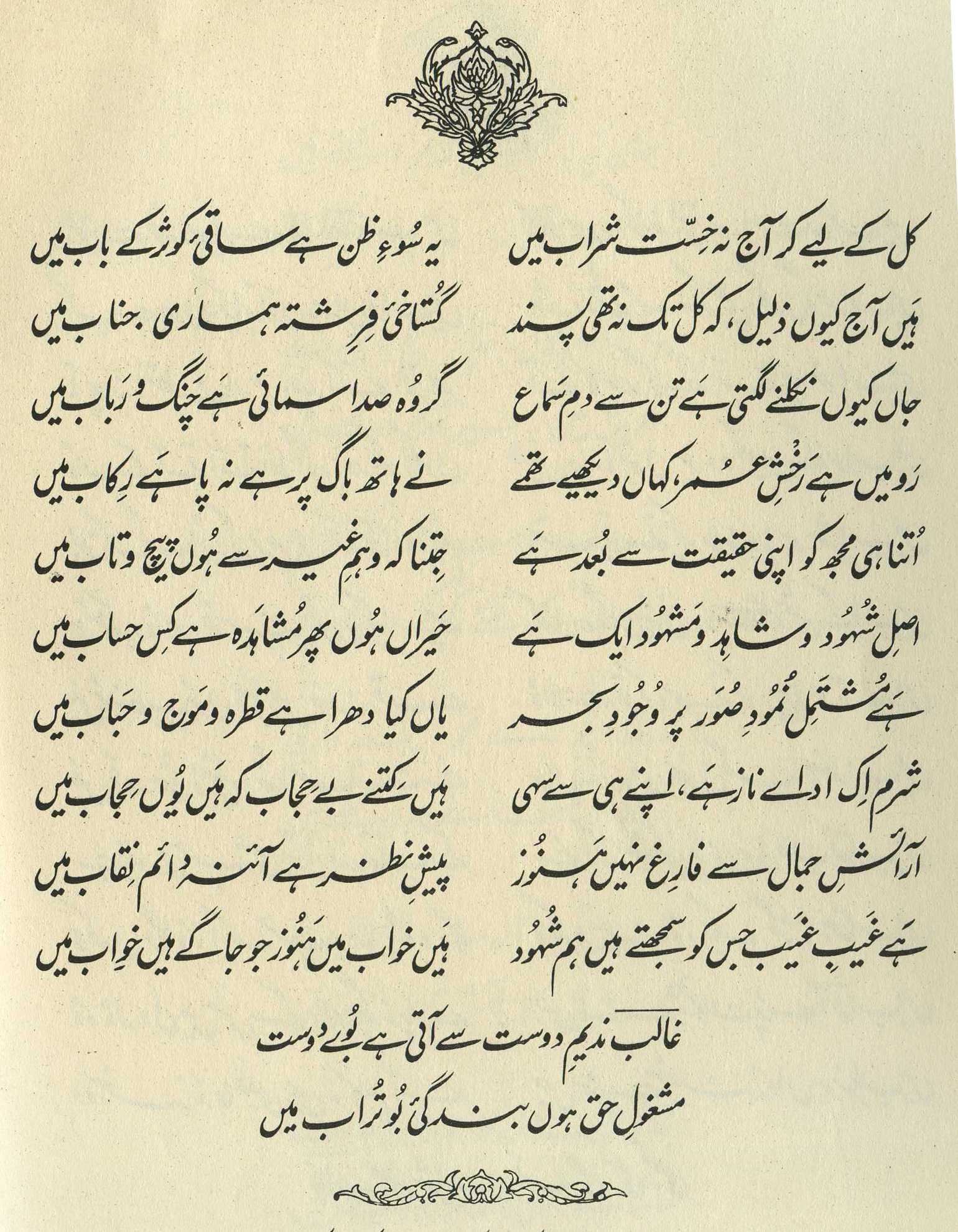
A number of verses of this ghazal are on themes of mysticism [], and this verse too is of that kind. He says that her feeling shame and not appearing before us is a beloved-like coquettish glance. We agree that no one else is present here, and her coquettish glance is for herself alone. But when a coquettish glance and airs and graces are themselves a kind of unveiledness, then her remaining veiled has become mere unveiledness. (102)
== Nazm page 102

He says, shame is a beloved-like gesture of coquetry. If it's for herself alone, even then it will be called a beloved-like gesture of coquetry. But its use will always be on occasions of unveiledness. That is, in a state of veiledness, a gesture of coquetry can't be used, and the state in which it can be used-- such a veiledness is mere unveiledness. This verse too is on mysticism []. The meaning of the verse is that the veiledness that is visible to us is such that the radiance/appearance of the Beloved can be seen. (153)
Shame too is a gesture of coquetry, whether it be shown before an Other or before oneself. In the latter case, showing shame too is a kind of unveiledness and it's clear that a gesture of coquetry must be unveiledness.
In the world, not to see the Lord's radiance/appearance is a beloved-like glance of coquetry; and since a gesture of coquetry is a form of unveiledness, this veiledness too is unveiledness. Although here too, in the manifestation of His power there is no Other. (199)
Some modern editors (including Hamid) have . As always, I follow Arshi.
For more on , see 9,4 .
Structurally speaking, this verse reminds me of 98,10 . Both verses show the same deliberate juxtaposing of paradoxical-seeming opposites in the second line, with repetition of the same key word, and almost parallel phrasing in the second line as well.
The commentators have explained the general sense clearly enough. But they've ignored the most elegant touch: the double sense in which can be read (see the definition above; for more on , see 30,1 ). Idiomatically, it can mean 'for no reason, vainly, casually, by happenstance'. On this reading (2a), the point is that the women are veiled by the merest happenstance, casually, uselessly, on a whim, or for no particular reason. Their being veiled is useless or irrelevant, a joke or a deception-- it doesn't prevent their 'unveiled' behavior toward themselves (and very possibly toward others as well).
Literally, however, means 'like this, in this manner'. So on this reading (2b), the emphasis falls on the nature of the women's behavior-- what's the point of veiling women who behave 'like this' (at least toward themselves, and perhaps toward others as well) when they're veiled? It's tempting to think of the sense as being 'even' when they're veiled, but without the 'even', further possibilities open up.
Then, how we are to interpret ? Is all shame mere coquetry? If so, it is part of people's inevitable play-acting toward themselves, as they try to persuade their own consciences that they're not really the kind of person who does or thinks the kind of thing they have just been doing or thinking. Thus the connection of shame with coquetry can be made: it involves the use of charm, and an attempt to persuade an (inner?) observer that one is a fine specimen. The 'veil' is then the pretense of virtuous behavior that one seeks to maintain-- before the outside world, and perhaps in one's own eyes too.
Or is it merely the so-called 'shame' of these flirtatious women that is a gesture of coquetry? If so, the indictment might be a narrower one and might apply only to them. Why, they're such flirts that even their show of 'shame' is flirtatious-- and not only that, but they do it even when nobody is looking, so they actually end up flirting with themselves!
graphics/veil.jpg