Verse 41847aabme;N
G3
1 a
the steed of lifetime/age is in motion-- let's see-- where would it halt?
1 b
the steed of lifetime/age is in motion-- let's see where it would halt
1 b
the steed of lifetime/age is in motion-- wait and see-- as if it would halt!
2 a
neither is the hand on the reins, nor is the foot in the stirrup
2 b
there is no hand on the reins, nor is there a foot in the stirrup
is really , but is spelled that way so it can become the metrically long syllable needed in that position.
'Light, rays or reflection of light; lightning; brilliance, splendour; —a horse; name of the horse of the celebrated Rustam'.
'Life; life-time, period of life; age'.
| References | |
|---|---|
| Arshi, Imtiyaz Ali | Ghazal# 110 |
| Raza, Kalidas Gupta | 392-93 |
| Hamid Ali Khan | Open Image |
The rider’s lack of power, and the horse’s becoming out of his control-- in the language of whip-riders, there can be no better expression for this. And to give for lifetime/age the synonym of an uncontrolled horse fulfills the claims of excellent use of simile s [].
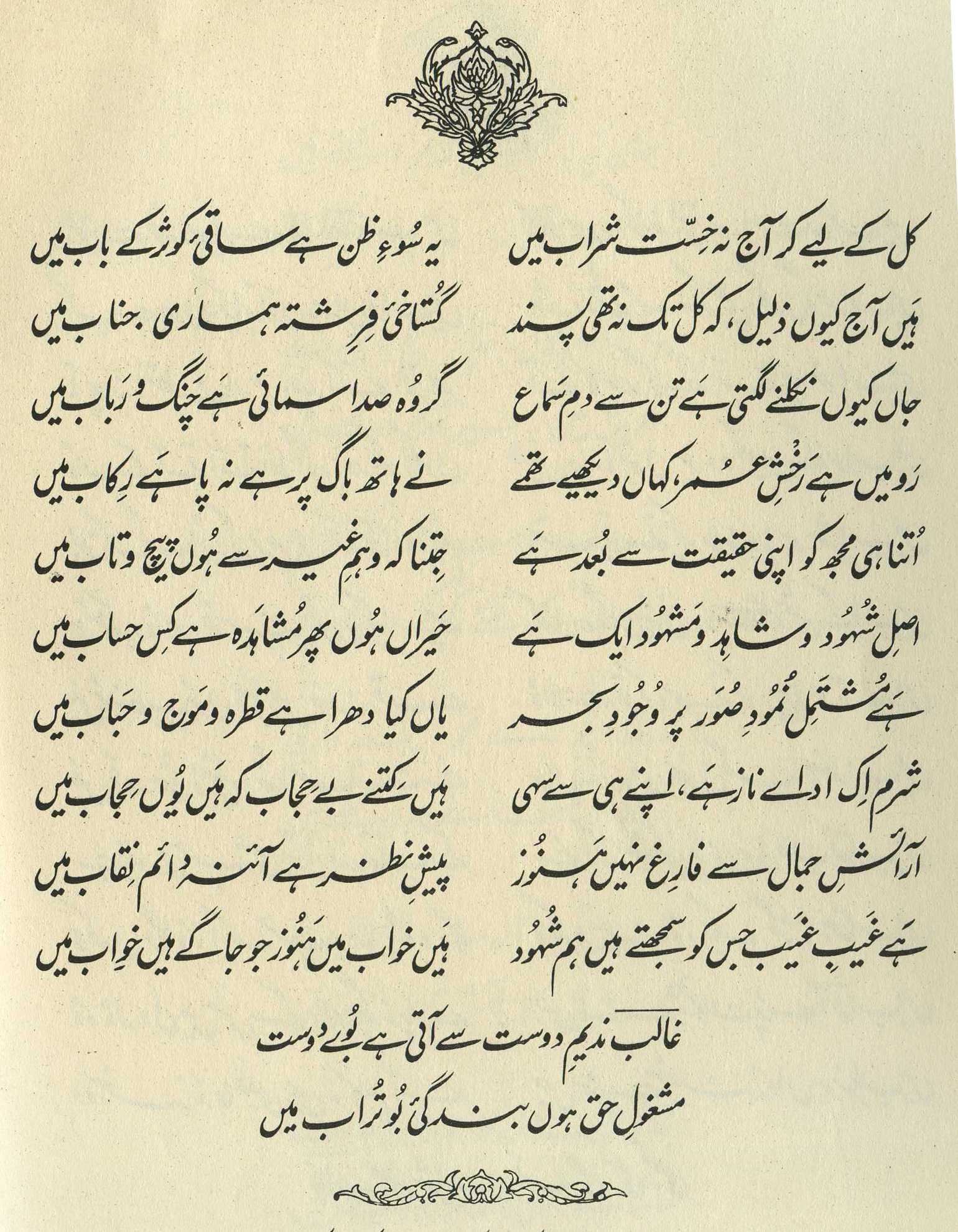
==Urdu text: Yadgar-e Ghalib , p. 149
Lifetime/age is a steed-- and a steed that is not in the rider's control. Let's see how far it takes him before throwing him off its back. (101)
== Nazm page 101

[Hali's words are the commentarial consensus; a few further points can however be added:]
1) 'The steed of lifetime/age is in motion' is a picture of the present. The next part points to the future's being uncertain-- . But what was the state of affairs in the past?... There was perhaps a time when it was not like this, when life was in our control....
2) The 'steed of lifetime/age' must also have stayed quiet at some time-- otherwise, how could I have mounted upon it? Thus its halting in the future will not necessarily be death; rather, it can also be the same kind of peace and serenity.
3) The word 'where' has taken the verse out of time and put it into space. The journey of the steed of the lifetime is in reality a temporal journey, but to establish that the interrogative word is 'when', not 'where'. It's as if in this temporal journey the means of interpretation is place. Are time and space both one?
4) In the second line there's one more suggestion of the unity of time and space. By controlling the reins, both speed and direction are kept in control. If the foot is firmly in the stirrup, the rider remains present on the horse's back. In both of these [images], there's a reference to time and space. (The presence is common to time and space)....
Despite all these points, in the verse the powerful image of movement and strength is beyond analysis and beyond praise. It's hardly a verse-- it's the spirit of all the fine arts.
== (1989: 131-32) 2006: 153-54
As Faruqi says, this verse has an implacability and force all its own. It's so transparent that it hardly needs to be explained, but Ghalib rarely misses the chance to create subtleties. In the first line, has an idiomatic versatility that goes far beyond its official grammatical definition. Its nearest English counterpart is probably 'let's see', or sometimes 'wait and see'. Together with the multivalent , it ensures that the first line can be read in several different rhetorical modes-- all, needless to say, appropriate to the human condition.
The second line contains two possible images behind the grammar. One image, (2a), is of a person astride a runaway horse, desperately holding on, but unable to secure the stirrups or make use of the reins. The other, (2b), is an even bleaker one: a possibly riderless horse, entirely uncontrolled, moving where it wishes or where chance takes it.
Related to these possibilities is another elegant (and elegantly unresolvable) ambiguity. Do we want the horse to pause, since it might mean a chance to reflect, to rest, even to grab the reins and get control of our life? Or do we dread the time when the horse will pause, since that will mean our death?
Compare Mir's version of this theme: M 1091,4 .
You might have noticed the Wallace Stevens lines that I chose for the main Ghalib index page that introduces this site. The poem those lines come from is called 'The Pure Good of Theory', and the lines are from the first stanza, called 'All the Preludes to Felicity'. I can't refrain from putting the whole stanza here, where it so richly and beautifully belongs:
It is time that beats in the breast and it is time
That batters against the mind, silent and proud,
The mind that knows it is destroyed by time.
Time is a horse that runs in the heart, a horse
Without a rider on a road at night.
The mind sits listening and hears it pass.
It is someone walking rapidly in the street.
The reader by the window has finished his book
And tells the hour by the lateness of the sounds.
Even breathing is the beating of time, in kind:
A retardation of its battering,
A horse grotesquely taut, a walker like
A shadow in mid-earth . . . If we propose
A large-sculptured, platonic person, free from time,
And imagine for him the speech he cannot speak,
A form, then, protected from the battering, may
Mature: A capable being may replace
Dark horse and walker walking rapidly.
Felicity, ah! Time is the hooded enemy,
The inimical music, the enchantered space
In which the enchanted preludes have their place.
graphics/steed.jpg