Verse 61847aabme;N
G3
1
the source/essence of witnessing and the witness and the witnessed is one
2
I am amazed-- then how is [the process of] witnessing/sight to be accounted for?
'Bottom, root, origin, base, foundation; original, source; an essential, a fundamental principle; essence; element, principle'.
The being present; —adj. & s.m. Present; —one personally present'.
'One who bears witness, a witness, deponent;... a sweetheart, a beloved object; a handsome man; a beautiful woman'.
'Attested, proved; witnessed'. (Steingass p.1250)
'In a state of confusion or perplexity; perplexed, bewildered, distracted, confounded, astonished... ; harassed, plagued, worried, distressed'.
'Witnessing, seeing, beholding, contemplating; —sight, vision; contemplation; observation; ocular demonstration'.
'A numbering, counting, reckoning, calculation, computation; arithmetic; account, accounts; bill (of charges); rate, price, charge; estimation, judgment, opinion; --condition, category'.
| References | |
|---|---|
| Arshi, Imtiyaz Ali | Ghazal# 110 |
| Raza, Kalidas Gupta | 392-93 |
| Hamid Ali Khan | Open Image |
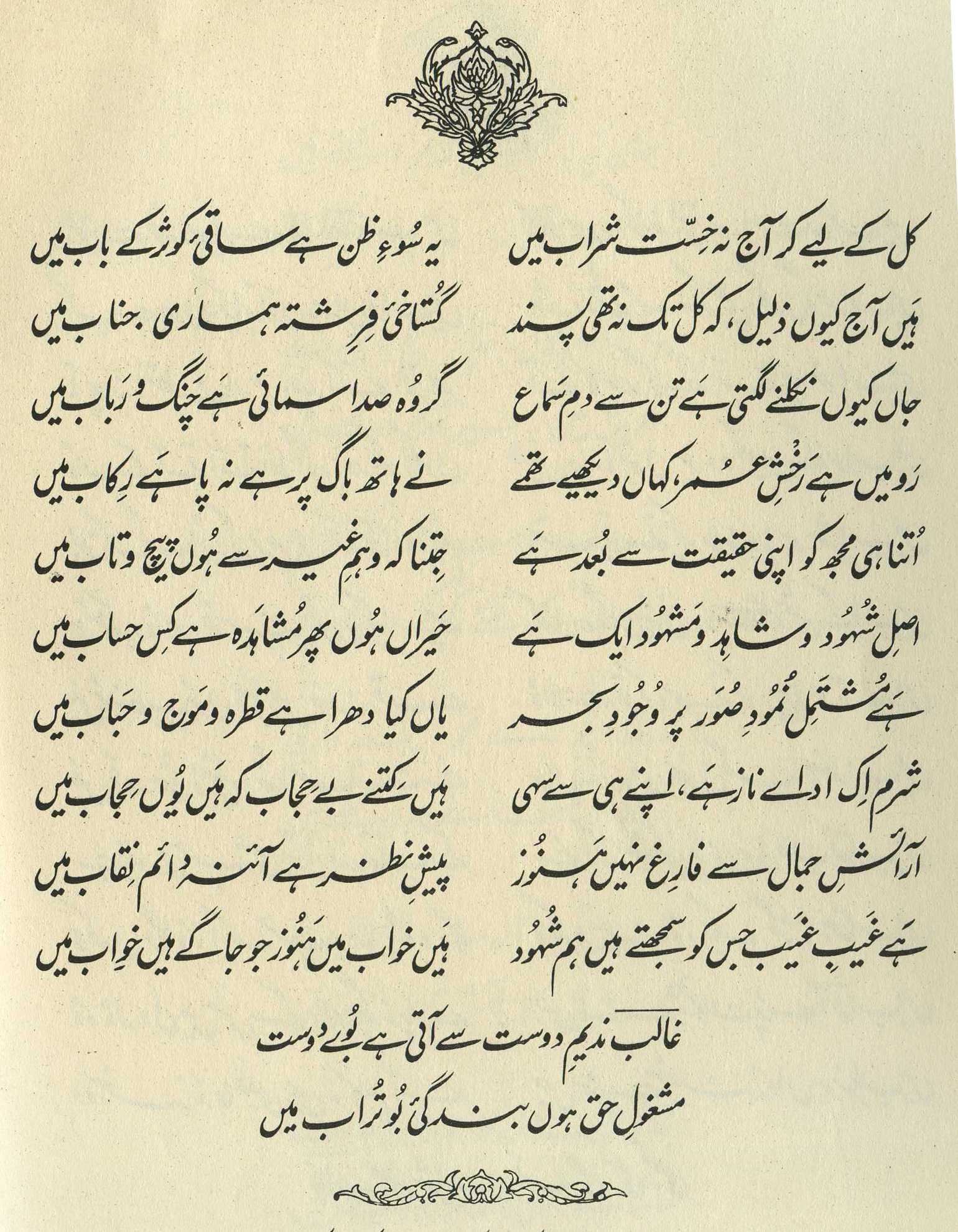
When the whole world exists through the One Existent [], then witness and witnessed become one, and except for the One, no other exists. And for His existence, no other creatures are needed as witnesses; rather, His existence is present by its own very nature. Because if there were a differentiation between existence and essence, then his essence would be in need of an existence, and his existence from all eternity, and to all eternity, and everlastingness, would not be proved. The gist is that the presence and the witnesses are exactly the witnessed and the witnessing. It is necessary for there to be a differentiation between witnessed and witnesses, and when here there's no differentiation at all, then what is the witnessing that people hope for in the afterlife? (101)
== Nazm page 101

To the [mystical] traveler, in everything in the world only God and more God is visible-- this they call 'witnessing/presence'. The meaning of 'witness' is 'beholder', and they call 'witnessed' that which is seen. Mirza Sahib says, the origin/essence of witnessing and witness and witnessed is only one. I am amazed-- when all these three things are one, then in what account is the act of witnessing to be entered? (152)
When it's settled that the whole world is a ray from the True Presence (the Lord), and apart from him there's nobody-- when the seer and what is seen and the sight have been declared to be one, then I don't understand how the act of seeing can occur. Who sees? Whom does he see?
In a famous anecdote of divine revelation [], the reason for the creation of the world is revealed to be that the Lord commanded, 'I was a hidden treasure. I wanted people to recognize me. I created the world.' In reply to this he [=Ghalib] says, the world is You, you are You-- so who will observe? And what will he observe? (198)
This verse has a lot of charm (as well as depth)-- provided we look at it as poetry, rather than as a passage of heavy-duty philosophical prose.
Structurally, it's a kind of a word-exploration verse centering on the word and its relatives. They all have to do with seeing or literally 'witnessing', in the sense both of seeing and of 'bearing witness', as in a legal proceding. (It's because the beautiful person's beauty 'bears witness' to God's creative power that the beloved is called a ; it's because martyrs 'bear witness' to God's truth that they are called.)
The energy comes from the speaker's reaction to the problem he's describing. He does a creditable imitation of a naive learner drowning in the strange depths of philosophical or theological language. Hey, he says-- if the 'seeing' and the 'seer' and the 'seen' are all basically one, then what kind of 'seeing' is going on here, anyway? He's surprised and amazed [], or at least professes to be so. Perhaps he's a bit sheepish-- he might be embarrassed by his inability to get it all straight? Or his tone might well be suspicious-- are they trying to put something over on him? Is this a shell game, or what? Or maybe he asks his (rhetorical?) question triumphantly-- 'ha ha, I've caught them in their tricky rhetoric, I've got them now!'
I imagine the speaker as counting the key words off on his fingers as he lays out his argument-- to help keep them straight, and to make it clear that he's no sucker who can be easily bewildered by a fancy vocabulary. The word 'account' [] lends support to my readings-- the speaker can be imagined as asking for a kind of reckoning; he's confronting one or more people, and demanding a better expanation, a less bewildering account.
Even if we stress the enjoyably non-straightforward uses and possibilities of the verse's question, that doesn't at all deprive us of the chance to think of the question seriously as well. Just the way paranoids have enemies too, naive beginners and cynical skeptics are often the ones to put their finger on the most importan, unanswerable questions. If anything, I think the serious theological questions implied in the verse are much more engaging when combined with less serious readings into a wonderfully variegated braid of possible performance styles. As usual, Ghalib gives us no help in choosing any one privileged reading, so we are invited (or forced) to consider them all.
This sophisticatedly fake naivete, as a rhetorical device, is called ' feigned ignorance '. As he does with every device he uses, Ghalib makes the most of it. My favorite parallel is the seemingly short and simple 162,4 -- 'when there's nothing there except You, what's all this fuss about?'. It's both the most naive question in the world (in fact even quite funny), and one of the most sophisticated and unanswerable.
The sound effects also work very well. The constant repeating of variations of the same Arabic root fills the verse with sounds. And if you recited cleverly, you could use them to create very nice effects of phonetic confusion that would add even further resonance to the predominant effect of semantic confusion.
graphics/escher.jpg