Verse 4after 1847aakyaa hai
G8
In this meter the first long syllable may be replaced by a short; and the next-to-last long syllable may be replaced by two shorts.
1
when/while/since without You, no one is present/existing
2
then, this commotion/crowd, oh Lord -- what is it?!
'adv. & conj. At the time when, when; while; since (temp. & caus.)'.
'Found; —brought into existence; existing; extant; —present; standing before; ready, at hand; available'.
'A convention, an assembly, a meeting; a crowd; --noise, tumult, commotion, confusion, uproar; sedition, disturbance, disorder; an affray; assault'.
| References | |
|---|---|
| Arshi, Imtiyaz Ali | Ghazal# 215 |
| Raza, Kalidas Gupta | 401-02 |
| Hamid Ali Khan | Open Image |
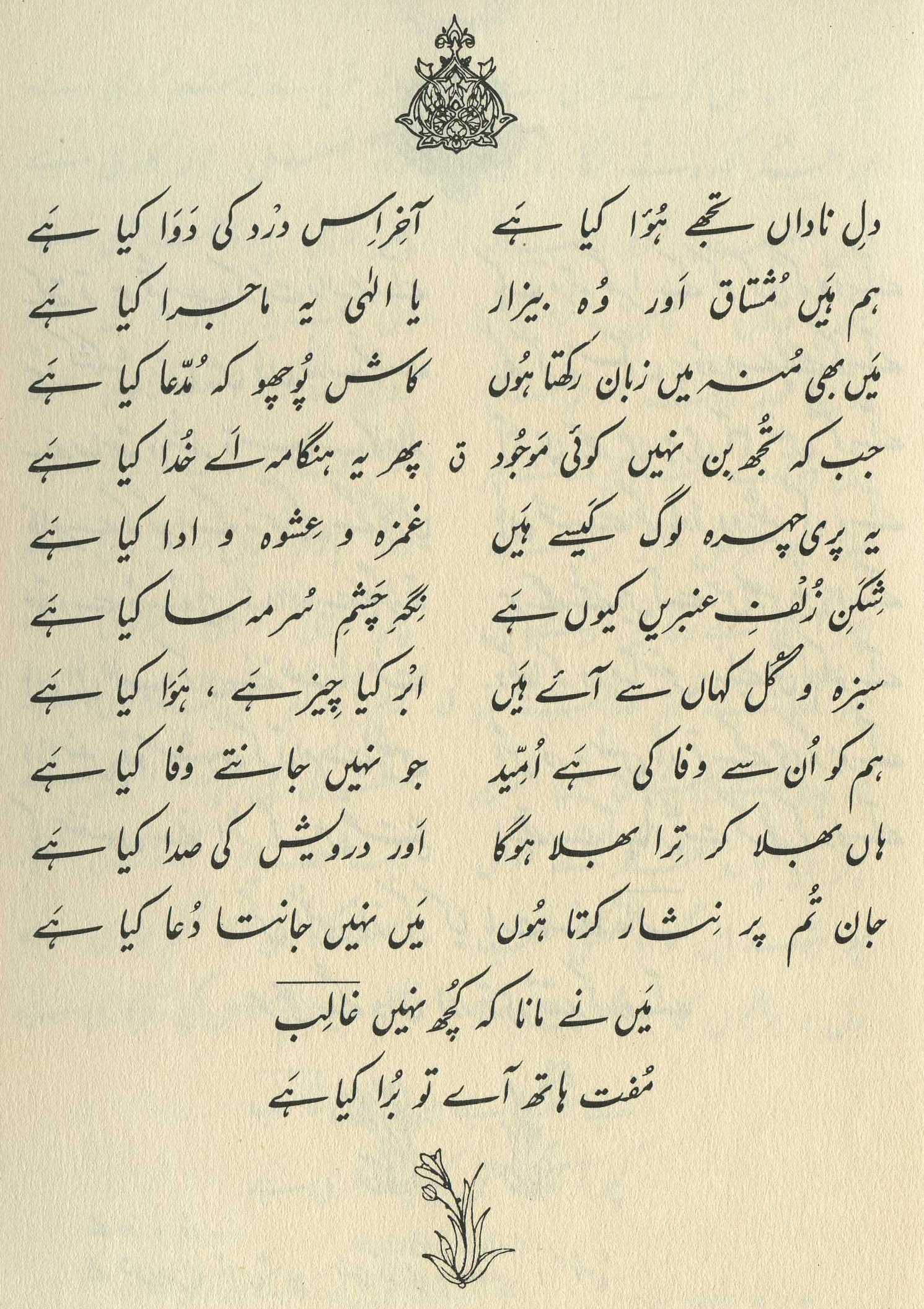
This verse-set is a complaint that during the movement of this interesting and captivating commotion, how can a person find the inner tranquility to consider it contemptible and turn his attention to the presence of the Truth? This mirage-like appearance has made us so absorbed that we've washed our hands of the search for the sea itself. The complaint is that we want to consider the pleasure of the world contemptible and and pay no attention to it, but its captivatingness doesn't cease to pursue us. (175)
== Nazm page 174 ; Nazm page 175


He says, 'Oh Lord, given that no one beside You is even present in the world, how does this commotion arise?'. (233)
The Sufis' belief is that there is nothing but the Lord; other than He, nothing else even exists. At this problem he is wonder-struck, and asks [in the whole verse-set], 'Oh my Protector, if Yours is the only existence, and no one else is present, then why is there this commotion-- that is, the variegatedness and hustle and bustle of beings? These airs and graces of beautiful ones, these black curly tresses, these collyrium-shadowed glances-- after all, what then is all this? And how were roses and grasses created? What kind of thing is a cloud, what is the breeze?' That is, our eyes are seeing all these things. So how would we be able to understand this problem? That is, multiplicity forbids us to understand oneness, and we are helpless. (312)
This is the beginning of a four-verse verse-set . It's a very real and strongly marked verse-set, too. This verse is the conceptual key to it, and poses the basic question; the following three verses add additional, powerful evidence of the (apparent) multiplicity and (genuine) attraction of the real (?) world.
The word is wonderfully apt-- every one of its meanings (see the definition above) works, and adds another layer to the question posed in the verse.
This verse-- and by extension, this verse-set-- seems to be addressed not to a human beloved but clearly to God. For more such examples, see 20,10 . The speaker is using a rhetorical device called ' feigned ignorance ': he makes a great show of naive perplexity.
The rest of the verses in this set are even more radically . They can be read either as sincerely interrogative ('Tell me, God, about these beauties of the phenomenal world'), or as admiringly exclamatory ('For things that don't exist, they're pretty phenomenal!'), or as derogatory ('What's the point of all this fake and superficial clamor?'). Needless to say, all three readings work beautifully with the basic question posed by the verse-set.
On the flexibility of , see 53,8 .
Compare the unpublished 424x,7 , which similarly plays with questions of existence or ownership of the self, and which might even be read as accusing the Lord of a veiled form of 'self-worship'.
Compare Mir 's equally mystical and faux-naïf M 70,4 .
graphics/fatimahmasumahqom.jpg