Verse 81816aar-edost
G1
1
when/while/since I make my complaint of weakness of the mind/nose
2
he 'heads into' a story of the fragrance-scattering curls of the friend/beloved
'adv. & conj. At the time when, when; while; since (temp. & caus.)'.
'To make head[way]; to bring to an end, accomplish, achieve, perform, complete; to discharge, fire (a gun)'.
'Ambergris, a rich perfume:... —, adj. Shedding fragrance, fragrant'.
is an archaic form of ( GRAMMAR )
| References | |
|---|---|
| Arshi, Imtiyaz Ali | Ghazal# 51 |
| Raza, Kalidas Gupta | 170-171 |
| Nuskhah-e-Hamidiyah | 88-90 |
| Asi, Abdul Bari | 99-100 |
| Gyan Chand | 173-174 |
| Hamid Ali Khan | Open Image |
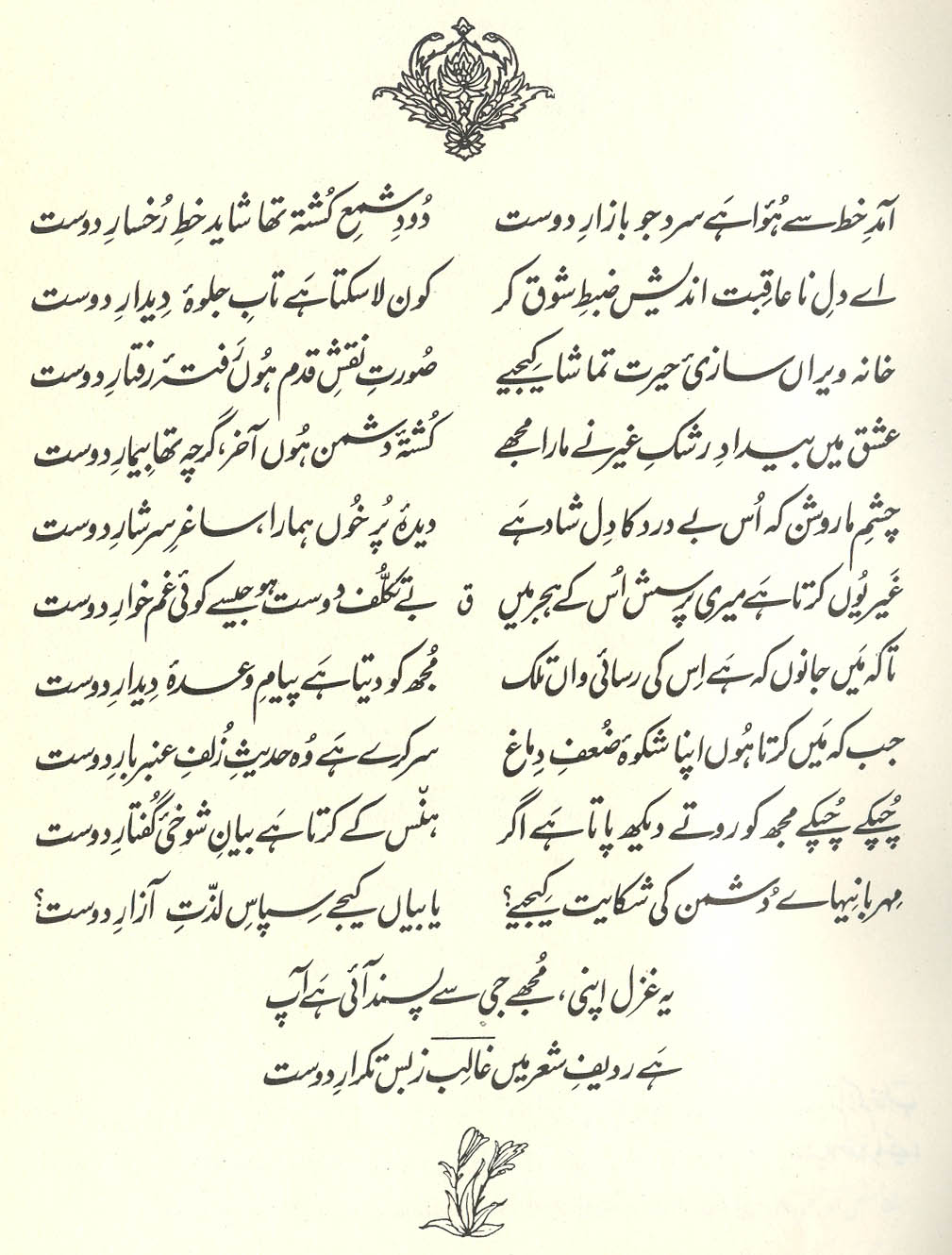
with a meaning of 'to begin' is a translation from Persian. (49)
== Nazm page 49

By saying this he means that the perfume of the beloved's curls is a cure for weakness of the mind, so why do you complain to me of weakness of the mind? (93)
Perfume is considered to be a cure for weakness of the mind. (191)
ABOUT : The versatility of (see the definition above) comes in handy here, since all three of its relevant meanings work very well with the second line. It could be marking an occasion ('at the time when I do' X, he always responds with Y); or emphasizing duration ('while I'm in the process of doing' X, he interrupts by launching into Y); or expressing causality ('since/because I do' X, as a result he does Y). For other examples of such flexibility, see 162,4 and 209,11 . Compare the similar (but even greater) flexibility of , discussed in 12,2 .
This is the third verse in a five-verse verse-set that begins with 53,6 and is discussed more fully there.
It's a verse that finds its chief charm in wordplay . Above all, it plays with the secondary meaning of the common , which means not only 'mind', but also 'nose'. (For more on this, see 11,2 .) When the lover complains about the weakness of his mind, 'he'-- whom we know from 53,6 to be his rival, the Other -- promptly 'heads into' a story about the beloved's ambergris-scattering curls. This final image works perfectly, since it unites the ideas of head (curls) and nose (perfume). Perfume as a cure for weakness of the mind is an additional notion invoked by some commentators. (It's true that 'heads into' isn't a perfect equivalent of -- see the definition above-- but it's pretty tolerable, and I couldn't resist capturing the wordplay.)
This is apparently another installment in the Other's campaign to harass and distress the lover, while pretending to offer company and cheer him up. The Other might, of course, be faking it: he might be as thoroughly deprived of the beloved's company as is the lover. But if so, he hasn't lost his hostility. Or could he possibly mean it kindly after all, as a form of distraction or even a curative process (as Bekhud Dihlavi and Mihr believe)? Unlike 53,7 , this verse contains no allegation of motive.
graphics/curls.jpg