Verse 31816aar-edost
G1
1
the house-desolate-making of amazement-- please make a spectacle of it!
2 a
I am in the semblance/shape of a footprint, [made] 'gone' by the friend/beloved's gait/'going'
2 b
like a footprint, I am made 'gone' by the friend/beloved's gait/'going'
'Form, fashion, figure, shape, semblance, guise; appearance, aspect; face, countenance; prospect, probability; sign, indication; external state (of a thing); state, condition (of a thing), case, predicament, circumstance; effigy, image, statue, picture, portrait; plan, sketch; mental image, idea; --species; specific character, essence; --means; mode, manner, way'.
'Gone, past, departed; deceased, defunct; lost'.
'Going, motion, walk, gait, pace; procedure, manner of proceeding'.
| References | |
|---|---|
| Arshi, Imtiyaz Ali | Ghazal# 51 |
| Raza, Kalidas Gupta | 170-171 |
| Nuskhah-e-Hamidiyah | 88-90 |
| Asi, Abdul Bari | 99-100 |
| Gyan Chand | 173-174 |
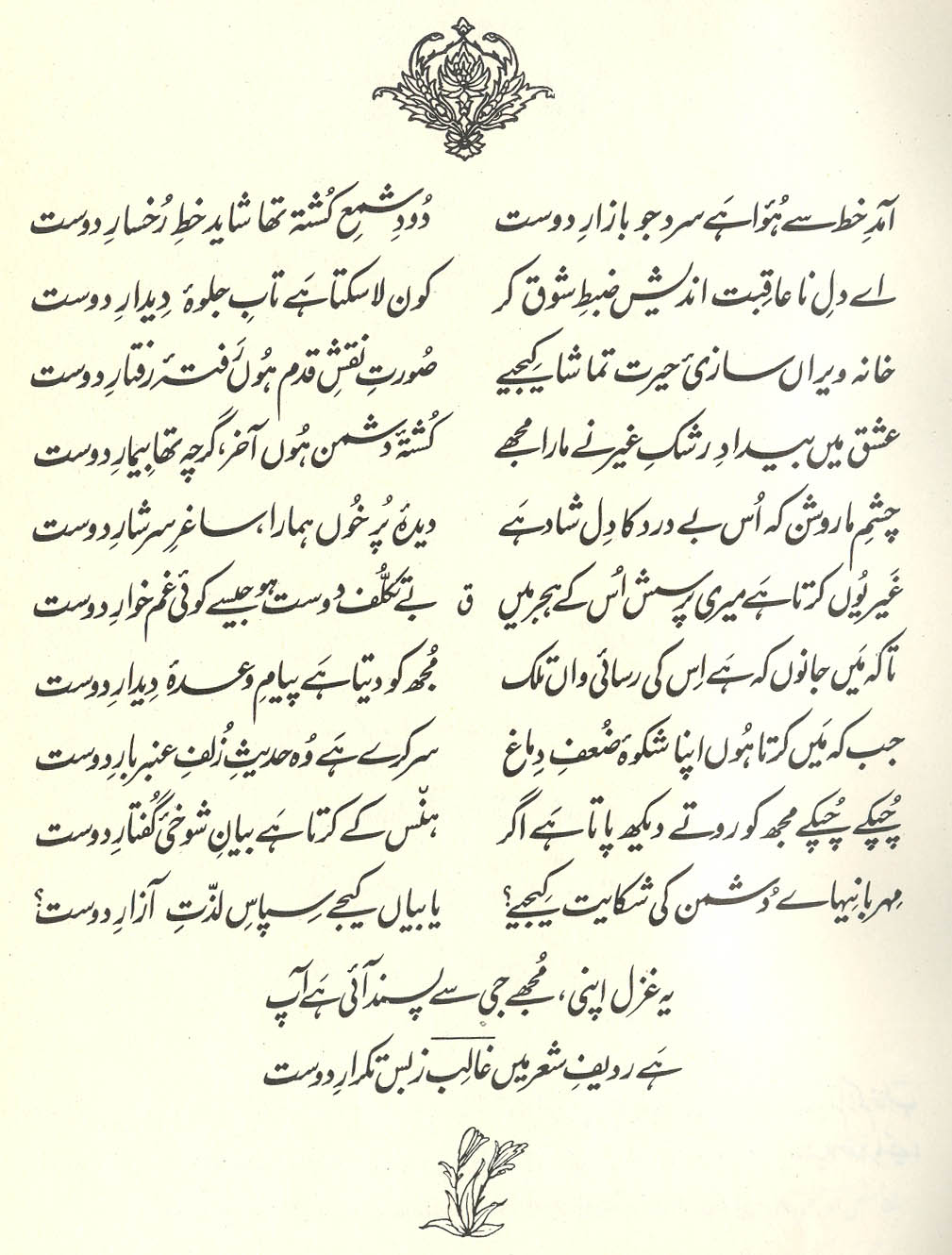
| Hamid Ali Khan | Open Image |
Among the qualities of a footprint, the amazement of poets is well-known. They say that just as a footprint, seeing the speed of movement, has become the eye of amazement, similarly I too am carried away by her gait, and the home-desolatingness of amazement has left me turned into a footprint by the side of the road. (48)
== Nazm page 48

, that is, erased by the gait, meaning mad for the gait. is the translation of a Persian idiom. He describes himself as in the grip of amazement, and trodden under foot, and in a state of homelessness, with the simile of a footprint. (81)
He says, consider the home-desolatingness of amazement. That is, we have become absorbed in amazement and forgotten our house, and without us that house has become desolate. We saw the spectacle of the beloved's gait; its effect was that we become self-less and intoxicated like a footprint and fell to the ground and lay there, and in a little while we will surely be erased. (92)
Just as the footprint, seeing the beloved's gait, remains amazed, similarly I too am absorbed in the gait. The beloved has gone on, but I lie in the street in amazement like a footprint, and amazement overpowers me, so that I have no power to move. Just as amazement has destroyed me, so it has desolated my house as well; it's a sight worth seeing.... 'House' can also mean 'the house of the body'. (227)
They call the footprint amazed because it never blinks its eye, as if it were an eye wide open in amazement. (127)
This verse, like others, builds on the double (worldly and mystical) meaning of ; for more on this, see 8,1 .
The second line is cleverly orchestrated to yield two distinct readings. The word .suurat can mean 'having the likeness/shape of' (the speaker has the appearance of a footprint), as in (2a); or it can be adverbial, meaning 'like' in a general way (like a footprint), as in (2b). And then the verb huu;N is in a 'midpoint' position, so that it can be read with either the clause before it, as in (2a), or the clause after it, as in (2b).
But surely the heart of the verse is the interplay between ('gone', past, departed; and idiomatically, 'mad about, crazy about') and ('going', gait, pace'). Both are from the same root, and are thus so similar in sound that their juxtaposition is a pleasure in itself. Thus the lover is [made to be] 'gone' through her 'going' [].
But the pleasure doesn't end there. The beloved's gait is what carries her away from the lover, as she walks onward; her gait also carries him away, as he watches it and is ravished with love. Yet he is like a footprint, and a footprint by definition is not carried away-- it's the very thing that is left behind when someone walks onward. As a footprint, the lover is merely an empty shape carved out by the brief pressure of that arrogant little foot on the ground; he was helplessly created, and is helplessly stupefied with love, and has now been helplessly left behind.
As Josh points out, the image of a footprint for the lover's 'amazement, stupefaction' [], is well established in the ghazal world. The footprint-- motionless and flat on the ground-- has the shape of an unblinking, unwavering eye, fixed open forever in helpless wonderment by the transcendent sight it has seen. For more on the special nature of , see 51,9x .
The 'house-desolatingness' [] of passion lies in its reduction of activity and agency to passivity and submission. The footprint is outside, homeless, an empty hollow in the ground; it has no further need of houses.
graphics/footprint.jpg