Verse 12x1816aar-edost
G1
1
the closed eyes of the people are nothing other than a shape/form of self-regard
2
the mirror is the mould/form of the brick/tile of the doors and walls of the friend/beloved
'Fastened, tied up, bound; shut, closed, stopped, stopped up, cut off; prevented, hindered, barred, checked, restrained'.
'Self-conceit, vanity, pride'.
'A mould, model, form, prototype'.
| References | |
|---|---|
| Arshi, Imtiyaz Ali | Ghazal# 51 |
| Raza, Kalidas Gupta | 170-171 |
| Nuskhah-e-Hamidiyah | 88-90 |
| Asi, Abdul Bari | 99-100 |
| Gyan Chand | 173-174 |
| Hamid Ali Khan | Open Image |
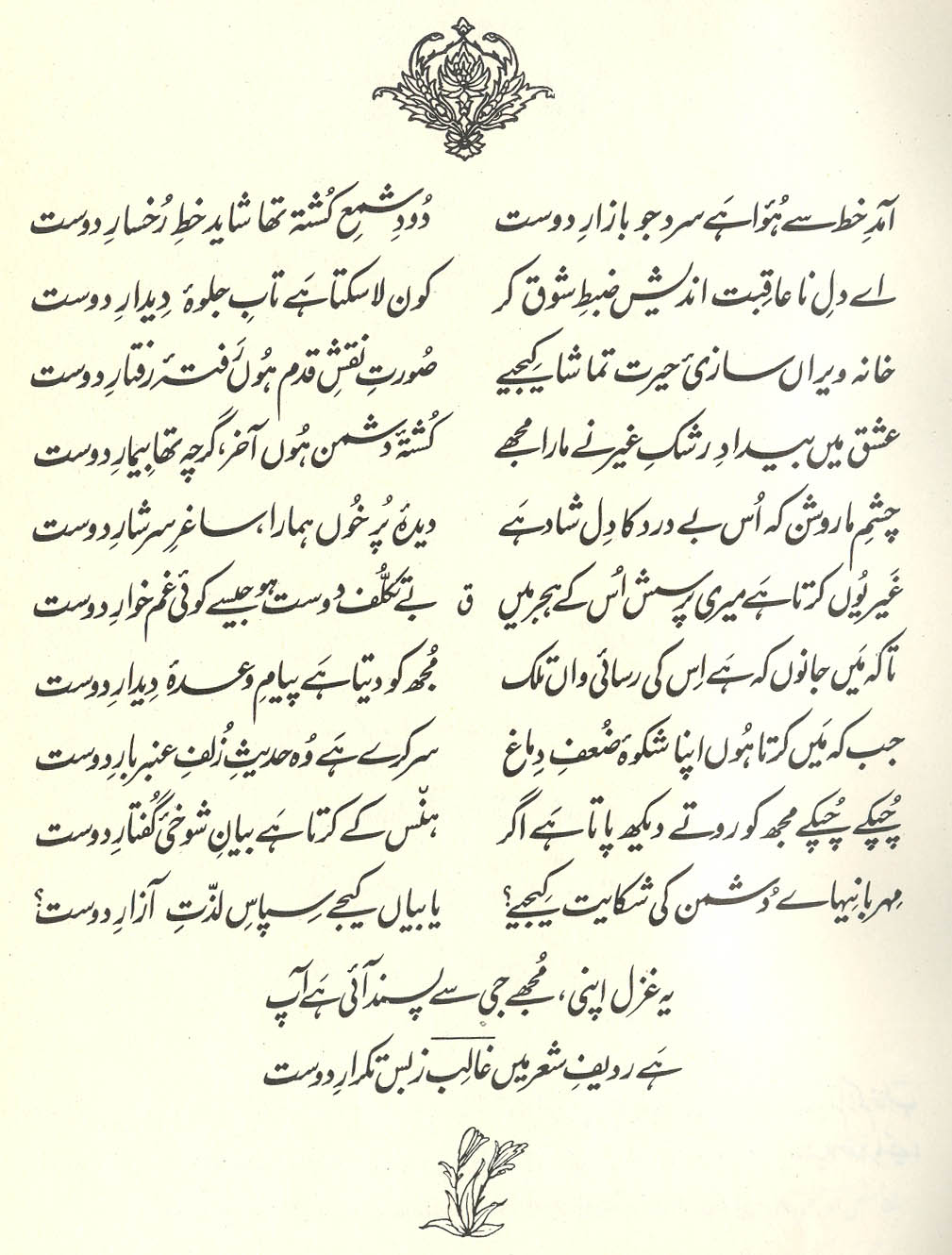
It is an allegory of self-regard-- that is, self-regard is a thing such that it closes the eyes of the world, and for this reason the radiance/appearance of the friend/beloved remains concealed and hidden from their eyes. In order to remain concealed and hidden, doors and walls of seclusion are necessary, and doors and walls are made of bricks. Bricks are made in a mould.
Therefore with regard to these doors and walls too that have kept the glory/appearance of the friend/beloved concealed and hidden from the eyes of the world, since bricks are necessary, we ought to remember that those bricks from which the door and walls are prepared, are shaped in the mould from which self-regard is made. That is, self-regard hides the glory/appearance of the friend/beloved from the eyes of the world.
== Asi, p. 99
That is, no one else closes the people's eyes-- it is their very own reflection that they see in the 'mirror of allegory ' of the friend/beloved's doors and walls....
Or else, our self-regard has deprived us of the sight of the Lord. In this case, the second line has no connection with the first line.
== Zamin, p. 142
In verses of an allegorical [] style, in the first line a claim is made, in the second line by means of a simile a proof is brought. This is just the mood of the present verse. In the first line the claim is that if the people of the world would close their eyes and make a show/guise of meditation, then in truth this is nothing more than self-regard. The result of averting the eyes from scenes of the external world and closing oneself up in a room will be that all the attention will remain limited to one's own self, and this is self-regard.
An allegory of it is that the beloved becomes shut up within her house. The bricks of her doors and walls have been shaped in the mould of a mirror-- that is, they themselves are mirrors. For this reason, in her doors and walls only her own form is visible to the beloved. This is because when no one else will be in the house, then she will think only about herself; this becomes self-regard.
In the above commentary, 'closed eyes' has been assumed to be the subject [], and 'a shape/form of self-regard' to be the predicate nominative []. In the same way, in the second line 'mould of the brick' has been taken as the subject, and 'mirror' as the predicate nominative. Asi has done the reverse of this and has created the following meaning: 'Remaining absorbed in self-regard closes people's eyes'-- that is, it makes them heedless and prevents them from seeing the glory/appearance of the beloved. The means of self-regard is the mirror. In this way the mirror between the beloved and the people becomes a wall and is an obstacle.
I will not endorse this commentary [of Asi's] because in 'the doors and walls of the friend/beloved' there's no style of veiling. A wall by itself can be an obstructive concealment, but for 'doors and walls' this meaning is not appropriate.
== Gyan Chand, p. 173
For background see S. R. Faruqi's choices . This verse is NOT one of his choices; I thought it was interesting and have added it myself. For more on Ghalib's unpublished verses, see the discussion in 4,8x .
Of course if a line says that X 'is' Y, it must through grammatrical symmetry be reversible, so that Y also 'is' X. But in a verse as abstract as this one, it's hard to see that it would make much difference either way. Still I'm pleased that Gyan Chand joins me in recognizing that such a structural and interpretive device exists.
To my mind, the real source of multivalence in this verse is its 'A,B' structure, such that we have to figure out for ourselves the relationship between the two lines. Are they both about 'the people' and their (in)ability to see the beloved? Are they both really about the beloved and her/His invisibility to the people? Or is the first line about 'the people' and the second line about the beloved? And in this latter case, are their situations being compared, or contrasted?
The real problem with this verse is that the multivalent possibilities don't form clearly in the mind. To say that 'closed' eyes are a form of self-regard or vanity is plausible in itself-- but then, what is the connection with the 'mirror' image in the second line? How can closed eyes see a mirror? Closed eyes themselves would seem to form a much more direct and literal image of 'self-regard' (through refusing to regard anything else), without the artificial mediation of a mirror.
And in the second line, if the beloved's doors and walls are made of mirror-bricks-- and the idea of a door made of mirror-bricks is problematical in itself-- then do those mirror-surfaces face inward, or outward, or both ways? For if they face inward, perhaps the (human) beloved is just as much a prisoner of 'self-regard' as are the people of the world. In fact this was the way I initially read the verse, and it still remains my favorite reading, since it's the only one that offers any real connection between the lines. The people with their closed eyes, the beloved in her mirror-chamber-- why should they not be in morally or physically similar situations?
The mirror, the most protean image (and Ghalib's favorite) simply has too many possible readings, and these are left too unresolved; thus the verse never sufficiently focuses our attention or thought. The mirror-brick imagery is intriguing, though, and there's the nice little wordplay betweenand .
graphics/mirrorbricks.jpg