Verse 41816aar-edost
G1
1
in passion, the injustice/iniquity of the envy/jealousy of the Other struck me down
2
I am [in a state of having been] killed by the enemy, finally, although I was sick over/through the friend/beloved
'Envy, emulation, jealousy, grudge, spite, malice'.
'Envy, jealousy; pride, haughtiness, self-admiration'. (Steingass p. 578)
| References | |
|---|---|
| Arshi, Imtiyaz Ali | Ghazal# 51 |
| Raza, Kalidas Gupta | 170-171 |
| Nuskhah-e-Hamidiyah | 88-90 |
| Asi, Abdul Bari | 99-100 |
| Gyan Chand | 173-174 |
| Hamid Ali Khan | Open Image |
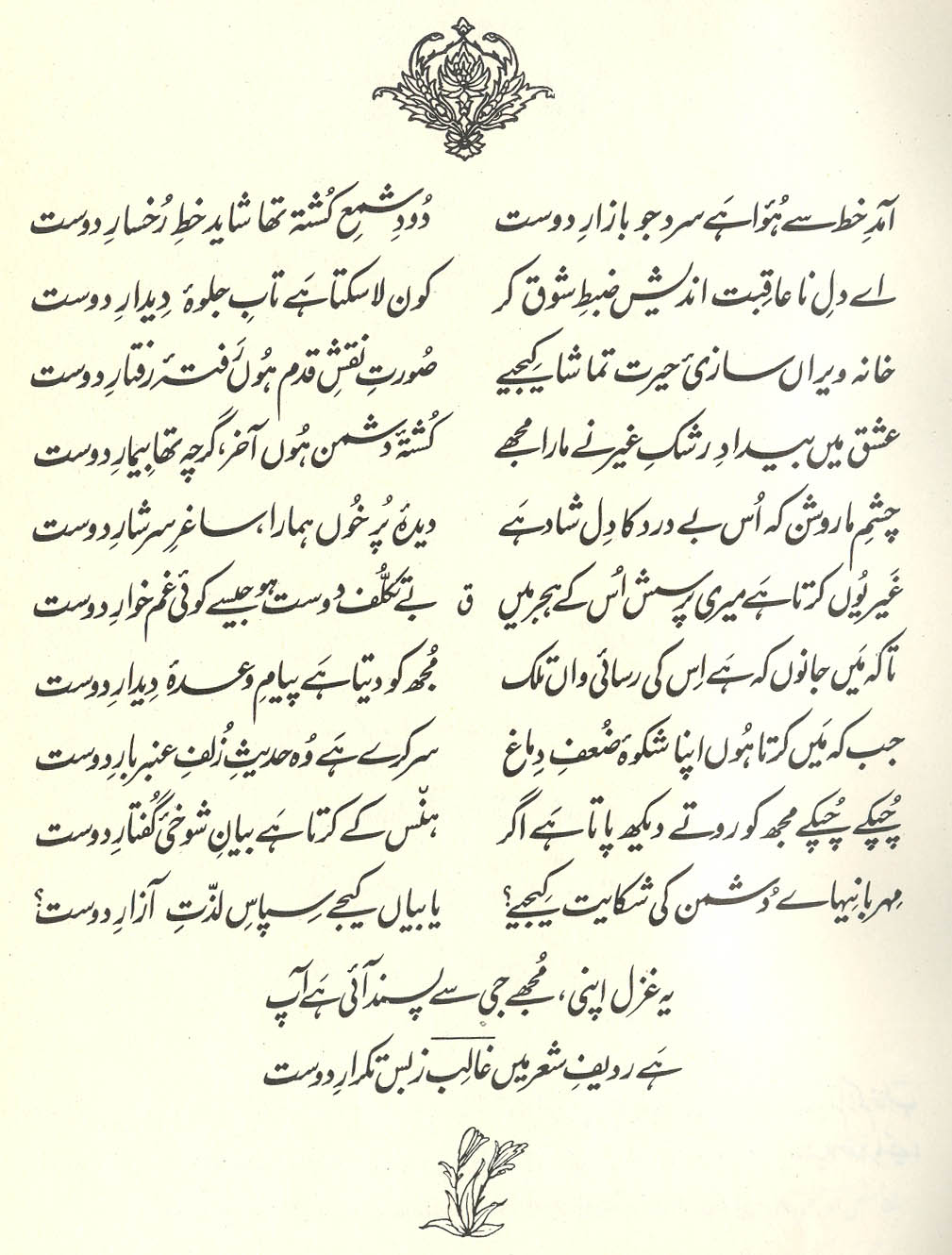
The cause of being sick over the friend is passion, and the cause of being killed by the enemy is that the envy/jealousy of the enemy slew me. (48)
== Nazm page 48

He says, absorbed in the beloved, I had been sick for some time with the sufferings of passion. I was already only half-alive; now the injustice of the envy/jealousy of the enemy gradually slew me. Previously I was sick due to the friend; now I have been slain due to the enemy. Alas, that I came to no good end. (92)
The injustice of the envy/jealousy of the Other took my life. (117)
ABOUT : As can be seen from the definitions above, is a versatile word. In principle, 'envy' is a broad term for the pain caused by non-possession: the fact that someone else has something that you don't have but want to have (as in 116,10 ). And 'jealousy' is a kind of pain caused by possession: the fear of losing someone (or something) that you have, to someone else (as in 99,2 ). The word can not only cover both-- if indeed they can really be kept apart (as in 404x,5 they cannot)-- but can include more general possibilities of 'grudge, spite, malice' as well.
Needless to say, Ghalib pushes a concept like this to its limits. He reflects on involving envy/jealousy of: testing ( 4,9x ); faithfulness ( 12,3x ); a sword ( 60,4 ); a bird ( 123,5 ); a sacred thread ( 173,7 ). He also considers it that it might be mutual ( 42,5 ); or directed against oneself ( 153,1 ); or even rejected entirely ( 198,1 ). On as 'to burn with jealousy/envy', see 60,1 and 312x,6 . (By contrast, has the sense of 'envy, malice', but no such overtones of jealousy.)
Here the dead lover speaks, and analyzes the circumstances of his demise. (For other verses in which the dead lover speaks, see 57,1 .) His death was caused by 'the injustice/iniquity of the envy/jealousy of the Other '.
In the present verse, thanks to the versatility of the , the 'envy/jealousy of the Other ' [] can mean two opposite things: either 'the speaker's envy of the Other', that is, the envy/jealousy felt by him toward the Other; or 'the Other's envy/jealousy of the speaker', that is, the envy felt by the Other toward him. Either way, the second line provides further wordplay: it was the speaker's ironic fate to be finally struck down (in whatever sense) by the 'enemy', even though he was initially made sick (with love) by the 'friend'.
If it was the lover's envy of the Other that finished him off, the reason might be that the beloved was far kinder to the Other than she ever was to him. Or if the envy was the other way around, perhaps the Other told lies to the beloved about the lover, or started malicious rumors. Perhaps he even visited the sick lover, and boasted about his own access to the beloved. The verse-set in this ghazal ( 53,6 -10}) seems to envision just such a situation.
In either case, the envy is characterized by not just cruelty but, literally, 'injustice' []. The final irony is that whichever of the two lovers is envying the other, the envy is misplaced, inappropriate, unjust. Because the beloved is so fundamentally untrustworthy that in fact her favor can't be counted on by anyone. For a more explicit analysis of the lover's envy and the beloved's fickleness, see 42,1 .
graphics/struckdown.jpg