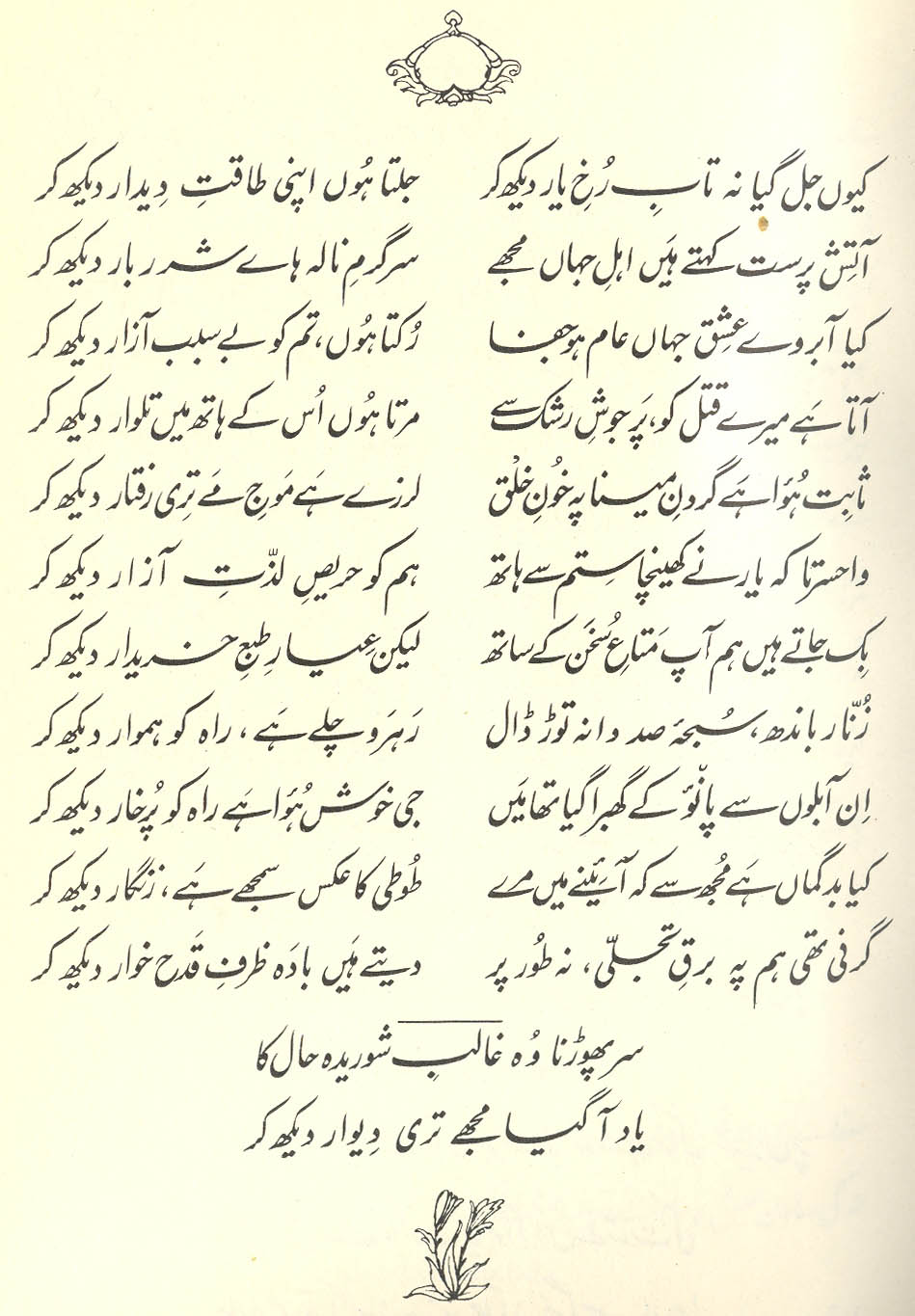
Verse 11833aardekh kar
G3
1
why did I not burn up, having seen the radiance of the beloved's face?
1
why did I not burn up, having seen [my] endurance of the [sight of the] beloved's face?
2
I burn [with jealousy/pain], having seen my own strength of sight/vision
'To burn; to be burnt; to be on fire; to be kindled, be lighted; to be scorched, be singed; to be inflamed, to be consumed; to be touched, moved, or affected (with pity, &c.); to feel pain, sorrow, anguish, &c.; to burn or be consumed with love, or jealousy, or envy, &c'.
'Heat, warmth; burning, inflaming; pain, affliction, grief; anger, indignation, wrath, rage; light, radiance, lustre, splendour; strength, power, ability, capability; endurance'.
| References | |
|---|---|
| Arshi, Imtiyaz Ali | Ghazal# 63 |
| Raza, Kalidas Gupta | 380 |
| Hamid Ali Khan | Open Image |
The way lightning is the limit case [of light intolerable to the eyes], in the same way the author has expressed the limit case of jealousy: I myself burn at my own strength of vision. The same meaning he has expressed very clearly in a later verse: 153,1 . (55-56)
== Nazm page 55 ; Nazm page 56


He's expressed the perfection of jealousy with such excellence that it's impossible to praise it sufficiently. He says, seeing the radiance of the beloved's face, I ought to have burned up-- why didn't I burn up? Now the result has emerged that seeing my own strength of sight, I burn [with jealousy]. That is, jealousy has lit a fire within my heart. (103)
The use of 'burn' in the two lines is entirely different; this pleasure of language is especially worthy of note. (139)
[See his commentary on Mir's M 1243,3 .]
ABOUT : In verses like this one wordplay is hard to distinguish from meaning-play. For the whole pleasure hinges on the various meanings of (and ). The protean (a Persian cognate to the Sanskrit , as in ) has the root meaning of 'heat', from which its associations of wrath, radiance, and endurance are all semi-metaphorically derived (see the definition above). More verses based on wordplay: 15,9 , ; 53,2 ; 64,2 ; 204,8 .
ABOUT : The literal meaning of is of course 'to burn' (see the definition above), but its range of extended, semi-metaphorical associations include suffering, pain, and jealousy/envy (on this latter sense see 53,4 ). Some examples with : 05 , of which it is the refrain . Compare the somewhat more limited range of ( 81,9x ).
In the first line, the sight of the , radiance, of the beloved's face ought to consume the lover in flame (1a); or, his own , endurance, of the sight of the beloved's face ought to consume him in flames of jealousy/wrath at his own toughness and presumptuousness (1b). In the second line, in either case the lover burns with jealousy and rage against his own 'strengh of sight', which has caused him to behave not with the glorious self-abandon of the Moth flying into the candle-flame, but with an entirely discreditable, un-lover-like enduringness (see 1,2 for the related concepted of , 'tough-lifedness'). In short, it is the lover's failure to that causes him to ; the problem is his of the beloved's .
Nazm rightly points to 153,1 as an excellent example of the same theme -- at the thought of his being able to see the beloved, the lover exclaims that he is 'jealous of himself'.
graphics/sun.jpg