Verse 111833aardekh kar
G3
1
the lightning of glory/manifestation should have fallen on us, not on [Mount] Tur !
2
they give wine [only after] having seen the capacity of the cup-drinker
'Manifestation; clearness, lustre, brightness, brilliancy, splendour, glory'.
zarf>> : 'Ingenuity, skill, cleverness; beauty, excellence;... --capacity, capability; a receptacle, vessel, vase'.
| References | |
|---|---|
| Arshi, Imtiyaz Ali | Ghazal# 63 |
| Raza, Kalidas Gupta | 380 |
| Hamid Ali Khan | Open Image |
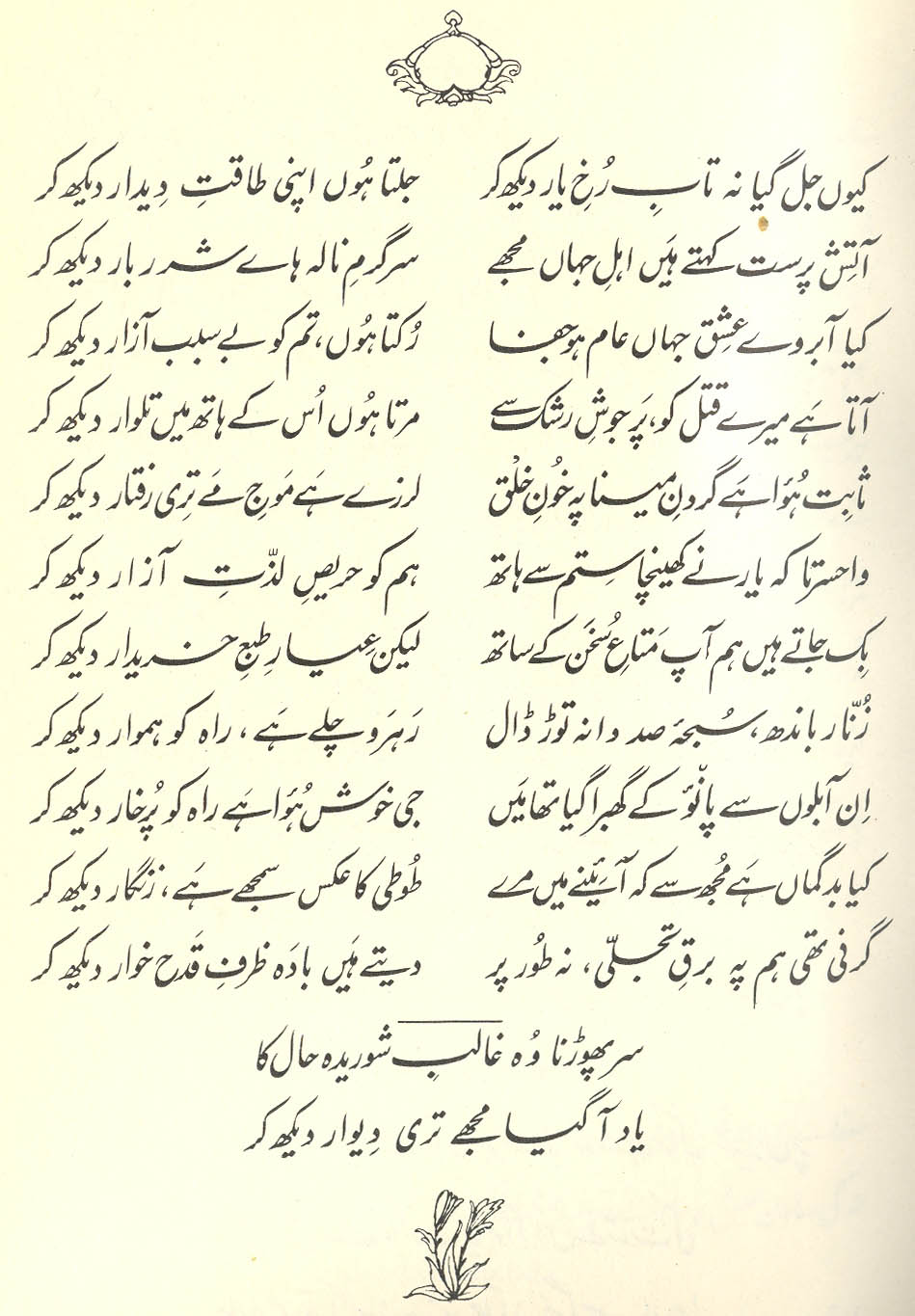
In this verse there is a reference to the theme of that Qur'anic verse in which it's said, 'We presented the trust before the earth and sky and the mountains, but they did not lift it up, and were afraid, and Man lifted it up' [Qur'an 33:72]. The poet says, it was my right to have the lightning of glory fall on me, not Mount Tur's right, because wine is given after seeing the capacity of the wine-drinker. Thus Mount Tur, which is of a middling rank-- how can it bear the lightning of God? This thought too, together with the illustration in which it is expressed, seems to be an absolutely untouched thought.
==Urdu text: Yadgar-e Ghalib , p. 122
He's produced a very ambitious line, and has given the simile s of wine for glory, and a winehouse of small capacity for Tur. And its being of small capacity is manifest-- it could not become the abode of glory. (59)
== Nazm page 59

Compare 12,2 . (25)
Janab Nazm says that he's used the simile of wine for the lightning of glory, and a winehouse of small capacity for Tur. However, the second line is neither an allegory nor a simile . In an allegory, the two terms of the simile have no relationship. Rather, the outcome turns into a simile. 'Capacity' [] means 'worthiness'. But together with 'wine' and 'wineglass', the verbal device of has a resemblance []. (217)
Here is another of Ghalib's trademark verses of mischievousness [], or what we might also call chutzpah. Imagine claiming to be (uniquely?) capable of receiving and sustaining the glory of God! The speaker doesn't humbly suggest the possibility, he clearly points out an injustice done to him, a flaw in the Divine arrangements. His logic is that of the wine-house: people give different amounts and kinds of wine to drinkers, according to their .
Bekhud suggests comparison with 2,2 , in which the lover equates capacity [] and thirst, claiming for himself unique preeminence in both. I would add 36,5 , in which the lover dismisses a mere single flash of lightning as nothing very special, observing pointedly that he was 'thirsty-lipped for speech', apparently with God.
To implicitly convert (or at least compare) God's glory to lightning, and lightning to wine, and a lightning-bolt to a stream of wine into the drinker's cup, is a fascinating trick in itself, when done as effortlessly as it is here. But that's only the background of the verse-- for it then goes on to make an aggrieved complaint about wine-distribution! How much more metaphysical complexity could possibly fit into two small lines?
Contrary to what Hali suggests, the real Qur'anic reference here is surely 7:143. As Mr. Mat Ansari points out, it's interesting that Ghalib compares himself not to Moses -- whom he (pointedly?) doesn't even mention-- but to Mount Tur . He imagines himself not as a mere observer (and one who collapses and faints, anyway), but as the actual recipient of the intolerably powerful divine force as it descends. In the verse that Hali speaks of, there's no reference to the actual descent of divine power at all, nor any mention of Mount Tur, while 7:143 contains both.
Compare 231,7 , with its irresistibly casual proposal for 'a stroll around Mount Tur'.
Note for trivia fans: from this verse Robert Bly and Sunil Dutta took the title of their book of Ghalib translations, The Lightning Should Have Fallen on Ghalib (1999). Unfortunately, in the abbreviated form they've chosen, the title sounds like a death-wish or curse.
graphics/mounttur.jpg