Verse 61833aardekh kar
G3
1
alas, longing/regret! for the friend/beloved lifted [her] hand from tyranny
2
having seen us greedy for the pleasure/relish of cruelty/wrath
'intj. (expressive of pain) Oh! ah! alas! alas for!'
'Grief, regret, intense grief or sorrow; --longing, desire'.
'Greedy, avaricious, covetous; --s.m. A greedy or covetous person'.
'Pleasure, delight, enjoyment; sweetness, deliciousness; taste, flavour, relish, savour; --an aphrodisiac; an amorous philter'.
| References | |
|---|---|
| Arshi, Imtiyaz Ali | Ghazal# 63 |
| Raza, Kalidas Gupta | 380 |
| Hamid Ali Khan | Open Image |
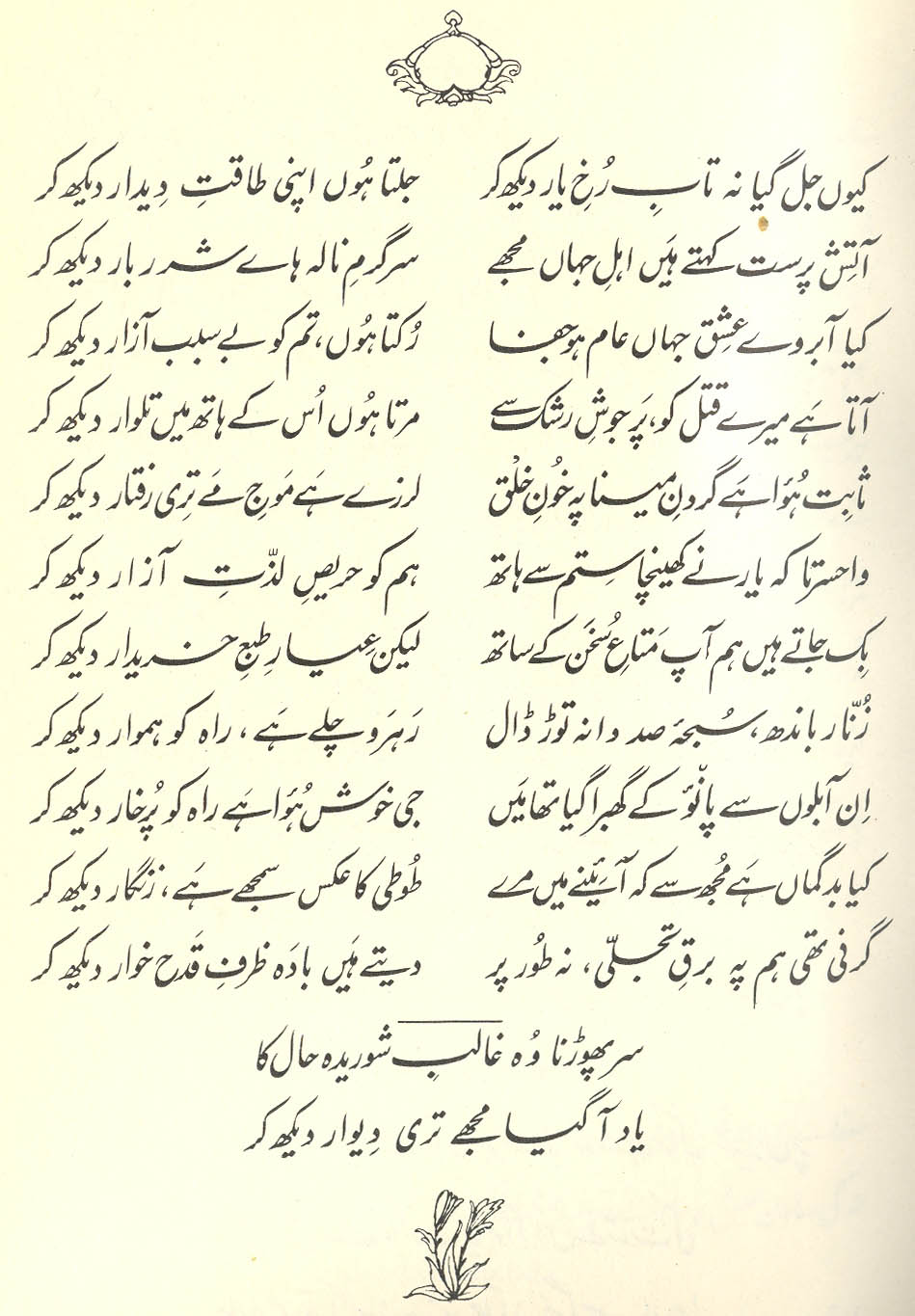
To make [love's sufferings] into a friend and beloved, and to long and pine and yearn for them, and to feel pride and joy and plume oneself on receiving them, is a theme such that there's no doubt at all that it's usually effective and heart-penetrating. (58)
== Nazm page 58

He says, Alas, oh woe-- seeing us desiring cruelty, that tyrant renounced anger. The meaning is that the beloved doesn't fulfill even the lover's bad wish. (105)
Compare 48,4 (181)
In 60,3 , the lover reproaches the beloved for being cruel to everybody, including others as well as himself. In the classic 38,1 , he reproaches the beloved for being cruel to everybody else and refusing to be cruel to him. Here, all others are filtered out and the lover reproaches the beloved simply for refusing to be cruel to him. Arshi rightly points to 48,4 as another treatment of the same complaint.
But of course, the nuances are always different. In the present verse, a sort of vicious circle is implied: the beloved is cruel to the lover, he joyously accepts her cruelty, she sees that he relishes the cruelty, so she then cruelly stops offering the cruelty. But then this act must inevitably restart the circle. If she stops offering the cruelty that he wants, that is clearly a fresh form of cruelty. The next step ought to be that he will learn joyously to accept her new cruelty (of withholding cruelty), and that she will see that he relishes it, so she then will stop offering the cruelty (of withholding cruelty). What will she do then? Will she think of some new way of frustrating her madly determined lover? The level of casuistry rapidly escalates out of control.
Which after all seems to be part of the point of the verse. The speaker is consoling his poor Longing, who not only can never be satisfied but whose satisfaction can't even be properly imagined. Can the speaker and his Longing find pleasure in the suffering brought on by the lack of cruelty? If they are greedy enough for such morbid fare, who knows-- maybe they can. After all, the lover's position is unstable and paradoxical from the start. A verse like this doesn't describe a new condition, but simply exposes the ongoingl bizarrerie of the lover's fate.
In the first line, could be a sort of nickname suggesting that the speaker and the addressee, , are on friendly and casual terms. But also, is used as a general expression of lamentation, like .; I thank Mahmood Piracha for pointing this out (Oct. 2022).
On the phrase , see 112,4 .
graphics/whip.jpg