Verse 4after 1821aaho jaanaa
G5
In this meter the first long syllable may be replaced by a short; and the next-to-last long syllable may be replaced by two shorts.
2
to this extent, to become an enemy of the possessors of faithfulness!
'Oppression, violence, cruelty, injury, injustice, hardship'.
'Greatness, dignity, honour, rank, power; importance, consequence; worth, merit; estimation, appreciation, account; value, price; --measure; degree; quantity; magnitude; bulk, size; portion, part; --whatever is fixed or ordained of God, divine providence, fate, destiny'.
| References | |
|---|---|
| Arshi, Imtiyaz Ali | Ghazal# 36 |
| Raza, Kalidas Gupta | 355 |
| Hamid Ali Khan | Open Image |
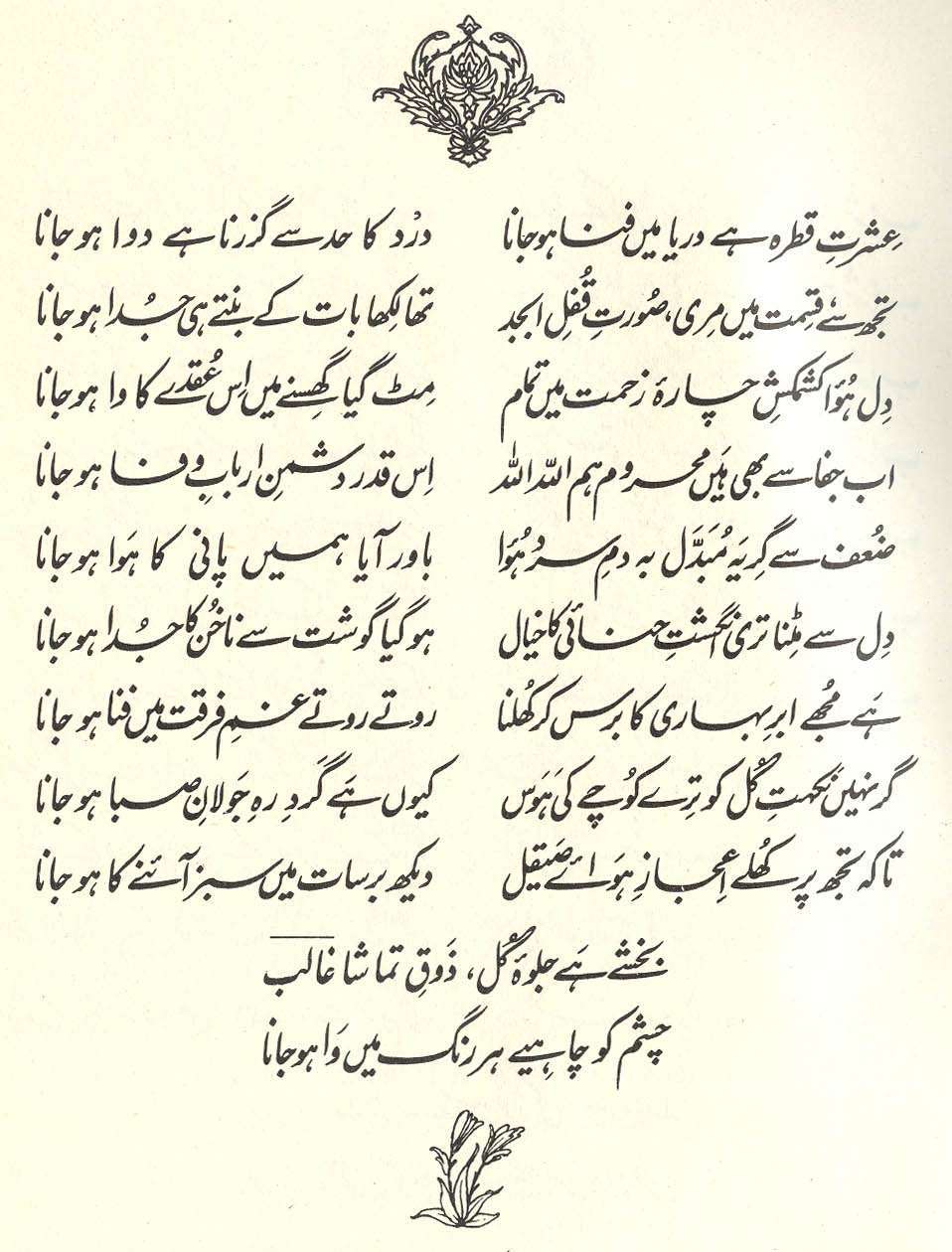
The meaning is apparent, and it's impossible to praise it enough. It's a picture of the beloved's anger, and that anger is of a particular sort. And this theme too is particularly that of the author. (43)
== Nazm page 43

Urdu text: Vajid 1902 {48}
The pleasure of this verse is ecstatic/enrapturing []; it can't be described. He says, there was a time once when we received many kinds of kindnesses and favors. Now a time has come when she doesn't show us even tyranny. Her distaste, anger, and hatred have reached such an extreme that it doesn't even please her to be tyrannical to us. God, God, to become such an enemy of the possessors of faithfulness! (86)
How can there be any other verse more filled with longing than this one? .... Compare 148,2 . (108)
This is among those verses for which to explain the meaning is to murder the attraction, meaningfulness, and effect. (393)
Compare 60,6 . (181)
Bekhud Mohani and Arshi both cite related verses; Bekhud's example, 148,2 , is the more apposite of the two, since it lays the matter out plainly; in it the lover begs, 'Don't break off relations with us-- if nothing else, at least show enmity'. For the beloved to deprive the lover even of 'oppression, violence, cruelty' is harsh treatment indeed.
But of course, in the world of the ghazal there's almost always another layer. Consider for example 91,3 -- 'tyranny is dear to me, I am dear to the tyrant: she's not unkind, if she's not kind'. If tyranny is dear to the lover, and depriving him of cruelty is the supreme tyranny-- well, doesn't it follow that even in that extreme or limit case the beloved is doing her proper duty as beloved? By treating him with a cruelty beyond all cruelty, isn't she even showing him a perverted kind of favor?
The exclamation 'God, God!' of course conveys a special emotional emphasis; but positioned as it is, it also almost suggests that the beloved is being called on as a deity, or that God is the one who is showing such cruelty to the lover. Juxtaposed to that invocation of God, the very appropriate secondary meanings of as 'greatness, dignity' and 'fate, destiny' can hardly help but resonate as well.
The verse seems quite simple. Yet it induces rapture in the commentators. As Bekhud Dihlavi says, its pleasure is 'ecstatic/enrapturing []' and 'can't be described'. Chishti says that to analyze it is to 'murder' it. In short, this a classic verse of ' mood '.
graphics/whatever.jpg