Verse 1after 1821aaho jaanaa
G5
In this meter the first long syllable may be replaced by a short; and the next-to-last long syllable may be replaced by two shorts.
1
the joy/sociability/mingling of the drop is, to become obliterated in the sea
2
pain's passing beyond the limit is, [for it] to become a medicine
'Social or familiar intercourse, pleasant and familiar conversation, society; pleasure, enjoyment, mirth'.
'Passed away, departed, deceased, defunct; non-existent, extinct'.
| References | |
|---|---|
| Arshi, Imtiyaz Ali | Ghazal# 36 |
| Raza, Kalidas Gupta | 355 |
| Hamid Ali Khan | Open Image |
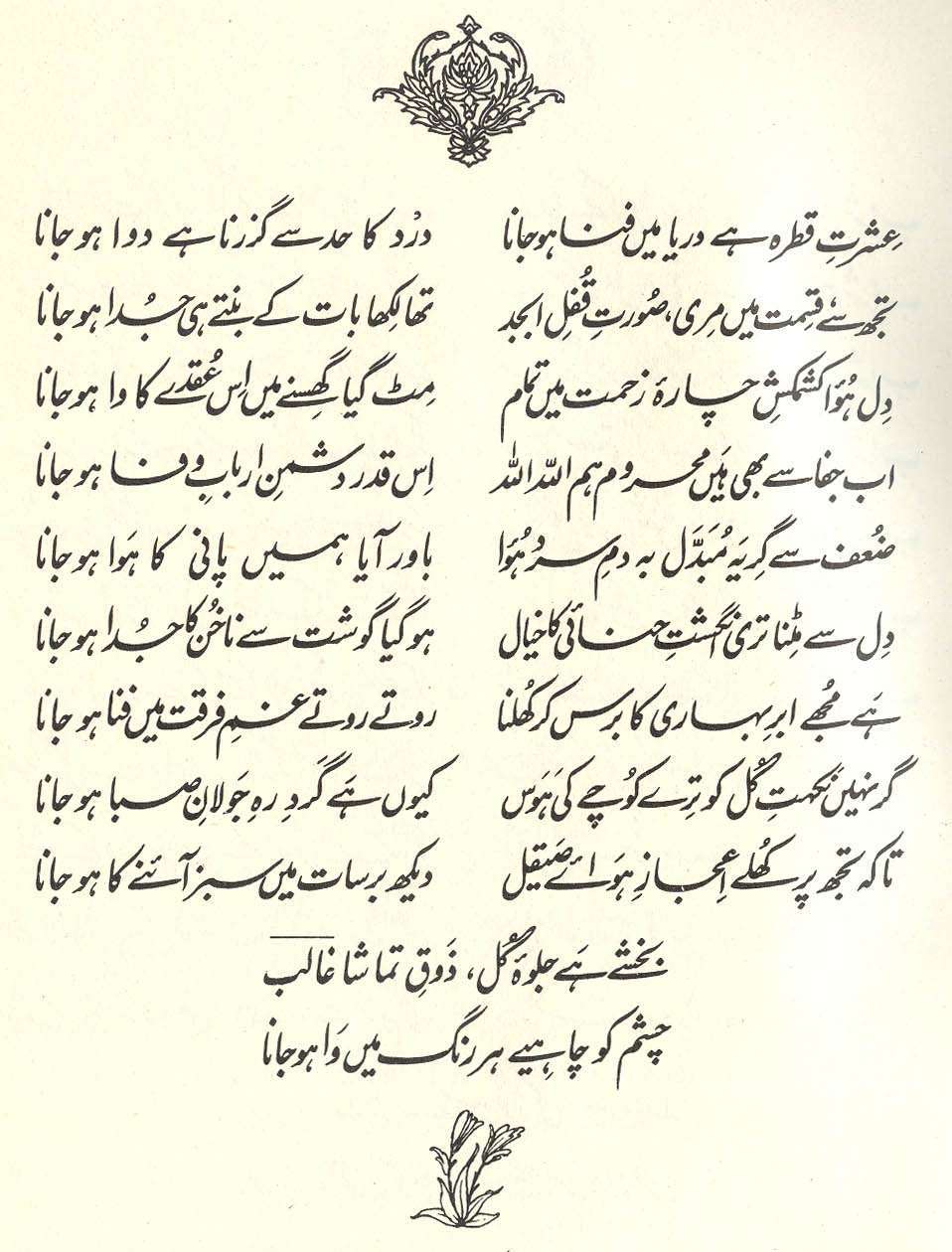
That is to say, when pain passes beyond the limit, he will die, that is, be obliterated, the way a drop is swallowed up in the sea; and this is his goal. Thus pain's passing beyond the limit is for it to turn into a medicine.
==Urdu text: Yadgar-e Ghalib , p. 143
For pain to pass beyond the limit, that is, to bring about oblivion; and to attain oblivion is exactly the goal. (43)
== Nazm page 43

Urdu text: Vajid 1902 {48}
Note: The first line is an allegory of the second one. (392)
We know from 21,8 and other verses that it's a proper ultimate destiny, and apparently a happy one, for the drop to merge into the sea and abandon its individual life (if in fact it ever had more than a momentary or illusory one). The drop starts in an unknown state; we are told only that its progress ends in a pleasurable and 'sociable' (see the definition above) merging with its own obliteration. The lover starts in a state of pain, moves through a pain beyond all bounds, and ends with a cure: an obliteration of pain in death. These don't seem to be the same journey. But are they parallel ones, or contrasting ones?
To believe the journeys are parallel, we would need to see strong resemblances between the lover and the water-drop. The drop is made of water, it is water, and its merging with the sea is a homecoming. Can we say that the lover is made of pain, that in some sense his identity is pain, and that for him to be entirely submerged in pain, to the point of death, is an equally overwhelming (and curative) homecoming? Even for the ghazal, it sounds a bit extreme; moreover, the intolerable pain becomes a metaphorically detached 'medicine' for the lover, not a medium in which he is happily submerged.
More plausibly, the two lines and the two journeys can be contrasted. For the drop, life is simple and untroubled: it anticipates a glorious, joyous, merging or homecoming of annihilation, in which will regain its true essence. For the lover, by contrast, the life of passion is full of incurable and increasing pain, and its only end is the forced termination of his being finally 'put out his misery' by an unendurable extremity of pain. (If he then somehow mystically merges with the Divine, the verse gives no hint of this.) So the drop is much more fortunate than the lover.
What the drop and the lover have in common is a means of escape from life 'here' in this finite, doomed world; but in more crucial ways they differ-- and greatly to the advantage of the drop. Surely Ghalib meant for us to compare, and reflect on, their different fates.
graphics/oceandrop.jpg